
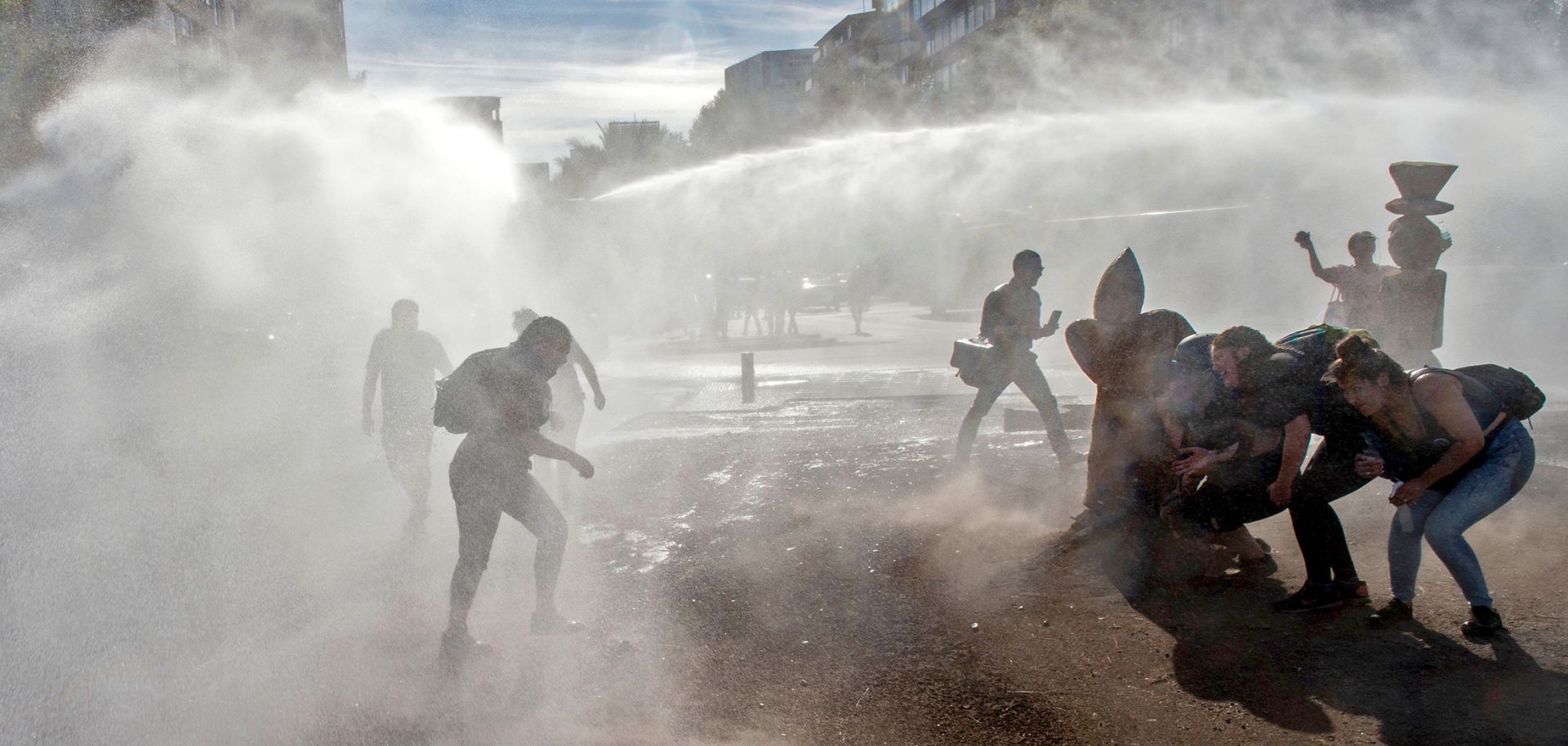
Demonstrators clash with riot police following a protest against the Chilean government Dec. 18, 2019, in Santiago, Chile.
Setbacks and controversies during the process of replacing the Chilean Constitution over the next several years will keep alive the risk of turmoil like the country has experienced in recent months. The continued unrest will threaten Chile's business-friendly reputation. Since October, demonstrations have periodically rocked Chile's urban areas, drawing in not only the left, students and radicals but also a broad cross-section of Chilean society, including professionals and the middle class. Government promises to replace the country's constitution have, however, somewhat quieted recent protests.
Deep-seated grievances over economic inequality and the legacy of the country's longtime dictator, Augusto Pinochet, have fueled the recent protests. The protesters, who by no means enjoy the support of all Chileans, are pushing to reverse some of the country's longstanding pro-market policies, which are embodied most concretely in the still-in-effect 1980 constitution. The government will, however, face the delicate balancing act of addressing popular grievances while avoiding changes that could undermine policies that have undergirded decades of growth.
The Chilean Model
By most measures, Chile has been an economic success story. It boasts the fifth-highest aggregate gross domestic product in Latin America, higher per capita than the larger economies of Brazil, Mexico, Argentina and Colombia. Only 0.7 percent of Chileans lived in poverty in 2017, according to the World Bank definition of poverty being an income of $1.90 or less per day, a percentage on a par with the figure in Australia and around half that of the United States. Even by Chile's own broader measure of poverty, which takes into account a wider range of factors, around 8.6 percent qualified as impoverished in 2017, down from 25.3 percent in 2009. Policies that strongly favor the private sector and entrepreneurs, with pensions and key sectors privatized and low levels of regulation that have moved Chile to the top rank in ease of doing business among Latin American countries, have undergirded Chile's growth. The Pinochet regime laid the foundations for this economic model, which conservatives across the region — most recently Brazilian President Jair Bolsonaro — have long lauded as a model to emulate.
Not all Chileans, however, feel the system has treated them fairly. The Chilean model has, in fact, produced high rates of income inequality. In 2017, the wealthiest 10 percent of Chileans accounted for over 52 percent of income. Among members of the Organization for Economic Cooperation and Development, Chile has the highest Gini coefficient, at 0.46. (The Gini coefficient measures income distribution in a population, with 0 representing full equality and 1 representing total inequality.)
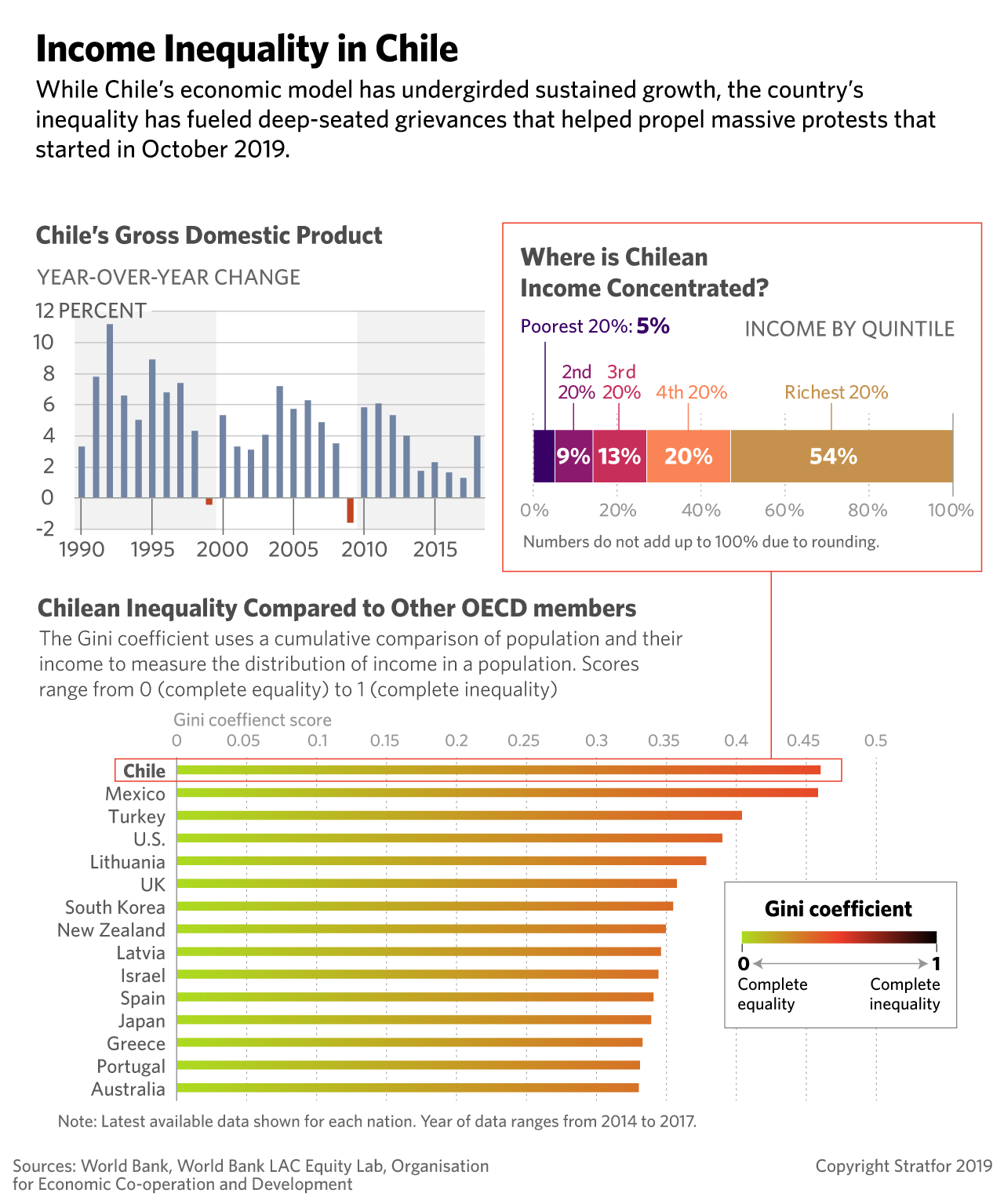
Though living standards have been steadily rising, with real wages up 4 percent since 2014 and the income gap declining somewhat, many Chileans remain skeptical about the pace of these improvements. Frustration, particularly in cities, abounds at the unequal distribution of wealth. Amplifying the anger, billionaire President Sebastian Piñera began his second term in 2018 promising to expand private pensions and slash taxes to spur further economic growth at the expense of efforts to reform education, health care and pensions. (Opponents of private pensions say they pay out low returns for workers and are too tied to the markets.) While he has backed off from these promises, continued opposition to his pro-market policies caused protests to erupt into sustained unrest.
The Nature of the Protests
In spite of numerous concessions from Piñera, Chilean protesters' demands for broad, systemic change and the decentralized nature of the movement and diverse demands of the protesters have made reducing the intensity of the unrest challenging.
The demonstrations began in early October when students responded to a modest hike on fares for the Santiago metro system with calls for mass fare dodging. A broad cross-section of Chilean society subsequently joined in the initial protests, bringing along their own grievances. Chile's decentralized protesters have pushed forward a diverse array of demands at different times, including those for better wages and enhanced labor rights, a public takeover of pension funds, education reform, tax reform, nationalization of energy and public services, and a constitutional overhaul. The protesters have periodically paralyzed Chile's major cities, in some cases looting and burning businesses and residences.
The Piñera government responded to the mounting pressure with a series of concessions that dampened, but did not fully end, the protests, including rescinding the initial transit fare hike, suspending corporate tax cuts and passing broad social support measures. His most successful move to placate the protesters came Nov. 15, when he agreed to initiate the process of replacing the Chilean Constitution through a series of three referendums and a consultative process, the details of which will be worked out later.
Changing the Constitution
Calls to revise or replace the country's constitution date back to when the document first went into effect, in 1980. While lawmakers made important amendments to the constitution in 1988 at the end of the dictatorship and once again in 2005, the charter has not changed much overall since its inception. Conservatives see the document as a stabilizing anti-populist pillar and bulwark of pro-growth policies. The left, however, sees it as enshrining Pinochet's legacy and an obstacle to a stronger social safety net, labor protections and democratic accountability. Former President Michelle Bachelet spent much time drafting reforms in keeping with the left's preferences. But Piñera pushed back against these proposed reforms, calling instead for gradual, less sweeping changes, sparking the current contentious period in Chilean politics.
Now, Piñera likely hopes that conservatives can limit the reforms emerging from his promised overhaul. Efforts to put the brakes on protesters' calls for major reforms, however, ensure that the process of revamping the constitution will be contentious, with setbacks, delays or other developments potentially drawing protesters back to the streets in force. Referendums in April and October 2020 that will determine the methodology of the redrafting are both likely to provoke mass rallies by the left, whether to whip up enthusiasm for the process or to express disapproval of the outcome.
The process will undoubtedly be a key issue in the late 2021 presidential election. And the potential for unrest stemming from the constitutional drafting process could extend until at least 2022, when the final document is likely to be presented for an up-down vote. Conservative or left-wing anger at whatever final version becomes law could sustain the unrest even after its passage. Given the need for political compromise, the final version might disappoint substantial numbers of people, meaning even a new constitution will not necessarily end the country's unrest.
The Ongoing Economic Impact of Unrest
The risk of unrest throughout the constitutional reform process threatens Chile's economy and business-friendly reputation. The protests already appear to have dampened economic growth, with fourth-quarter GDP projected to contract 2.5 percent year-on-year, and the central bank forecasting 2019 growth of only 1 percent — the lowest since the 2008 global financial crisis.
Because protests have been centered in urban areas, economic pain has been focused on the non-mining sector, which contracted 4 percent as compared to mining sector growth of 2 percent. Chile's mineral exports, primarily copper and lithium, will, therefore, become increasingly important to sustaining overall economic growth. The central bank already projects that overall foreign investment in Chile may drop 4 percent in 2020. This will spur the government to incentivize investment in the mineral sector, threatening Chile's longtime goal of moving up the value chain of exports and moving away from reliance on sales of raw metals.
Growing copper demand in the coming year due to a nascent energy transition could help increase Chile's copper revenues and exports. So could a potential durable trade truce between the United States and China, which alone accounts for over half of global copper imports. Lithium presents some opportunities, but not as many as copper. The Chilean government has plans to boost lithium production and expand from the current operations in Atacama to new ones at the Aguilar salt flat. Still, lithium prices remain depressed, despite an expected increase in demand for electric vehicle batteries. U.S.-led efforts to secure a supply chain of the strategic metal from friendly countries, however, could help offset the economic headwinds limiting Chile's lithium ambitions.
But regardless of the government's efforts, the next few years in Chilean politics will remain unpredictable, and the economic damage from unrest could worsen — even potentially affecting the mining sector. If nationwide unrest once again spikes, copper miners or even critical fuel workers may stage sympathy strikes. And given the need for political compromise, the final constitution may fall short of satisfying public demands — meaning the successful conclusion of charter change is unlikely to totally quiet unrest.
