
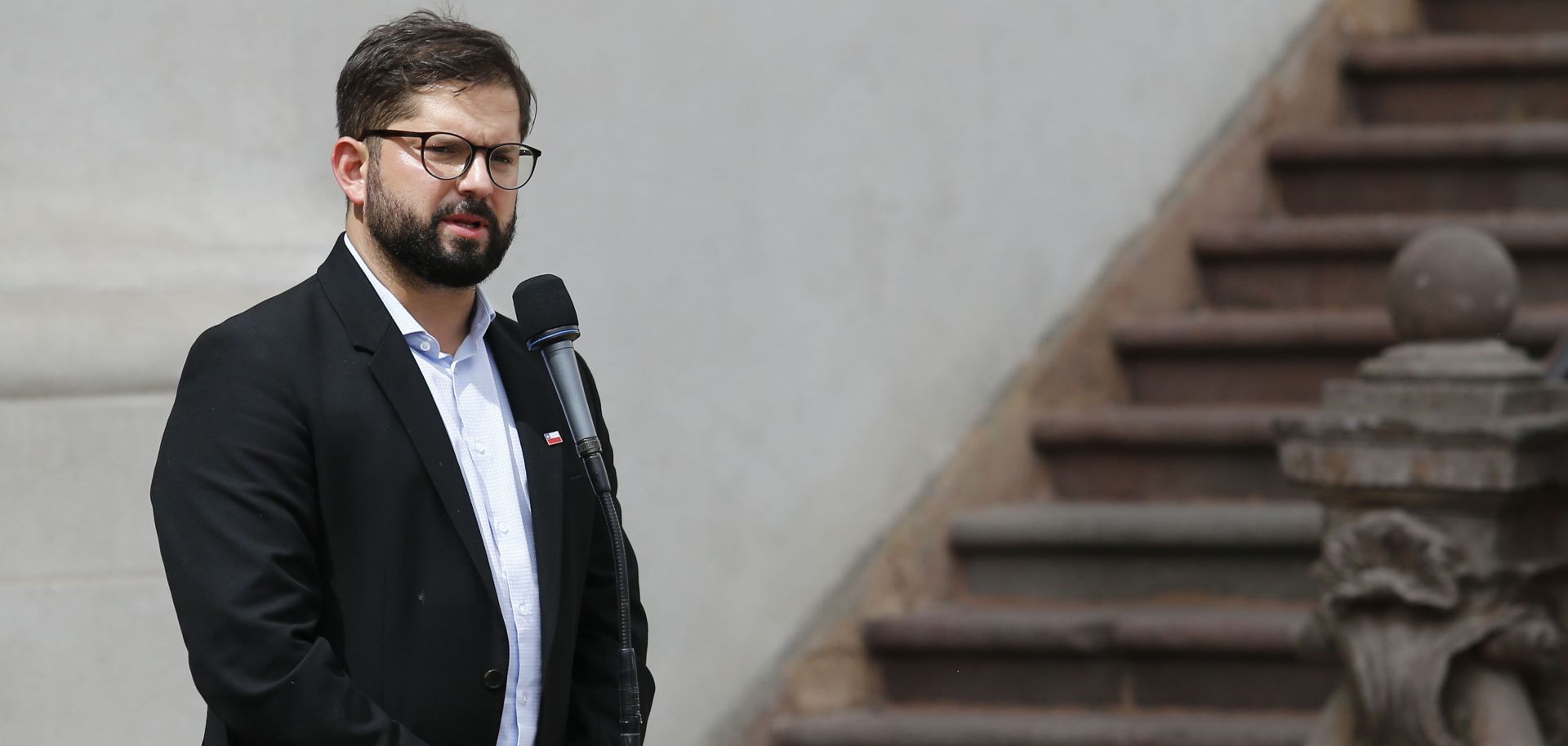
Chilean President-elect Gabriel Boric speaks with the media at the presidential palace in Santiago, Chile, on Dec. 20, 2021.
The election of a leftist president will likely see Chile’s government impose higher taxes on wealthy households and large companies, especially those in the crucial mining sector, which could worsen the business climate in the country. Leftist student leader Gabriel Boric will be sworn in as Chile’s next president on March 11 after beating out his right-wing opponent Jose Antonio Kast in the Dec. 19 presidential runoff race. After the final results showed Boric securing 55% of the vote, Kast quickly conceded and called for “constructive collaboration.” At 35 years old, Boric will be Chile’s youngest-ever president. While he moved from the far-left to the center-left over the course of his campaign, Boric remains highly focused on economic inequality, social justice and promises to make significant investments in an expansive social net by reallocating services — including education, health care and the pension system — from the private to public sector.
- 56% of eligible voters cast ballots in the final round of Chile’s presidential election — roughly 10% more than those who voted in the first round, which was held in November.
Boric is likely to face difficulty enacting his broad agenda, though constraints could ease if a new leftist constitution is approved. Chile’s slow economic growth leaves little room in the fiscal budget to expand social services, especially after two years of increased pandemic-related spending. This, combined with the country’s divided parliament, will challenge Boric’s ability to pass legislation that enacts the sweeping economic and social changes he promised on the campaign trail. While Congress is likely to work with Boric on his center-left economic proposals, lawmakers will probably block the more controversial aspects of his agenda, such as tax increases on wealthy households. In response, Boric will likely use his veto and decree powers to sidestep some congressional blockages. In Chile, only the president can present legislation on certain issues, such as taxes and administration of the budget, which will enable Boric to control the policy agenda as well. If approved, the new constitution — which will likely give the state the power to restrict property rights and weaken some of the business-friendly elements of the current constitution — will likely free Boric to fulfill more of his policy agenda, including the reallocation of land and water ownership from the private sector to the public sector and Indigenous peoples. The approval of such a constitution would also reduce the number of judicial roadblocks to Boric's agenda.
- Chile’s current constitution — written in 1980 under General Augusto Pinochet’s repressive military dictatorship — favors private sector procurement of infrastructure projects and social services.
- The new constitution will be put to a referendum in late 2022. Right-leaning leaders such as Kast and Francisco Parisi from the libertarian People’s Party will almost certainly campaign against the new constitution.
- Though Chile’s economy expanded nearly 12% in 2021. But that pace of economic growth is expected to slow to just 2% over the next year due to a pullback of the current post-lockdown consumption boom.
Political and constitutional changes will likely worsen Chile’s business climate, negatively affecting the country’s standing in international markets as well as the profitability of its extractive industries. Pledges to increase taxes on both wealthy Chileans and the country’s mining sector will likely weaken Chile’s position in international markets, which have up until now favorably viewed the country’s economic trajectory. Economic risks (including the potential for downgraded credit rating, a weaker Chilean peso and/or a capital flight spike) will increase, especially if the government implements anti-business policies. Boric is likely to receive support among the center leftists to increase taxes and tariffs on Chile’s mining sector, potentially severely cutting into profits for global mining companies and decreasing investment in the sector, which is the backbone of the Chilean economy. Boric has also suggested he would attempt to bolster state-owned mining company Codelco against private-sector competition and fully nationalize lithium production. This could threaten the country’s ability to take full advantage of the global energy transition, which will increase global demand for Chile’s abundant copper and lithium resources (which are both key to electric vehicle production).
- In his Dec. 19 victory speech, Boric stated that he would oppose mining projects that “destroy the natural environment,” including the $2.5 billion Dominga copper, iron and gold mining project.
- The National Mining Society congratulated Boric on his win, but called for moderation.
- Under Chilean law, the private sector must work in partnership with the Chilean Production Development Corporation to develop lithium, which is classified as a strategic material. The constitutional convention is debating whether the new draft should fully nationalize the element or allow private sector involvement via concessions.
- The mining sector contributes approximately 10% to Chile’s GDP and makes up over 50% of the country’s total exports.
