
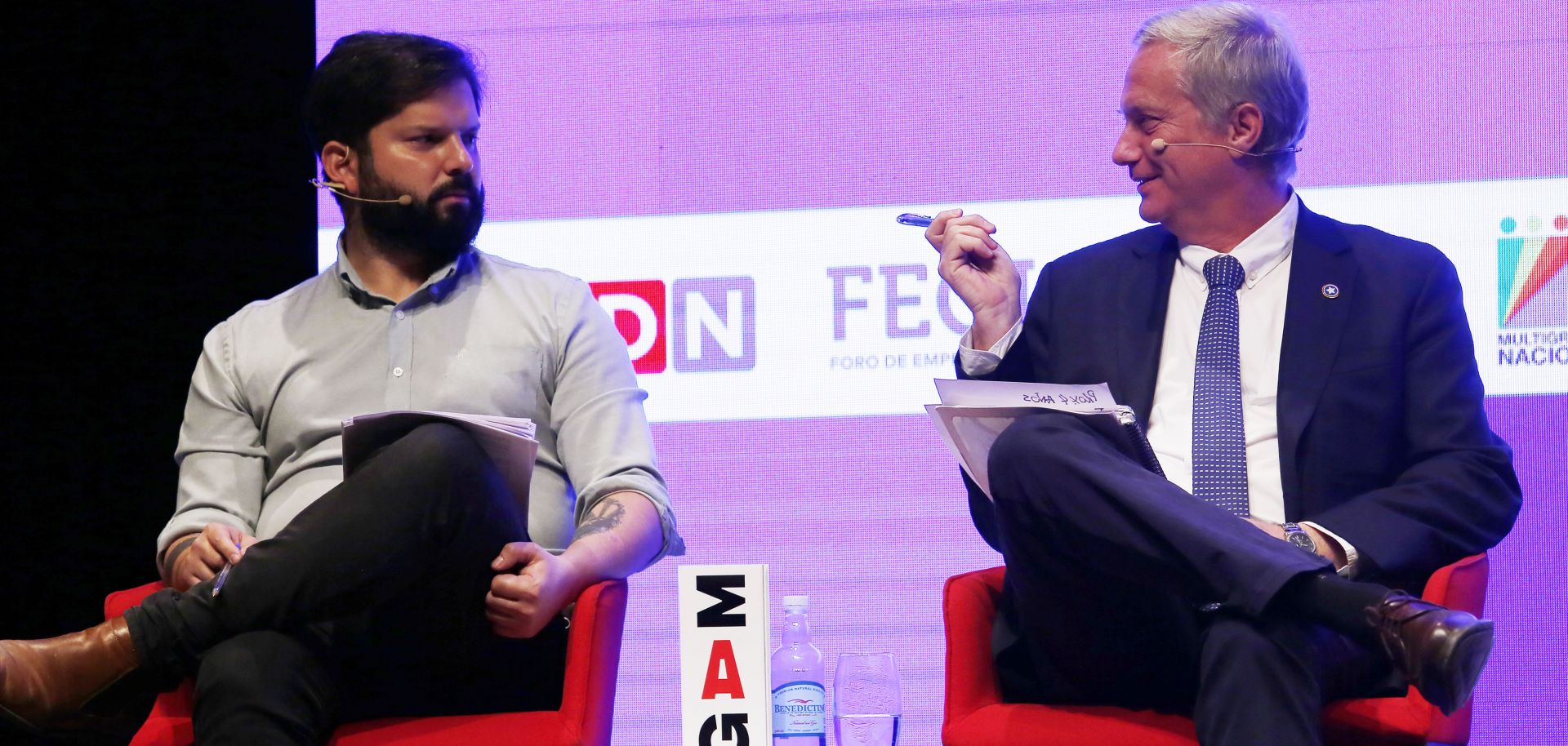
Chilean presidential candidates Gabriel Boric (left) and Jose Kast talk during a debate in Santiago on Nov. 2, 2021.
The results of Chile’s general election will likely exacerbate existing political polarization and threaten the success of the constitutional rewrite process, increasing uncertainty for businesses operating in the country. Jose Kast from the far-right Republican Party and Gabriel Boric from the left-wing “Apruebo Dignidad” (I Approve Dignity) coalition will compete in the final round of Chile’s presidential election on Dec. 19 after coming in first and second, respectively, in the first round held on Nov. 21. Kast (who won 27.9% of the vote) supports maintaining Chile’s free-market economy and combating illegal immigration, while Boric (who won 25.8% of the vote) supports increasing taxes and royalties on businesses in order to pay for a dramatic expansion of social services in the country.
- Despite residing in the United States and failing to travel to Chile for the election, economist Franco Parisi from the libertarian “Partido de la Gente” (People’s Party) still won 12.8% of the vote. Sebastian Sichel from the right-wing “Chile Podemos Mas” (Chile We Can Do More) coalition also received 12.7% of the vote, while Yasna Provoste of the center-left Cristian Democratic Party received 11.6%.
- Influential political figures like Parisi and Provoste will likely serve as kingmakers, as whoever candidate they endorse will likely earn their supporters’ votes in the Dec. 19 runoff. While Parisi’s right-leaning People’s Party will likely announce their support of Kast, Provoste’s center-left Christian Democratic Party is more likely to support Boric.
Chile’s fragmented Congress will make it difficult for the next president to advance his policy agenda, which will likely lead to high levels of political stagnation. No one party or coalition gained a two-thirds majority in the country’s concurrent legislative election on Nov. 21. In the lower house, Boric’s left-wing coalition won 20% of seats while the right-wing Chile We Can Do More coalition won roughly 25%. Parisi’s libertarian People’s Party, meanwhile, gained seven seats — positioning it as the likely deciding vote between left- and right-wing lawmakers in the lower house.
- Parisi campaigned on a combination of the right’s commitment to free-market principles and increasing security, with aspects of the left’s platform (such as a better pension system and guaranteed access to high-quality healthcare). This indicates that his libertarian party would be likely to side with pro-business economic policies while supporting a limited expansion of the social safety net.
The election of either a solidly left- or right-wing president, combined with the ongoing process to rewrite the constitution, will likely threaten business interests in Chile by increasing political risks regarding the country’s current free-market principles. While technically politically independent, the assembly currently drafting Chile’s new constitution is composed of leftists and independents. The new draft is, in turn, expected to mandate increased social welfare spending to guarantee rights, which would force the Chilean government to either raise taxes or threaten its free trade agreements by increasing tariffs on imports. Politicians, meanwhile, will likely try to impose higher taxes and tariffs on the country’s lucrative extractive industries, such as copper or lithium. There’s also a more immediate threat of disruptive demonstrations ahead of the Dec. 19 presidential runoff vote, most likely in Santiago or Valparaiso — increasing risks to business continuity in those cities. Chile’s far-left collectives are naturally opposed to right-wing Kast, but they also believe Boric is too centrist and are thus likely to stage protests in the coming weeks to voice their concerns with both presidential candidates.
- Once the assembly unveils the new constitution, likely around August 2022, Chile will hold a final referendum to reject or approve the draft.
Should right-wing Kast win the presidency, increased tensions between his executive office and the more left-wing constitutional assembly could complicate the constitutional rewrite process, sowing more discord and uncertainty. Increased legislative gridlock will not directly affect the ongoing constitutional drafting process in Chile since it’s being carried out by an independent body. But as president, Kast would likely rally against the ratification of the new constitution in favor of keeping Chile’s current constitution and its private-sector protections. Should a new constitution still be approved that enshrines an expanded social safety net, Kast would likely be tasked with ensuring financing for the new government programs, which he’s unlikely to do as raising taxes on corporations goes against his right-wing, business-friendly policy platform. Knowing this, the constitutional assembly may opt for a change of the political system — from a presidential system to a parliamentary one — in an effort to trigger the clause allowing for new elections to, in turn, try to oust Kast. This would trigger a significant political crisis as the executive and constitutional assembly vie for power.
- Should Boric win the presidency, Chile would likely continue to shift toward leftist social policies to expand the role of the state into the country’s infrastructural and health care systems, which are currently both dominated by the private sector. Boric is unlikely to generate enough support in Chile’s fragmented Congress to rapidly implement leftist economic policy (such as raising taxes to fund social programs) — especially with the right-leaning People’s Party likely holding the tie-breaker vote. But compared with Kast, his election is also far less likely to trigger a greater political crisis with the constitutional assembly since Boric wouldn’t be seen as a threat to the implementation of a new constitution.
