
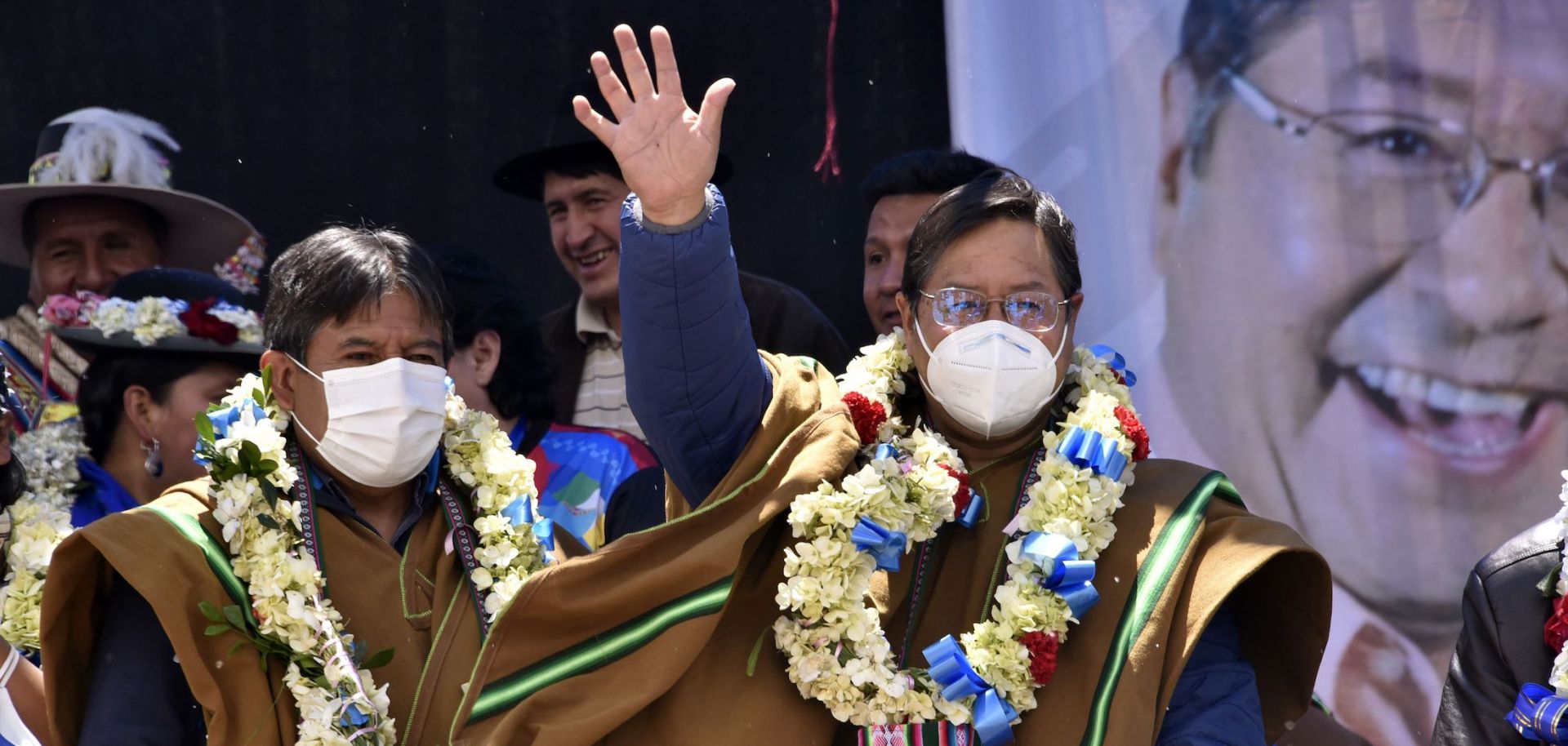
Bolivia's president-elect, Luis Arce, celebrates his electoral victory during a rally in El Alto, Bolivia on Oct. 24, 2020.
The strong showing for Luis Arce in Bolivia's Oct. 18 presidential election will facilitate a smooth power transition, but his administration will struggle to garner the political support and foreign investment needed to steer the country out of its pandemic-induced economic crisis. Luis Arce, the presidential candidate from former President Evo Morales' Movement Toward Socialism (MAS) party, won more than 50 percent of the vote in the South American country's long-delayed election, eliminating the need for a runoff.
- Led by Interim President Jeanine Anez, Bolivia’s government had delayed both presidential and congressional elections several times due to COVID-19, creating a tense political climate that generated uncertainty about acceptance of the results.
- The final tally of the votes shows Arce winning 55 percent of the votes against 28 percent for his closest rival, former President Carlos Mesa. Arce won in six of Bolivia’s nine departments, with his weakest showing in the southern department of Santa Cruz, which has traditionally opposed MAS.
- MAS also appears set to win a simple majority in Bolivia’s Chamber of Senators, although not the two-thirds majority needed to enact constitutional changes without opposition support.
Arce’s margin of victory, along with the prompt recognition of the election results by both Mesa and Anez, reduces the possibility of a lengthy and violent post-electoral conflict. Some residual pockets of resistance may come from supporters of Luis Fernando Camacho, the far-right candidate, but Bolivia is unlikely to experience the type of unrest that followed its October 2019 election, which precipitated the resignation of former President Morales. Hailing from Santa Cruz (which accounts for 30 percent of Bolivia’s GDP and 70 percent of its food production), Camacho is the only candidate who has not yet recognized Arce’s electoral victory. This sets the stage for a repeat of the contentious relationship that the southern region had with Morales’ government.
But despite its sizable electoral mandate, Arce’s MAS party will still need to address the deep ethnic, ideological and regional divisions that permeate Bolivian society in order to reactivate the country’s economy and reduce the risk of future unrest. MAS has a strong political support base among the majority of the indigenous population, with most of its support coming from the country’s altiplano and rural areas as opposed to Bolivia’s urban centers and its southeast region. This political geography means that despite his ample victory, Arce lost six of the nine departmental capitals in the election — a clear indication of the urban-rural divide.
To shore up support for his economic agenda, Arce will seek to leverage the policy successes he achieved between 2006-2019 as Morales’ finance minister, but Bolivia’s internal and external economic conditions have deteriorated since then.
- Bolivia’s economic growth during the 14 years of Morales’ presidency averaged 4.7 percent a year. But the country experienced its slowest growth since 2006 in 2019 at 2.2 percent.
- The International Monetary Fund now expects the Bolivian economy to shrink by almost 8 percent in 2020 due to the COVID-19 pandemic.
- Bolivia’s public balance has also deteriorated, running deficits since 2014. Foreign investment has also collapsed since a record high in 2013.
Arce’s initial success and ability to attract fresh foreign investment will hinge on creating and executing a credible plan for Bolivia’s post-pandemic economic recovery. On Oct. 20, Arce unveiled some of the economic measures he plans to tackle first upon taking office, including the immediate distribution of emergency funds to all Bolivians (which his own party had blocked the past three months), a proposed new wealth tax for the richest Bolivians, and the start of negotiations with international lenders to restructure Bolivia’s foreign debt. But while stimulus measures such as the emergency payments will help cushion the blow of the pandemic’s sharpest economic impacts, they’ll also increase pressure on the country’s public finances, making negotiations for new loans necessary. The new president will thus need to put out a more comprehensive plan in order to attract foreign investment and secure debt relief.
Arce will find it difficult to rely on revenue from natural gas exports, exacerbating the need for more foreign investment. Prior to the current COVID-19 crisis, most of Bolivia’s economic slowdown was linked to the significant decline in the price of natural gas, Bolivia’s main export product, over the past four years. Natural gas exports have recovered slightly over the past few months, but lower overall export volume and demand will continue to restrict revenue growth.
- Arce has expressed interest in finding investment partners to further develop Bolivia’s large lithium reserves, estimating that lithium could be generating up to $2 billion in revenue for the country by 2025. Increasing Bolivia’s lithium exports would help offset the loss of gas revenue, though Arce would likely want to keep the Bolivian government as a majority shareholder in any new venture, which could dampen investor interest.
To secure Bolivia’s financial and political stability, Arce will also need to seek deeper cooperation with right-wing political opponents in the wealthy Santa Cruz region. With growing political figures like Camacho, the rich province of Santa Cruz seems to be preparing for another showdown with the national government. Such a showdown could end up providing the province yet more autonomy over its economy, like the one in 2008. Any potential conflict between La Paz and its wealthiest department, however, would risk further eroding the Bolivian government’s access to an important tax and investment base Arce needs to improve the country’s economy.
In addition, Arce will need to define the role of former President Morales, who will remain in the background of Bolivian politics as an important — and possibly divisive — leader. As a technocrat and former finance minister, Arce is a considerably less polarizing and more pragmatic character than the former president. But there are signs Arce’s electoral mandate is dampening his enthusiasm for cooperating with Morales, with the former already taking steps to separate himself from the latter.
- Arce did not mention Morales during his victory speech. In an Oct. 19 interview with the BBC, Arce also said that he did not intend to invite Morales to be part of his government.
