
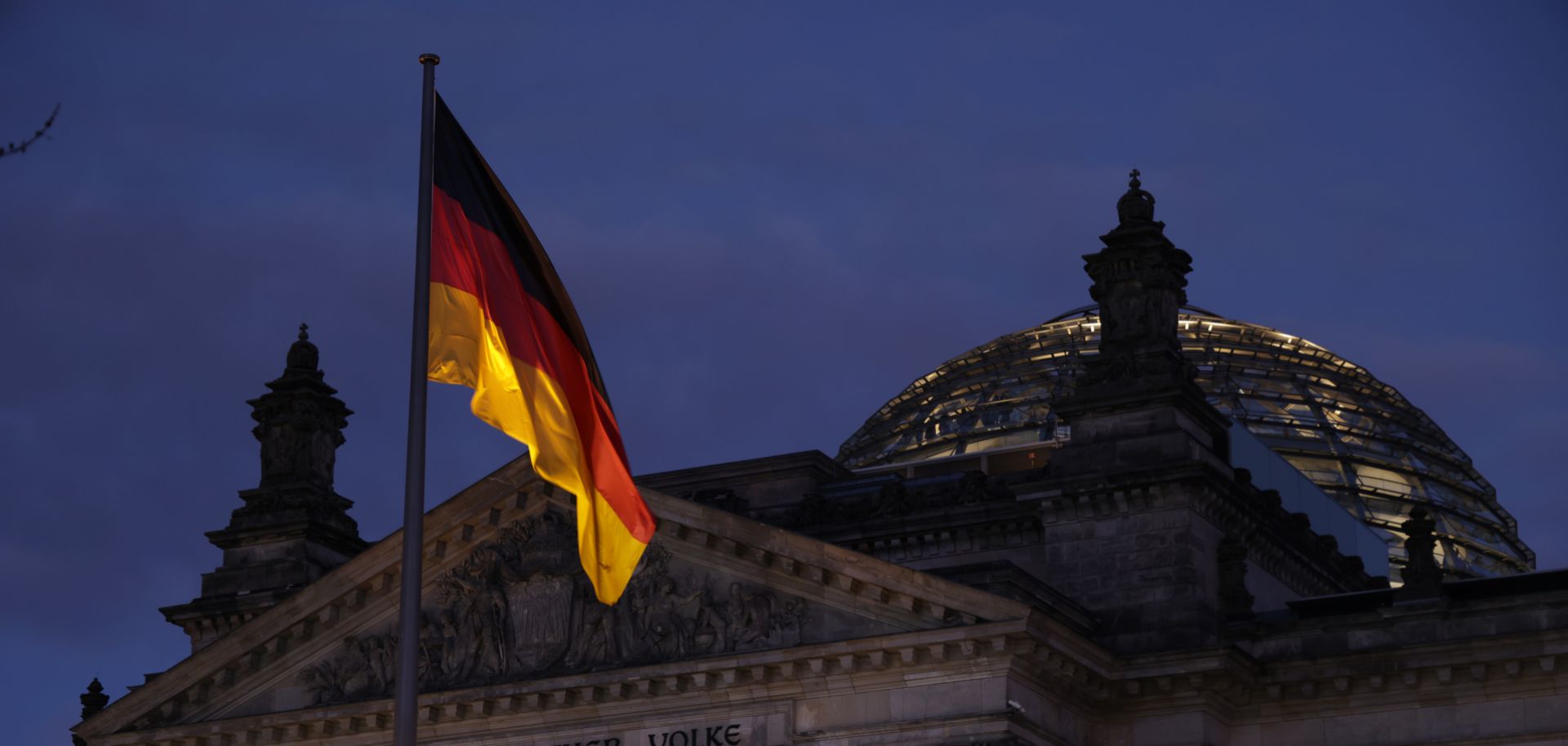
The seat of Germany's lower house of parliament stands at dusk on the day police conducted nationwide raids against a suspected insurrectionist group on Dec. 7, 2022, in Berlin, Germany.
Germany's coalition government is unlikely to collapse in 2023, but a combination of economic challenges and electoral tests will create new internal tensions that could lead to incongruent policymaking. Germany's first-ever, three-way ruling coalition has survived an especially tumultuous first year in power, despite internal ideological differences and the immense external challenges brought on by Russia's shock invasion of Ukraine, which happened less than three months after the alliance took office on Dec. 8, 2021. Over the past year, the ideological diversity of the ruling bloc's three partners — the center-left Social Democratic Party (SPD), the environmentalist Greens and the pro-business Free Democratic Party (FDP) — led to difficulties in the coalition finding common ground and managing the competing policy priorities of its constituent parties. But most importantly, the government's first year in power was almost entirely shaped by the Ukraine conflict and, in particular, the subsequent energy and inflation crises. The fallout from Russia's war put Berlin in permanent crisis mode and radically altered the coalition's initial policy agenda by forcing it to prioritize finding alternative supplies of energy, avoiding gas rationing and blackouts in the coming winter, and shielding households and businesses from soaring energy costs.
- In the September 2021 federal election, the SPD won the most seats in the Bundestag after securing 25.74% of the vote, followed by the Christian Democratic Union/Christian Social Union alliance at the opposition with 24.07%, the Greens with 14.75%, and the FDP with 11.46%.
- The SPD campaigned on promises of higher welfare spending, the Greens were elected on promises for more ambitious climate and environmental protection policies, while the FDP emphasized economic liberalization and a fiscally conservative agenda.
- The coalition government is led by Chancellor Olaf Scholz from the SPD, together with finance minister Christian Lindner from the FDP and economy minister Robert Habeck and foreign minister Annalena Baerbock from the Greens. Other key cabinet members include defense minister Christine Lambrecht and labor minister Hubertus Heil from the SPD, and digital and transport minister Volker Wissing from the FDP.
The German government's relatively successful response to the fallout from the Ukraine crisis came at the cost of taking on massive public debt, painful political compromises, and an overall slower decision-making process. Despite lingering internal differences, Scholz's coalition has managed to weather the shocks brought by the ongoing war in Ukraine, while at the same time delivering on many of its electoral promises (including raising the minimum wage, reforming the country's welfare system, and accelerating the long-term green transition process with a reform package aimed at significantly expanding the country's renewable energy generation by the end of the decade). However, this came at the cost of taking on new massive public debt, wrangling to reach compromises between the coalition parties (particularly on climate, fiscal and foreign policy), breaking political taboos (most notably on coal and nuclear power), and an overall slower decision-making process. The fact that Germany's coalition government emerged from such a turbulent first year intact is, in itself, a feat. But the immense challenges that Berlin faced over the past year are poised to only intensify in 2023 — with a worsening energy crunch this winter, a widely expected recession for the first half of the year, and a populace whose support for the coalition government is wearing thin.
- Weaning Germany off Russian energy required the Greens to concede on restarting coal power plants, extending the lifespans of nuclear plants, and sign new long-term liquified natural gas (LNG) supply deals.
- To cushion households and businesses against soaring energy prices, alongside other measures, the government decided to take on about 449 billion euros of new debt in 2022 — a particularly contentious issue for the fiscally conservative FDP.
- Russia's invasion of Ukraine forced the SPD to break with its long-established appeasement strategy toward Moscow, but this has not led to a broader shift in the country's approach to other potential geopolitical rivals. In fact, the relationship with China - with Scholz prioritizing maintaining business and commercial ties with the country while the Greens and the FDP have a more hawkish approach to Beijing - has proven another major point of contention between the SPD and its junior coalition partners.
- Differences among Chancellor Scholz's cabinet members have periodically resulted in mixed messaging from Germany on EU policies over the past year. An EU decision in July to ban new sales of fossil-fuel-powered cars by 2035, for example, was officially supported by Germany in the EU Council but was publicly opposed by German Finance Minister Christian Lindner (who pledged, to no avail, to veto the proposal).
Additional debt increases, clashing energy and environmental priorities, and tough foreign policy decisions will be the primary potential drivers of conflict between the co-leaders of Germany's government over the next year. To respond to the country's energy and economic crises, the government has so far resorted to ''special funds'' outside of the regular federal budget in order to avoid violating a constitutionally enshrined ''debt brake'' that limits annual borrowing to 0.35% of GDP — one of Lindner's top priorities. But if Germany's economic situation significantly worsens, pressure from opposition parties against the use of such funds and Lindner's own opposition to any eventual tax hikes to cover for increased spending may force the government to lift the debt break again next year, as it did during the height of the COVID-19 pandemic in 2020. If Europe's energy crisis does not improve after the winter, Chancellor Scholz may also face pressure from the FDP and the conservative opposition to keep Germany's three remaining nuclear plants online (which are currently scheduled to be decommissioned by April 2023), stoking tensions within the ruling coalition between the pro-nuclear FDP and the pro-environment Greens. Increased Chinese aggression in the Indo-Pacific — along with the January 2023 implementation of the U.S. green sector subsidies under the White House's contentious Inflation Reduction Act (IRA) — may clash with Scholz's goal to preserve Germany's traditional export-driven, free trade model as well, by prompting the Greens and (to a lesser extent) the FDP to call for a tougher approach toward Beijing and Washington.
- The German government has already earmarked more than 500 billion euros of debt issuance for 2023 to cope with the worsening energy and economic crises, according to the German Finance Agency's issuance plans published on Dec. 14. This surpasses the previous record of 483 billion euros in 2020.
- Borrowing will include as much as 242 billion euros to be sold on the money market and federal bonds worth 274 billion euros, while the government plans to issue a further 8 billion euros in inflation-linked bonds and 17 billion euros in Green bonds, according to the German Finance Agency.
- In October, Scholz ordered Germany's remaining three active nuclear power plants to stay operational until April 15, delaying a planned phase-out by four months. The decision was a compromise between Lindner, who wanted to keep all three plants running until 2024, and economy minister Habeck, who was originally opposed to any extension beyond 2022 but eventually settled on keeping just two reactors in reserve until April 2023.
- Scholz faced criticism from the FDP and the Greens after signing off on a deal allowing Chinese state-owned shipping giant Cosco to buy a 24.9% stake in one of Hamburg's port three terminals in October, despite the opposition of several members of his own cabinet. Scholz also faced backlash after he traveled to Beijing in November with a large business delegation to meet Chinese President Xi Jinping shortly after Xi secured an unprecedented third term.
- Germany has so far refused to set up new EU funds to compete with the U.S. green subsidies introduced in the IRA — an option raised by the European Commission and supported by France. Berlin has instead supported national solutions in countering the IRA. However, the government's messaging on the issue has been mixed. Habeck was initially open to the option of enacting EU green subsidies, saying Europe might have to enforce so-called ''local content'' requirements and that ''more precise funding programs'' would be needed to do so. But Lindner has categorically refused to accept another compromise to his promise to respect the country's constitutional debt limits, pushing back against any ''additional joint European debt.''
While the coalition government has so far managed to overcome internal differences thanks to its leaders' willingness to compromise, these may lead to increased tensions in 2023, particularly in light of political considerations around upcoming key local votes. All three government parties have seen their popular support decline throughout 2022 as they compromised on many of their main policy goals. This may lead to internal strife as party leaders seek to win back support by taking more hard-line positions on various issues — notably on energy, climate, debt and foreign policy. Internal disputes between the three coalition parties may deepen particularly around upcoming state elections, including Berlin in February, Bremen in May, and Bavaria and Hesse in October. Lindner's FDP may be particularly prone to such calculations given that the party's polling numbers have taken the worst hit over the past year, with voters punishing the FDP for not standing up enough to its left-wing coalition partners. In the unlikely scenario that the FDP decides to quit the ruling coalition, new elections may be necessary to form a new government.
- According to recent polls from Germany's Infratest Dimap, only 41% of surveyed voters would vote for one of the three governing parties, compared with the combined 53% vote share the parties secured in the 2021 election. The Greens and the SPD are currently polling at 18%, while the FDP is polling at only 6%.
- In October, state elections in Lower Saxony gave mixed results for Germany's ruling coalition. But the FDP emerged as the clear loser, failing even to make it into the state legislature. Following the electoral defeat, FDP leaders (including Lindner) said the party was hurt by its participation in the federal government and must do more to defend its interests in the ruling coalition.
Even without a government crisis, Berlin's inward-looking policy may frustrate key European allies and deprive the European Union of decisive German leadership. While unlikely, a coalition break-up would have significant consequences for Germany's political landscape. The creation of a new coalition or fresh elections would lead to political uncertainty in the country, as parties would seek to form new alliances and stake out positions on key issues, a process that could take weeks or even months. If the coalition were to break apart, this could also have broader implications for the stability of the European Union given Germany's central role in shaping the bloc's policies and strategic direction. A shift (most likely to the right) in the country's political landscape could lead to substantial changes in its approach to key EU issues (including those related to the bloc's enlargement, energy policy, fiscal rules and response to the U.S. IRA). While Germany's government will likely survive another year in office, growing coalition tensions could force Scholz to continue pursuing a foreign policy that's more focused on appeasing domestic allies than bolstering Germany's external partnerships. This internal focus could frustrate Germany's European allies (particularly France and Poland) and deprive Europe of its most influential leader. It could also disrupt or slow down the decision-making process at the EU level, should Berlin increasingly isolate itself through decisions that are more aimed at addressing domestic challenges than finding a coordinated response to common EU problems (including on the energy and inflation crises, domestic industrial subsidies, and migration).
