
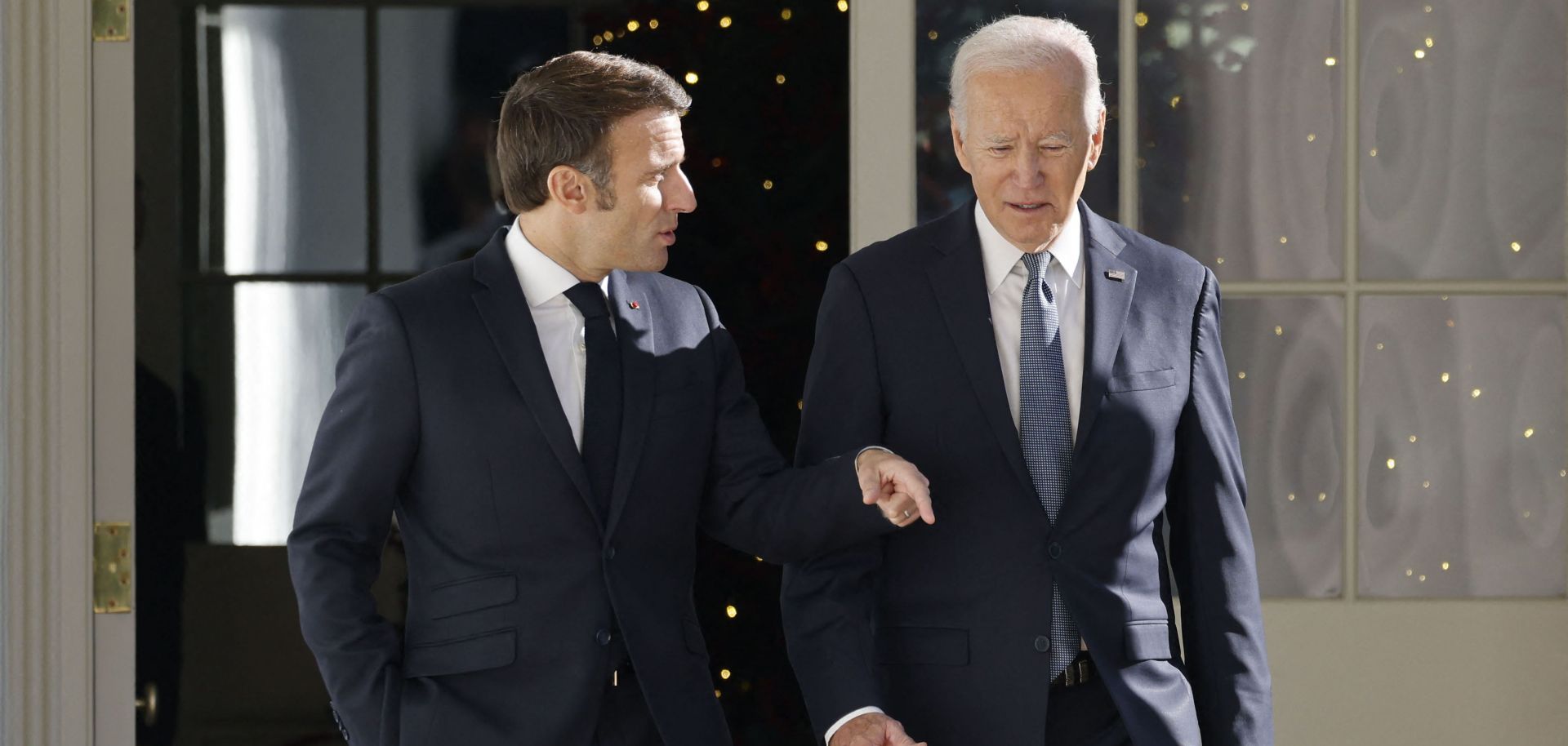
U.S. President Joe Biden (right) and French President Emmanuel Macron walk outside the White House in Washington, D.C., on Dec. 1, 2022.
The U.S. Inflation Reduction Act will force the European Union to increase subsidies for green technologies and adopt local content requirements to protect its green industrial base and mitigate the continent's deindustrialization. But this will come at the cost of alienating some EU trade partners and potentially distorting competition in the bloc's single market. French President Emmanuel Macron traveled to the United States on Nov. 29 where he met with President Joe Biden on Dec. 1. One of the main topics on Macron's agenda was the White House's plan to provide subsidies and financial assistance for U.S. companies in the clean energy sector under the soon-to-be-implemented Inflation Reduction Act (IRA), which the European Union sees as discriminatory against its companies. Macron secured an apparent concession from Biden, who promised ''tweaks'' to ''fundamentally make it easier for European countries to participate and/or be on their own.'' But what those tweaks may amount to (if anything) remains unknown. Meanwhile, the EU Council on Nov. 28 approved a new foreign subsidies regulation that aims to address distortions posed by such subsidies granted by non-EU countries to companies operating within the EU single market. The measure, however, does not go far enough to mitigate concerns that the IRA will severely hurt EU competitiveness in low-carbon industries, and several member states called during a meeting of EU trade ministers on Nov. 25 for a concrete solution to be found by the next meeting of the EU-U.S. Trade and Technology Council (TCC) on Dec. 5.
- Signed into law on Aug. 16, the IRA introduces $369 billion worth of subsidies for green technologies (e.g., solar panels, wind turbines, electric vehicles, green hydrogen, heat pumps, and various components related to the renewables industry). The bill includes tax incentives, grants and loans aimed at accelerating low-carbon technological innovation in the United States, while attracting investment in domestic manufacturing and encouraging the sourcing of critical supplies from either U.S. producers or U.S. free-trade partners.
- The EU foreign subsidies regulation enables the European Commission to investigate such subsidies and avoid foreign companies to benefit from, for example, zero-interest loans, below-cost financing, preferential tax treatment and state grants that would enable them to outbid EU competitors in mergers, acquisitions or public procurement procedures. However, the regulation only applies to subsidized non-EU companies operating within the bloc's single market, which means it will not impact European companies' global competitiveness vis a vis their U.S. counterparts.
- Prior to the TCC summit on Dec. 5, French Finance Minister Bruno Le Maire said he had started talks with his U.S. counterparts to see if EU ''green products'' sold in the United States could benefit from the IRA. On the other hand, European Commission President Ursula von der Leyen said that the European Union should adapt its state-aid rules in response to IRA subsidies. This mixed messaging signals the European Union's willingness to continue engaging with its U.S. allies on the matter, while also working on concrete solutions to prop up the bloc's industrial competitiveness.
The European Union sees the IRA's tax credits and subsidies as discriminatory toward EU industrial players and as an existential threat to Europe's manufacturing sector. The European Union believes the IRA to be both a violation of World Trade Organization (WTO) subsidy and non-discrimination rules, as well as a serious threat to its own industrial base — especially at a time when sky-high energy prices are already eroding the global competitiveness of European manufacturers by increasing the cost of doing business on the continent. Brussels argues the IRA's tax credits and subsidies (which are conditional on U.S.-manufactured content) penalize European producers of electric vehicles, green hydrogen, wind turbines and other renewable energy equipment. While temporary, the IRA's provisions could grant a first-mover advantage for companies that relocate production to the United States and permanently draw investments in green technologies out of Europe.
- The European Commission has identified five measures in the IRA that include subsidies with ''clearly discriminatory domestic content requirements'' against EU automotive, renewables, battery and energy-intensive industries. Brussels is particularly concerned about the IRA's impact on the bloc's automotive sector. Under the act, U.S. consumers who buy new electric vehicles could receive a tax credit of up to $7,500. But this subsidy only applies to cars made with parts from North America and/or assembled in North America, which EU leaders fear will disincentivize Americans from purchasing European EVs. Democrats in Congress recently introduced a bill that would give automakers more time to gradually fulfill the IRA's sourcing requirements. If passed, the bill would delay the implementation of the EV tax credits, though this would only ease the immediate threat to Europe's automobile industry.
- Increased competition from the United States' new green subsidy scheme comes as EU governments are already under enormous financial pressure from the aftermath of the COVID-19 pandemic and the ongoing energy crisis. A protracted subsidy race would most likely put Europe at an even greater disadvantage against the United States, whose lower energy prices are already pulling manufacturers away from the continent.
But despite these concerns, the White House will likely still move forward with implementing the IRA as-is. Brussels and Washington launched a joint task force in October to address the former's concerns with the IRA. Ideally, the European Union would like to receive the same preferential terms that the United States has extended to Canada and Mexico, which are exempt from the discriminating subsidy conditions in the IRA. The European Union will continue to negotiate with the Biden administration to obtain such exemptions for EU companies before the IRA takes effect on Jan. 1. However, a compromise is unlikely because the act is a central component of Biden's economic agenda and was passed by Congress with an extremely narrow margin. Given this reality, discussions in Brussels are now mostly focusing on how to react to Washington's expected implementation of the IRA as-is. Meanwhile, a Franco-German consensus has emerged on the need to respond by boosting joint subsidies in the European Union's strategic industrial sectors.
- In October, U.S. Treasury Secretary Janet Yellen dampened expectations for a negotiated settlement over the IRA, confirming that the legislation will be implemented as it was written.
- On Nov. 22, France and Germany's economy ministers called for a ''common response to the Inflation Reduction Act,'' suggesting the creation of ''a new European platform for transformative technologies'' and a ''buy European act'' that would introduce subsidies and preferences to the procurement of European components in given industries.
In response, Brussels will seek to ease state subsidy rules and introduce controversial requirements to privilege European over foreign production. If the IRA is implemented without exemptions for European companies, EU policymakers have threatened to take the case to the WTO and eventually introduce similar subsidies and/or tariffs against U.S. companies. However, the European Union is unlikely to enforce any retaliatory measures against the United States since its member states have no appetite for initiating a Transatlantic trade conflict at a time of mounting economic uncertainty and geopolitical tensions amid Russia's ongoing war in Ukraine. Taking the case to the WTO would also likely prove costly, time-consuming and ultimately unsuccessful given the organization's effectively paralyzed appellate body. In response to the IRA's expected implementation, the European Union will most likely seek to ease state subsidy rules and funnel billions into key green technologies while introducing controversial requirements to privilege European over foreign production. A subsidy scheme replicating the U.S.'s IRA would likely be financed through EU-backed grants and loans to private investment under the European Sovereignty Fund. A Buy European Act would then give preferences to the use of European components in such industries and would be compounded by increased scrutiny on investments (i.e., through the new foreign subsidies regulation) and anti-dumping measures on non-EU companies. The European Commission would then seek to cut red tape and accelerate approval processes for green projects benefiting from EU incentives. The mix of funds, protective measures, and local content provisions would enable the European Union to balance out the allure of the U.S. IRA on its industrial players without sparking a trade conflict with Washington.
- During her State of the Union address in September, von Der Leyen proposed creating a ''European Sovereignty Fund.'' Thierry Breton, the EU commissioner for the bloc's internal market, has since repeatedly called for the establishment of such a fund to support an industry ''Made in Europe.''
- In a Nov. 24 interview with the German newspaper Handelsblatt, Germany's vice-chancellor and minister of economy Robert Habeck suggested that local content requirements similar to those the European Union has enacted for semiconductor manufacturing — which mandate chipmakers operating in the bloc to use a certain amount of domestically-made materials in their products in order to receive subsidies and other benefits — could be applied to green tech manufacturing. Habeck also noted that extending such requirements to green technologies might qualify for an exemption under WTO rules by serving the ''strategic need for sovereignty in the area of energy policy.''
Subsidies and local content provisions may help the European Union avoid an exodus of investment in key industries and maintain global competitiveness in the development and production of green technologies. But such measures will also pose serious challenges to the bloc's Open Strategic Autonomy agenda. An EU-version of the IRA may antagonize the bloc's other trade partners for breaching WTO rules and discriminating against their commercial interests — just as the IRA has antagonized the United States' trade partners (including those in Europe). It would also seriously challenge the European Union's Open Strategic Autonomy agenda, which aims to balance the need to maintain openness to the global market against the need to act autonomously to defend the bloc's strategic interests in the new geopolitical context. This is because imposing measures and incentives that privilege European companies over foreign firms would force the bloc to progressively abandon its commitment to an open multilateral trade order. The European Union would also have to abandon its own internal competition rules to match increasingly protectionist industrial policies from the United States and China and allow the emergence of ''European champions'' that are able to compete in the global economy.
- The proposed European Sovereignty Fund would need to have sufficient firepower to rival the IRA while granting financing to all EU member states at the same market conditions to avoid further fragmentation within the single market. This is because, as seen in recent intra-bloc tensions over state-level responses to Europe's ongoing energy crisis, not all EU countries have the same financial resources to offer large-scale subsidies. Leaving industry support to single member states would thus most likely exacerbate existing imbalances among EU countries' competitiveness in the single market.
- The European Union has recently eased its state aid rules — which aim to preserve a level playing field among member states, as well as third countries, when operating in the bloc's single market — in order to provide relief to EU countries grappling with the economic fallout from the COVID-19 crisis and now the Ukraine-induced energy crisis. But Brussels will need to permanently revise these rules in case of a massive, long-term subsidy scheme.
- In response to the mounting international economic protectionism and increasing foreign competition of the past few years, France and Germany have spearheaded an initiative in the European Union to create so-called ''European champions,'' which aims to bring European companies more on par with Chinese and U.S. companies by reforming the bloc's strict competition rules and adopting a more active industrial policy.
