
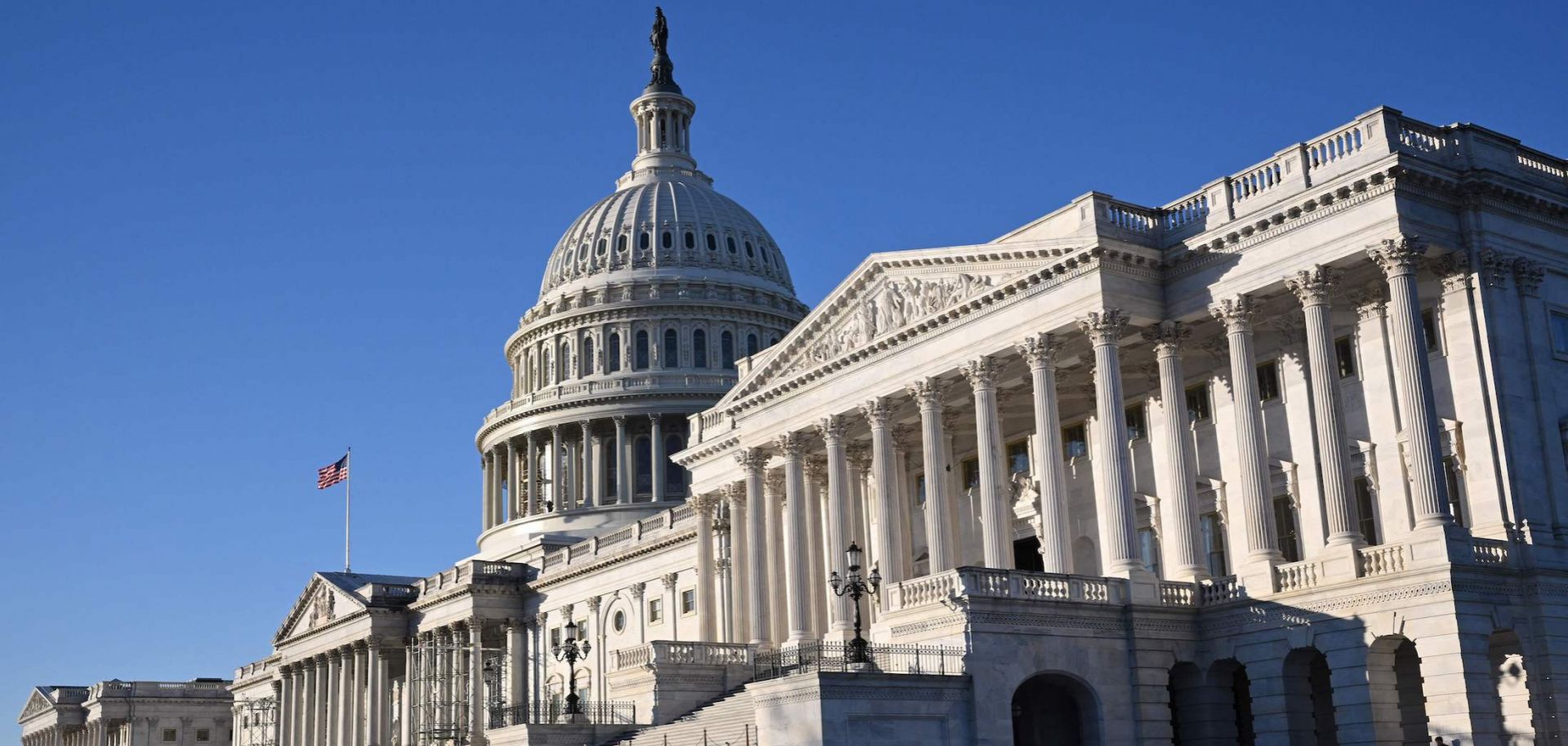
The U.S. Capitol building is seen in Washington D.C. on Nov. 14, 2022.
The United States' return to a divided Congress will significantly limit its response to more politically-charged foreign policy issues, like immigration and climate change. But the impact on Washington's approach to critical issues — like containing China's influence and helping Ukraine fend off Russia's invasion — will be more modest. The Nov. 7 midterm elections have left the United States with a divided government and Congress, with the Democratic Party retaining control of the Senate and the Republican Party gaining control of the House of Representatives. While Republicans performed below expectations, the overall outcome was largely expected, as such a split result has become typical in recent years after midterm elections.
- Nevada Senator Catherine Cortez Masto's victory (which was confirmed only on Nov. 12) has given Democrats at least a 50-50 split control of the Senate, where Vice President Kamala Harris has the tiebreaking vote. One more Senate seat remains up for grabs in Georgia, which will hold a runoff election on Dec. 6 between incumbent Democrat Raphael Warnock and his Republican challenger, Herschel Walker.
- As of Nov. 16, Republicans had been declared winners of 217 seats in the House of Representatives. The races for 11 House seats remain too close to call, but Republicans are highly likely to win at least one of those seats, which is all they need to hit the 218-seat threshold to control the chamber.
The election results confirmed the United States' deep domestic polarization, which will further draw Washington's attention inward and limit its assertiveness abroad over at least the next two years. The election reaffirmed the long-term trend of polarization in the U.S. political system that is occurring not only between Democrats and Republicans, but also between progressive and moderate Democrats and between former President Donald Trump and the rest of the Republican Party. This growing polarization (and rising political violence associated with it) will continue to force the U.S. government to focus its attention inward, which will constrain the country's foreign policy. For one, the close balance of power between Democrats and Republicans will force both the White House and Congress to take into account the impact of foreign decisions on the domestic political environment. The deep polarization in a divided Congress means most major legislation will also fail to pass. Since the 1990s when the Republican party has controlled the House, it has largely abided by the so-called Hastert Rule, the informal governing principle where the House Speaker doesn't bring legislation to the floor unless a majority of his or her party supports it. The Republicans will likely again use this informal rule once it retakes control of the House in January. This will curtail Democrats' ability to pass legislation with a small cohort of Republicans, despite the latter only having a majority in the House by a couple dozen seats. Unilateral executive action in other areas (such as climate policy) will face heavy scrutiny in Congress and more legal challenges as well.
Policy Implications
At a high-level strategic level, this inward focus of the U.S. government will grant other countries more space internationally to shape global policy – including U.S. rivals like Iran, China and Russia, as well as U.S. allies like France, Germany and Japan. But at a more nuanced level, the outcome of the U.S. midterms will also have specific implications for a number of key geopolitical areas:
Ukraine: The outgoing Congress will likely approve a large aid package for Ukraine for 2023. But once they take control of the House in January, Republicans have promised to increase scrutiny on President Biden's support of Ukraine through their subpoena power and the budget legislation, with future Republican House Speaker Kevin McCarthy hinting in October that his party will not ''write a blank check to Ukraine'' while the United States is facing an economic slowdown. But while GOP demands for more concessions (like more funding for border security) will probably slow the approval process for additional aid, Republicans ultimately remain split on the matter — meaning such aid will likely still be approved, even if at lower amounts. House hearings and increased scrutiny on the Biden administration's Ukraine policy will thus likely amount to very few real consequences in the immediate term.
Climate change: Climate and energy-related policies are among the most divisive issues in U.S. politics at the moment. At the state level, Republicans have criticized the rising role of environmental, social and corporate governance (ESG) considerations in the investment strategies of asset managers, banks and other institutions. With control of the House, the Republicans are likely to open investigations and inquiries into various climate change commitments and carbon-cutting targets. They will also use Congressional hearings to put pressure on financial companies to reduce or explain ESG-related investment strategies. In addition, they will likely increase scrutiny on the U.S. Securities and Exchange Commission (SEC) and other regulatory agencies that are imposing more rules and regulations around climate change and emissions target disclosures. Over the next two years, such efforts could tarnish some companies' reputations in the eyes of Republican voters, and will widen the greater ideological split between Americans who think fiduciary responsibilities include ESG considerations versus those who do not. Ultimately, however, control of the House alone will not give the Republican Party significant power to actually change U.S. policy on climate- and energy-related issues over the next two years.
Immigration: The worsening humanitarian crisis in nearby Haiti — along with the recent influx of northbound migrants reported at the Darien Gap between Colombia and Panama (which saw a record 150,000 migrants in October) — signals that 2023 will be another year of significant migration to the United States. Republican lawmakers campaigned heavily on curbing immigration from Central America, which will remain their primary focus during the next legislative session. When the new Congress takes office in January, McCarthy said that the first bill Republicans will put forth when will be one to secure the border. This bill will likely include many of the same proposals the Republicans made during the administration of former U.S. President Donald Trump, such as increasing funding for the border wall and border patrols. Given how the issue resonates with their voters, Republicans may threaten to shut down the U.S. government over funding or connect border security issues to appropriation bills and the annual must pass National Defense Authorization Act. Republicans may also demand additional border control funding in exchange for supporting Democrats' budget resolutions and other policy proposals. But while immigration will emerge as a major political issue on Capitol Hill, it will have little impact on the actual situation at the U.S. border because the fundamental drivers causing people to flee their home countries in Latin America (i.e. political repression, economic uncertainty and widespread violence) remain unsolved. Over the next two years, this could see officials in Arizona and Texas (the two Republican-led states that border Mexico) increasingly take matters into their own hands to curb migration flows. More incidents like that seen earlier this year in Texas — where Governor Greg Abbott closed certain border crossings to drum up pressure on the federal government — could, in turn, cause more delays and interruptions to goods moving from Mexico to the rest of North America.
China: Broadly speaking, both major U.S. political parties support taking a hard-line approach to China and further curbing the development of the Asian country's technology sector. This is one of the few areas that could see productive bipartisan negotiations, with Republicans and Democrats agreeing to impose more restrictions on China's tech sector and potentially even a new mechanism for reviewing overseas investment into China's technology sector. Any such legislation passed by a Republican-controlled House, however, may be narrower in scope or have certain carve-outs to protect U.S. businesses interests, given that Republicans have generally taken positions aligning more closely to that of corporations. Biden's push to reduce the United States' greater economic dependence on China by boosting public finance for domestic manufacturing is also less likely to gain bipartisan support. Many fiscally conservative Republicans have criticized Biden's Inflation Reduction Act and the CHIPS and Science Act as exemplifying the ''big government'' spending they oppose, since both bills include billions of financial support for the semiconductor and other sectors.
Venezuela and Cuba: Florida Governor Ron DeSantis' landslide victory was one of the most striking results of the U.S. midterm election. DeSantis won by nearly 20 points and became the first Republican governor to carry Miami-Dade county in two decades — revealing that Florida is now a more squarely Republican state than it has been in recent years. U.S. policies toward Cuba and Venezuela are major political issues in Florida — especially in Miami-Dade county, which has a large population of Cuban- and Venezuelan-Americans who often support hard-line policies against Havana and Caracas. The outcome of the latest U.S. midterm election, however, has shown Florida to be a more squarely Republican state than it has been in recent years. Democrats may, in turn, decide that appealing to Cuban- and Venezuelan-American voters — who overwhelmingly supported Republicans in the last race — is a lost cause. In Venezuela, the Biden administration has been offering limited sanctions relief in exchange for President Nicolas Maduro's regime resuming negotiations with the political opposition. But without the pressure of needing to appease Florida voters, the White House may accept weaker concessions in talks to maintain relief, which could see an easing of U.S. sanctions on Venezuela's oil sector. And when it comes to Cuba, the Biden administration may also take more steps toward normalization, such as easing travel restrictions and removing Cuba from the U.S. State Department's list of state sponsors of terrorism.
Iran: House Republicans will likely demand that Congress be granted the power to review and/or vote on any agreement that comes out of U.S.-Iran nuclear talks, should those talks resume. While this would complicate negotiations, the United States and Iran appear unlikely to return to the table anytime soon — especially amid Tehran's brutal crackdown on ongoing protests over women's rights and growing military support to Russian troops in Ukraine, which likely see the United States impose more sanctions on Iran in the short term. Republican and Democratic lawmakers may work together to craft those new sanctions, but the Iran hawks in the Republican Party will likely also try to add poison pills that make it more difficult for a future agreement to suspend sanctions in exchange for nuclear concessions.
Big tech: With control of the House, Republicans will hold a number of hearings on the tech sector and perceived bias by social media companies against conservative ideologies. But this is unlikely to result in any significant reforms on regulating the tech sector and social media. The Republicans and the Democrats both have an interest in curbing the power of these companies but have very different views on how to do it. The former is more concerned about stifling conservative voices while the latter is more concerned about the rising market dominance of companies like Amazon, Apple and Google.
