
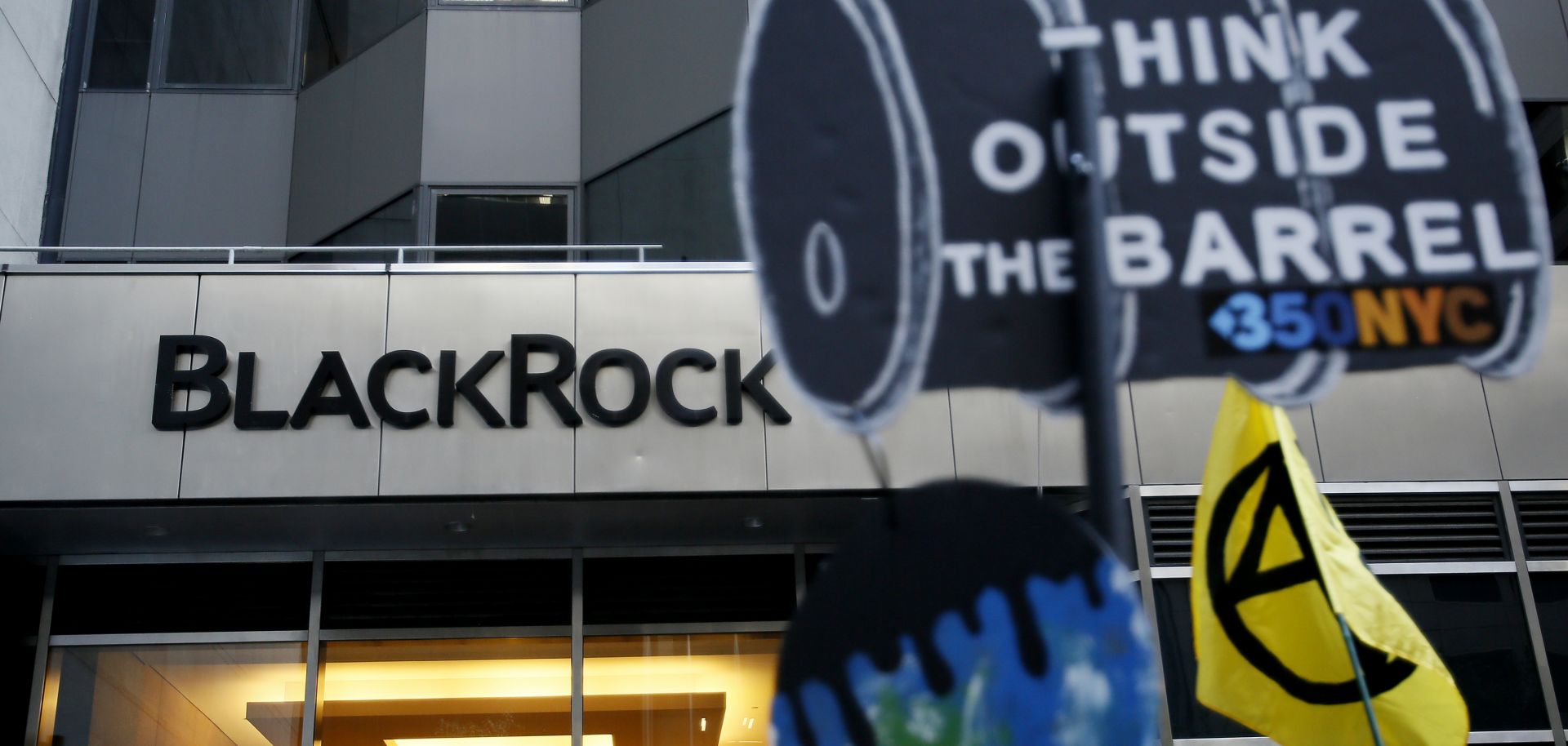
People hold up placards during a climate protest outside investment firm BlackRock's office building in New York City on Oct. 29, 2022.
Financial institutions' ongoing push for more flexible climate-related goals will limit private sector enforcement of emission-reduction pledges, slow down the pace of the energy transition and limit progress in the upcoming COP27 climate summit. On Oct. 27, the Glasgow Financial Alliance for Net Zero (GFANZ), a group of financial institutions committed to the fight against climate change, said that it will no longer require its members to partner with the U.N.-backed campaign Race to Zero (RTZ), which aims to boost commitments from non-governmental entities like financial institutions. The group dropped this membership requirement after pushback from banks and governments over harsh criteria set by RTZ. In its annual progress report, GFANZ said members should ''take note of the advice and guidance of'' the Race to Zero. A GFANZ official later stated to Reuters that members ''are encouraged, but not required, to partner with the Race to Zero.'' The easing of the requirements came two weeks ahead of the 2022 United Nations Climate Change Conference (commonly known as COP27), which begins in Sharm El Sheikh, Egypt, on Nov. 6. During the conference, financial institutions will likely come under pressure from governments and global institutions to back tougher carbon-cutting goals.
- GFANZ was launched in April 2021 by former Bank of England Governor Mark Carney and comprises seven sector-specific alliances that are focused on achieving net zero emissions by 2050. The alliances collectively have more than 550 members and manage assets worth more than $150 trillion.
- On Oct. 17, the chairwoman of GFANZ member Net-Zero Banking Alliance (NZBA) wrote in an open letter that participating in GFANZ ''[did] not impose any additional or different obligations on'' her alliance's members, after some NZBA members reportedly expressed concern about GFANZ's RTZ partnership requirement. According to the letter, ''GFANZ has no decision-making authority in relation to the NZBA and cannot direct the NZBA or its members to act in any particular way.''
- Climate activist groups criticized GFANZ's change in requirements for backtracking on climate commitments. In an Oct. 28 statement, the U.S.-based Sierra Club called on GFANZ to ''stay committed to robust, science-aligned policies,'' and that if entities like GFANZ wanted to maintain their credibility, they must have explicit commitments to phase out coal, natural gas and oil financing.
Many financial institutions are threatening to pull out of alliances like GFANZ and NZBA for fear that their membership may expose them to legal risk. In September, U.S. banks including Bank of America, JPMorgan and Morgan Stanley threatened to leave GFANZ after RTZ adopted tougher criteria for companies making net-zero pledges in June. The new criteria included a requirement for members to phase out all unabated oil, coal and natural gas projects, including financing for such projects, with members needing to begin complying by June 2023. RTZ's new criteria also require its members to set specific emissions targets, including so-called Scope 3 emissions (which include emissions generated by their investments), and annually disclose progress towards their commitments. Moreover, prior to the GFANZ announcement that it was no longer requiring its members to partner with RTZ, RTZ reportedly was in the process of setting up an accountability body where civil society and non-government organizations could report non-compliance bodies, which would have the power to expel organizations from GFANZ. For a number of U.S. banks, the aggressive commitments and the enforcement mechanism could increase their exposure to legal liabilities created by third parties reporting non-compliance and suing them. In addition, the U.S. Securities and Exchange Commission (SEC) proposed a new rule earlier this year that would require SEC-regulated companies to disclose and be held accountable for any commitments made, and to have specific plans on how to achieve those goals. Under the proposed SEC rule, the RTZ's more stringent criteria would thus force SEC-regulated institutions to come up with detailed plans to achieve targets that were more aggressive than the institutions wanted to set if they adopted RTZ's criteria — thereby opening them up to legal, regulatory and compliance risks. Some banks are also reportedly concerned that phasing out coal financing as a part of a climate-focused organization may violate various antitrust laws globally.
- The Australian pension fund Cbus Super and the German pension fund Bundespensionskasse became the first two financial institutions to withdraw from GFANZ after they both announced they were exiting the Net Zero Asset Owner Alliance, one of the net zero alliances that is a part of GFANZ, earlier this year. Neither fund, however, cited RTZ's criteria as a reason for exiting.
In the United States, many Republican-led states are threatening to expand restrictions on financial institutions' membership in emissions-reduction initiatives, arguing that they boycott the hydrocarbon industry. In recent years, several U.S. states — including Texas and West Virginia — have either passed or proposed laws that empower their state governments to retaliate against financial institutions that can't prove they're not boycotting the hydrocarbon industry. Most of these laws are narrow in scope, such as barring state-owned pension funds from using asset managers that the state government has branded as boycotting the hydrocarbon industry. But they nonetheless offer a preview of the types of ESG-related policies that could be employed at the national level if the Republicans win control of Congress and the White House in Nov. 8 midterm elections and the 2024 presidential race, respectively. The laws also indicate that Republican states will take more aggressive action should financial institutions make stricter commitments on reducing financing for oil, natural gas and coal projects. If the Republicans win control of the House of Representatives or the Senate in the midterms, they are likely to use their oversight functions on the SEC to review the commission's same draft rule that has sparked banks to be concerned about the new RTZ criteria. They are also likely to organize Congressional hearings on the matter and get executives at financial institutions to answer questions. Republican complaints would probably focus on their view that such investment policies violate a fiduciary responsibility for companies to maximize their clients returns. Collectively, these efforts will be aimed at deterring financial institutions from making more aggressive commitments going forward.
- In June 2021, Texas — the largest oil- and gas-producing U.S. state — adopted a law forbidding most state entities from signing contracts with companies placed on a list for reducing investment into the hydrocarbon industry and boycotting it. In August of this year, the Texas comptroller then added ten major financial institutions to that list, including BNP Paribas (the European Union's largest banking group) and the U.S.-based investment firm BlackRock.
- In March, West Virginia — the second-largest coal-producing U.S. state — adopted a law similar to the Texas law. In July, West Virginia's treasurer then added BlackRock, Goldman Sachs, JPMorgan Chase, Morgan Stanley and Wells Fargo to a list of companies that would no longer receive state contracts.
- In August, 19 state attorney generals signed a letter criticizing BlackRock's ESG investment policies, and said their state fiduciary laws required entities like BlackRock to have a sole focus on maximizing returns that ''would potentially include the opportunistic purchasing of fossil fuel assets discarded by companies seeking to meet net zero.'' The letter is illustrative of a difference in opinion in the United States around fiduciary responsibility and the extent to which climate risk on returns is material.
- In August 2022, Florida's State Board of Administration trustees led by Governor Ron DeSantis — a leading contender in 2024 presidential elections — banned state pensions from using ESG-related standards in their investment strategies.
In the coming months and years, financial institutions that are a part of GFANZ, NZBA and other alliances will demand greater flexibility in their commitments as they face a challenging regulatory environment and increasingly recognize that at least some hydrocarbon investments will be needed for the foreseeable future. There is significant government, public and shareholder pressure for financial institutions to adopt energy transition targets for their investment portfolios in 2030 and 2050. However, many financial institutions will reject the idea that any non-governmental body (like RTZ) can set specific requirements that they're then forced to follow, which would reduce institutions' flexibility when it comes to dealing with various regulations and potential legal risks. Financial firms' need for flexibility will force alliances like GFANZ and NZBA to weaken some of their proposed policies because if any major institution withdraws, it could lead to other members leaving and question the legitimacy and viability of the organizations. Over time, this will likely drive a growing wedge between groups like RTZ (as well as activist groups) calling for more explicit commitments, transparency and accountability. Already, some activists have dubbed this process as a more sophisticated form of greenwashing called ''green-crowding,'' wherein companies join bodies like NZBA and GFANZ that have the public appearance of being environmentally progressive, only to then pressure those bodies to commit to the bare minimum in aiding the transition to clean energy.
- Financial institutions are likely to demand the most flexibility when it comes to reporting commitments, Scope 3 emissions and setting their own commitments. Scope 3 emissions, in particular, have received significant pushback from companies due to the fact that they include emissions from their investments and not just emissions specifically tied back to the company itself (such as at office premises).
- The ongoing energy crisis and the war in Ukraine have led to a number of governments weakening or delaying their own energy transition commitments to secure coal or natural gas amid rising energy prices. This has, at least for now, reduced some of the pressure on financial institutions from shareholders and governments to make more significant climate commitments this year.
The push for more flexible climate commitments will limit the intensity of the private sector's push toward net-zero emissions and the pace of the overall energy transition, making it more difficult for the 2015 Paris Agreement to achieve its goals. Western governments have limited financial resources to invest in new green technologies, as well as a limited number of state-owned enterprises to implement their green policies directly. Private sector participation and enforcement are thus crucial in the fight against climate change and the advancement of the energy transition, as the widespread adoption of clean energy sources and carbon-cutting measures will largely depend on the investments and projects carried out by private companies. Governments are putting into place a number of new requirements to accelerate the transition, such as various ESG-related regulatory, disclosure and transparency requirements for financial institutions. But on the whole, explicit emissions reduction requirements for companies and investments have been uncommon. If the private sector continues to weaken some of its commitments, some governments (most likely in Europe) may try to force companies in the financial sector and other industries to take greater action by mandating the adoption of more explicit climate commitments.
- In October, the U.N. Framework Convention on Climate Change released a report ahead of evaluating the most recent combined pledges by the Paris Agreement's parties that found that efforts remain ''insufficient'' to limit global temperature rises to 1.5 degrees Celsius by 2100. Weaker participation by the private sector makes it only more likely that global efforts will remain insufficient in the eyes of the United Nations.
Because of these ongoing trends, carbon-cutting pledges made by governments and private entities during the upcoming COP27 will be considerably more modest than in previous encounters. During the 2021 climate conference in Glasgow, the United Nations and the United Kingdom (which hosted the event) pressured companies and countries to make significant commitments as a part of the 2015 Paris Agreement's ratchet mechanism requiring countries to adopt tighter commitments every five years. In addition, GFANZ's formation by a former Bank of England governor was a part of London's diplomatic push to make COP26 successful. However, COP27 host Egypt does not have the same global political gravitas as the United Kingdom, and the summit is likely to see fewer commitments as the global energy crisis will be on many participants' minds. Moreover, as a developing African country, Egypt is likely to try to steer discussions toward issues of concern for the global south, such as Western investments into Africa as a part of the energy transition or investments into climate adaptation and mitigation amid the record floods that Africa has recently seen. The choice of Egypt as a host is also likely to blunt the conference's success as some activists and environmental organizations are critical of Cairo's climate policies, given its close political and economic alignment with the world's largest oil producer, Saudi Arabia. The Egyptian government's human rights record has also come under scrutiny, which has already prompted some famous climate activists, like Greta Thunberg, to boycott the upcoming conference. Next year's COP28 will bring similar criticisms as it will be hosted by the United Arab Emirates, a top oil producer and OPEC member. This means that progress on emission reduction commitments at COP conferences will remain modest for the next two years.
- Egypt has outlined four areas of focus for COP27: adaptation (which focuses on dealing with extreme weather events); collaboration (which focuses forging more consensus among different global stakeholders); finance (which focuses on financing the energy transition globally); and mitigation (which focuses on trying to get some tighter commitments from countries). While Egypt is focusing on finance, its focus is different than financial sector concerns related to GFANZ as the developing world is in dire need of trillions of dollars of financing commitments.
- A number of leading financial institutions, including BlackRock, are reportedly sending lower-level officials to COP27 instead of their CEOs, further suggesting that commitments by the financial sector at the next U.N. climate summit will be limited.
