
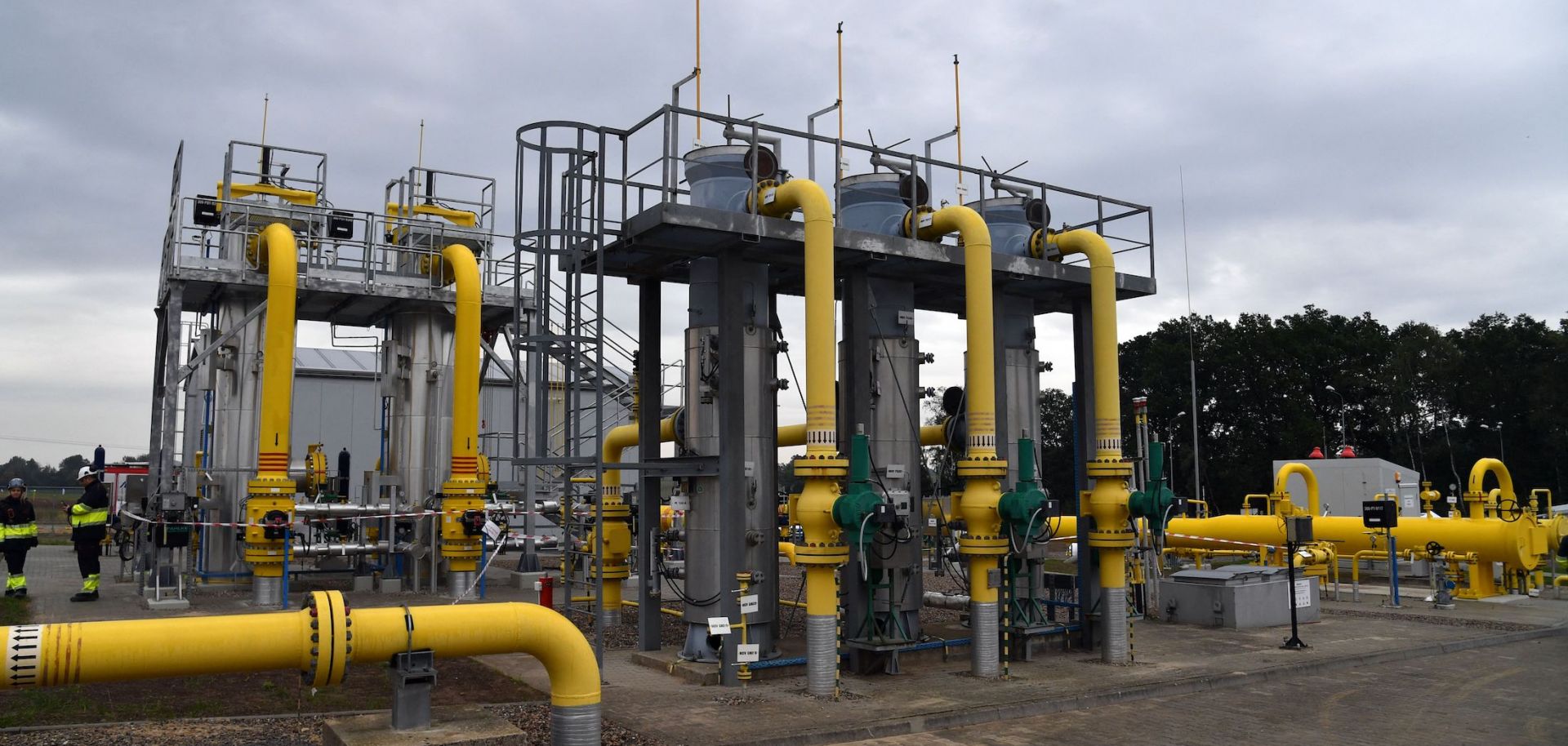
A compressor station is pictured on the grounds of the Baltic Pipe near Goleniow, Poland, prior to the gas pipeline's opening ceremony on Sept. 27, 2022.
Despite growing pressure from some member states, the European Union is unlikely to implement a natural gas price cap anytime soon, which means that highly exposed, poorer European countries will continue to struggle to secure supplies and shield citizens from high energy prices. Ministers from 15 EU member states including France, Italy, Spain, Poland and Belgium have signed a letter calling on the European Commission to put forward a proposal for a bloc-wide price cap on natural gas at the meeting of EU energy ministers on Sept. 30. However, member states including Germany, Denmark, the Netherlands and Hungary are skeptical of the idea, arguing it could jeopardize supply as EU buyers have to compete with other regions of the world for limited LNG cargoes on the global market. Countries remained split at an informal meeting of EU diplomats on Sept. 28, where the European Commission was supposed to present an analysis on the feasibility of a bloc-wide wholesale gas price cap and instead offered a policy paper mostly consisting of warnings against what it says could prove a hard-to-implement measure that would pose risks to the continent's energy security. Discussions continued at the Sept. 30 meeting, where EU energy ministers approved less controversial measures, including windfall taxes on energy firms and liquidity support to utilities, but again failed to reach an agreement on a bloc-wide gas price cap.
- A price cap on wholesale gas transactions would mean the mechanism would apply to contracts with suppliers and intra-EU deals.
- The letter, addressed to Energy Commissioner Kadri Simson, was signed by ministers from Belgium, Bulgaria, Croatia, France, Greece, Italy, Latvia, Lithuania, Malta, Poland, Portugal, Romania, Slovakia, Slovenia and Spain.
- While European energy-intensive industry representatives are lobbying for a gas price cap that would reduce operational costs, energy companies are largely opposed to major interventions into gas and power markets arguing, any market manipulation could endanger the security of supply.
- To replace Russian gas, Bloomberg estimates European buyers would need to purchase almost twice as much LNG on the spot market as they have so far secured under long-term contracts. This means paying very high prices for limited cargoes sought by several potential buyers in regions like East Asia.
- In her State of the Union speech at the European Parliament on Sept. 14, European Commission President Ursula von der Leyen stepped back from earlier plans to introduce a bloc-wide gas price cap, proposing instead windfall taxes on energy firms and cuts in electricity use as EU emergency measures to tackle soaring energy prices.
- Germany is particularly opposed to a price cap because it has more financial capacity to outbid other EU countries to get the gas it needs and is able to implement national gas price subsidies to lower the prices for its own consumers. In fact, on Sept. 29, Berlin announced a 200 billion euro package to cap gas prices domestically. Should an EU-wide cap be imposed, gas will have to be redistributed between EU countries politically, not by market forces, taking away Germany's competitive advantage.
Rising gas costs in Europe amid growing fears that Russia may halt supplies via Ukraine are adding pressure on the European Commission to find solutions to contain prices. Price-driven demand destruction — along with European countries' progress in diversifying supply away from Russia and filling up their gas stockpiles — had eased pressure on Europe's rattled energy market in recent weeks, with gas costs falling from the all-time highs recorded in August. But prices have recently ticked back up amid the discovery of major gas leaks on the Nord Stream 1 and 2 pipelines and Russian energy giant Gazprom's threats to disrupt remaining gas flows through Ukraine. The Nord Stream gas leaks reported on Sept. 26 and 27 have not directly impacted gas supplies to Europe, as operations at the two pipelines were already halted. But indications that they were acts of sabotage (most likely at the hands of Russia) have nonetheless rattled markets by dashing hopes of Nord Stream 1 reopening anytime soon, as well as highlighting the greater vulnerability of European energy infrastructure to Russian aggression amid the ongoing war in Ukraine. Only hours after Nord Stream leaks were reported, Russia's state-owned gas giant Gazprom then exacerbated market anxieties by warning that flows through Ukraine (the last remaining route for Russian gas into Western Europe) could be interrupted due to its ongoing legal dispute with Ukrainian energy firm Naftogaz — causing benchmark gas prices in Europe to rise an additional 14% on Sept. 28. This latest escalation in Europe's energy crisis comes just before demand for heating traditionally begins to increase across the continent amid the onset of colder weather in October — raising pressure on the European Commission to quickly come up with an effective emergency instrument to address high energy prices before demand peaks in the winter.
- Russia's threats to fully sever the European Union's gas supplies this winter have prompted Brussels to accelerate its supply diversification efforts. According to the European Commission, pipeline gas from Russia now only accounts for 9% of total EU gas imports, down from 41% in 2021. Gas storage capacity across the European Union is also 88% full, as of Sept. 29.
- On Sept. 28, Russia's state-owned gas giant Gazprom said Russia may sanction Naftogaz (which operates transit pipelines in Ukraine) and prohibit all transactions if the Ukrainian energy company does not give up attempts at resolving a dispute over transit fees through international arbitration. Naftogaz CEO Yuriy Vitrenko has since said his company still plans to proceed with the arbitration case — raising the specter of sanctions that would suspend the transportation of all EU-bound gas supplies through Ukraine.
- If flows through Ukraine are halted, Western Europe would be effectively cut off from Russian natural gas supplies, leaving only the TurkStream pipeline sending gas to south and eastern European countries through Turkey and Serbia.
With an EU-wide natural gas price cap unlikely in the short term, uncertainty about the evolution of supplies will continue to create volatility in energy prices. According to plans currently under discussion in Brussels, the European Union could establish a dynamic price cap, which would set mobile price limits that are slightly above what other importers pay, so that Europe would maintain a market advantage over competitors and avoid supply risks. While EU importers would still pay prices above their Asian competitors, these would still be lower than current European prices. Such a price cap would also level the amount paid among EU buyers, which would remove the internal competition that has so far contributed to driving prices further up. The same could be achieved through common purchasing of natural gas, another solution suggested by EU officials. Either way, leveling down prices internally would require the European Union to find a mechanism to distribute natural gas among single countries, a level of coordination it has yet to achieve. Moreover, besides concerns regarding the security of EU energy supplies, a price cap would risk increasing demand by incentivizing consumption, which is the opposite of what Brussels is trying to achieve. Any price cap would thus have to be effective in mitigating price levels and volatility while minimizing adverse reactions on demand and security of supply — meaning an outright price cap on all wholesale gas transactions, as urged by the 15 member states, is unlikely. Nevertheless, the idea will remain at the center of discussions throughout the fall.
- EU countries have proposed a variety of different bloc-wide gas price caps, all of which entail some risks, including a cap on Russian gas imports, an option already largely discarded as it would lead to a full cutoff of Russian supplies; a cap on gas used to produce electricity, which risks incentivizing demand from the power sector; and a cap on all wholesale gas prices, that might increase demand and endanger supplies.
- For the time being, the European Commission will likely stick to power savings targets and windfall taxes on low-carbon power generators and on fossil fuel upstream companies to fund increased financial support to consumers and struggling utility companies. However, these measures are far from a comprehensive answer to the energy crisis, and more will be needed to go through winter.
- A wholesale price cap on all gas imports, besides posing risks for supplies from third countries, could compromise cross-border flows between EU states as flows would no longer be driven by pricing toward areas where demand is high or supply is scarce. An EU gas price cap could thus be implemented only in parallel with a new entity in charge of distributing gas among individual member states.
