
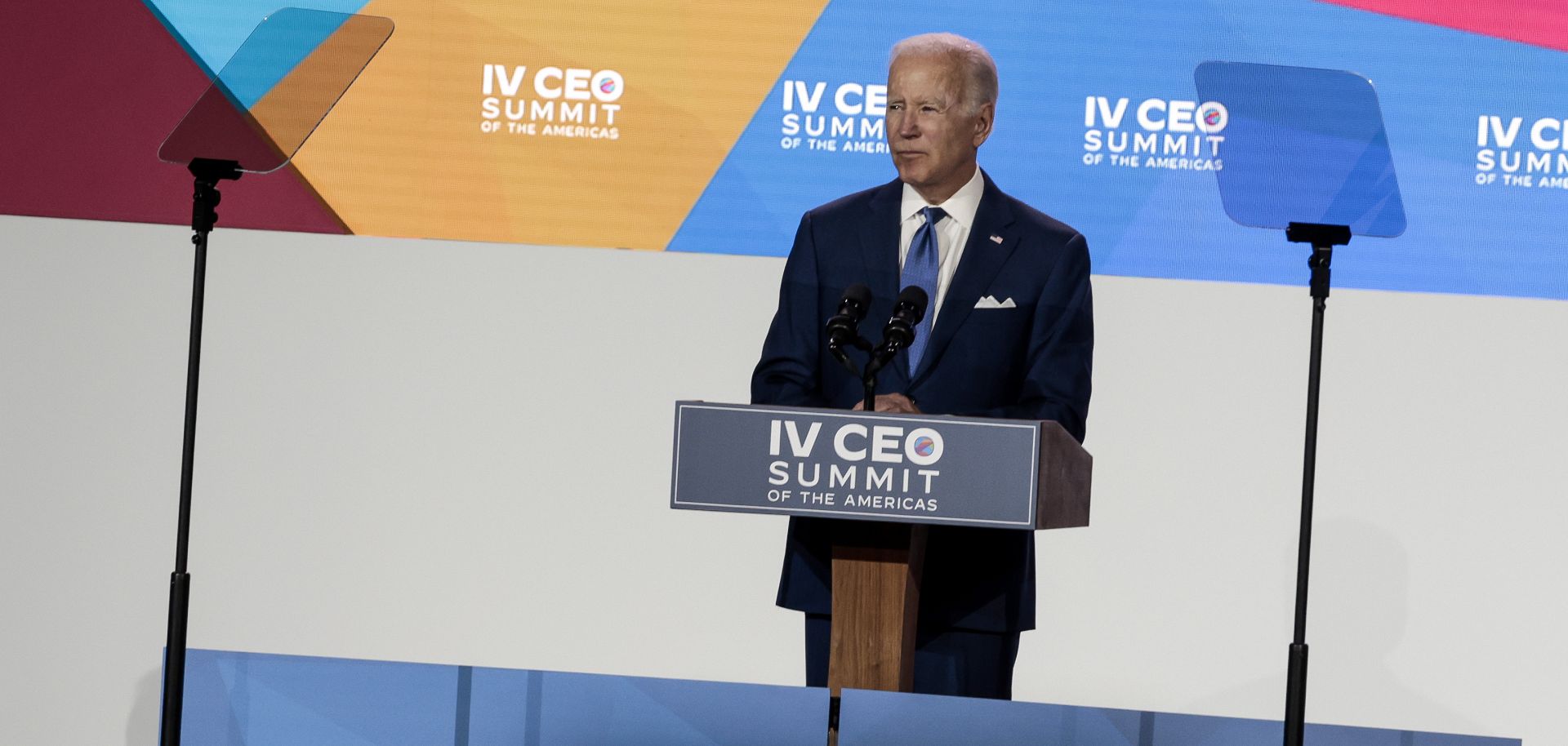
U.S. President Joe Biden speaks at the Summit of the Americas, which was attended by leaders across the Western Hemisphere, on June 9, 2022, in Los Angeles, California.
In his famed 1918 Fourteen Points speech, U.S. President Woodrow Wilson laid out a vision of a liberalized global order that promoted free trade, freedom of navigation on the seas, open agreements (i.e. no secret treaties) between governments, and the League of Nations to champion world peace. But the United States never joined the ill-fated League of Nations, which Woodrow helped create in the face of growing domestic opposition against his interventionist foreign policies. And in 1920, just two years after Woodrow made that speech, the United States went on to reject the Treaty of Versailles ending World War I, and then entered a depression. Wilson’s vision of free trade was then rejected again (and again) over the next 15 years as the United States went into an extended period of economic protectionism that included the 1922 Fordney-McCumber Tariff Act (which raised tariffs by 25% and triggered a trade war with Western Europe) followed by the even more extreme 1930 Smoot-Hawley Tariff Act (which raised tariffs by another 20%).
Fast forward to today, and growing domestic support for protectionist policies is once again constraining the United States’ global trade strategy. U.S. President Joe Biden recently unveiled two economic initiatives: the Indo-Pacific Economic Framework for Prosperity (which was announced in late May during his first visit to Asia as president), and the Americas Partnership for Economic Prosperity (which was announced in early June at a regional summit hosted by the United States). Free trade supporters have criticized both deals for being too narrow in scope, as neither is a free trade agreement. Free trade agreements, however, are now no longer en vogue in Washington, where an increasingly polarized political environment — along with longstanding accusations that trade has hollowed out America’s industrial and manufacturing base — has left more lawmakers in support of protectionist policies (or hesitant to say otherwise).
In terms of cementing the United States’ ties with foreign partners, the additional economic cooperation outlined in the new Indo-Pacific Economic Framework for Prosperity and the Americas Partnership for Economic Prosperity is thus likely the most Biden thinks he can offer without causing an uproar at home — illustrating how domestic political conditions can prevent U.S. presidents from making decisions that, on the surface, look to be in their country's strategic interest, for better or for worse.
Trade Pacts as Tools Against China
For all of its rejection of the global alliance structure, multilateral institutions and existing free trade agreements, the administration of former U.S. President Donald Trump stated in its 2017 National Security Strategy that it viewed China and Russia as “revisionist powers” and that, “China seeks to displace the United States in the Indo-Pacific region [...] and reorder the region in its favor.” The blunt language used by Trump’s administration is little different than that used by both his predecessor and successor. It’s an assessment that most on Capitol Hill would also agree with, regardless of their political allegiances: From the United States and the West’s perspective, China’s economic, political and military rise may be the greatest threat to the Western-led liberal global order since the end of the Cold War.
Prior to Trump’s election, the promise of free trade agreements was the United States’ primary economic weapon to counter China’s growing influence in the Asia-Pacific region by offering an alternative to Beijing’s state-led economic policy and authoritarian governance. The United States remains the world’s largest economy and many of the Western Pacific nations that are most at risk of becoming closer to China are those that the United States does not have a free trade agreement with — the majority of which are members of the Association of Southeast Asian Nations (ASEAN). Through the Trans-Pacific Partnership (TPP), both George W. Bush and Barack Obama’s White House administrations offered free trade access to the United States market in exchange for countries agreeing to implement substantial negotiations on non-tariff-related issues, such as the digital economy and environmental and labor standards. The idea was that the deep trade deals would serve as an ideological blueprint for more modernized trade and investment relationships between different countries and offer an alternative to China’s model, dangling access to the lucrative North American market as the hook to reel in Asian countries. But just as domestic politics led the United States to abandon the League of Nations it helped build more than a century ago, the United States abandoned the TPP shortly after Trump was elected.
The way in which free trade agreements and economic globalization has fallen out of favor with many Americans in recent decades can largely be attributed to broader socioeconomic trends in the United States. U.S. manufacturing jobs have fallen from a peak of 19.5 million workers in 1979 to 12.6 million workers in early 2022. Manufacturing jobs often did not require a college education and were a pathway to good-paying jobs and career opportunities in the Midwestern region of the United States. But then came the arrival of global trade, which led to a massive decline in those industries as the United States began importing more manufactured goods from countries like Japan, Taiwan, South Korea, China and Mexico. This economic shift was buoyed by cheap labor overseas and technological advancements that reduced the cost of shipping goods, particularly in standardized containers. But while changes in shipping technology and cheap labor abroad are likely more to blame, the trade deals the United States inked in the 1990s have nonetheless since become synonymous with the decline in U.S. manufacturing and the subsequent dimming of the American Dream, with well-paying jobs that don’t require college degrees now increasingly hard to find.
Virtually all reputable economic studies conclude that the trade deals actually increased the number of jobs in the United States. The benefits, however, were not universal. In the U.S. region now known as the “Rust Belt,” manufacturing hubs in Indiana, Michigan, Ohio and Pennsylvania (like Gary, Detroit, Cleveland and Bethlehem) struggled immensely as companies moved their operations overseas — even as cities like San Francisco, Dallas, Houston and Los Angeles thrived.
The State of U.S. Trade Policy
President Biden’s hands are tied in offering any significant level of access to the U.S. economy. Within the current political environment, there is virtually no chance of Congress passing a free trade agreement with most countries. During their time in office, both Bush and Obama relied on trade promotion authority (or TPA, also commonly referred to as “fast track authority”), where Congress — which constitutionally is responsible for U.S. economic policy — temporarily authorized the White House to negotiate free trade agreements in a way that would expedite their approval process in Congress and prevent them from falling prey to a filibuster by a small minority in the U.S. Senate and extensive amendments tacked on by Congress. TPA lapsed in July 2021, making it impossible for the Biden administration to use the mechanism in its trade policy. If the Biden administration wants to sign a free trade agreement that lowers U.S. tariffs to a country, Congress will now need to re-authorize TPA; otherwise, the White House would have to submit it to a Congress that would have expansive authority to modify the agreement — both of which appear highly unlikely. Of the United States’ current free trade agreements, its small and unconventional deal with Jordan is the only one that has been passed without using TPA.
TPA relied on the notion that the president needs more freedom to use trade policy to carry out foreign policy objectives, which falls under the executive branch. Congressional gridlock would render the United States’ trade negotiators powerless in convincing other countries that an FTA would be adopted by Congress in the form they negotiated without Congress clawing back U.S. concessions. President Trump withstanding, virtually every U.S. president in recent history drifted toward a more pragmatic pro-free trade stance due to foreign policy objectives once they took office, regardless of what they pledged on the campaign trail. President Bill Clinton made supporting NAFTA a pillar of his 1992 presidential campaign, much to the chagrin of U.S. labor unions and some members of his own Democratic party. And once he took office, Clinton furthered the U.S. free trade push by concluding negotiations on the World Trade Organization (WTO) and then on China’s subsequent entry into the WTO, despite some opposition among Democrats. In 2008, President Obama campaigned on the need to renegotiate NAFTA to protect U.S. workers. But once in office, Obama folded NAFTA renegotiations into talks on the Trans-Pacific Partnership started by his predecessor, which resulted in an agreement that ended up actually increasing free trade access to the United States from Mexico and Canada in the automotive industry, instead of restricting it to protect U.S. workers.
President Biden’s intention to use economic frameworks and partnerships to deepen economic ties with other countries is a return to form for the White House, putting him in line with Obama, George W. Bush, Clinton and a string of presidents before them. With free trade agreements off the table, the recently-inked Indo-Pacific Economic Framework for Prosperity (IPEF) and the Americas Partnership for Economic Prosperity (APEP) may represent the maximum extent to which the Biden administration can offer in terms of additional economic cooperation.
For IPEF countries, the framework appears to build on some of the issues previously negotiated during TPP talks, like digital trade and environmental issues. But without lower tariffs being dangled to countries desiring cheaper access to the U.S. market, the Biden administration’s best offer may not be enough to convince IPEF countries to enter talks or offer concessions on more contentious issues, such as India over climate policy. The APEP, however, may find more success, as the framework is intended to start negotiations with countries in the Americas that the United States already has a free trade agreement with. The APEP can thus build on already deep economic ties – both from a trade and investment perspective – between the United States and Latin American nations like Chile and Peru.
Pragmatism vs. Transactionalism
Biden, however, may be running out of time to get his APEP and IPEF initiatives off the ground. U.S. inflation is the highest it’s been in 40 years, with gasoline prices at record highs as well. Against this backdrop, polls are showing that most Americans have a negative view of the economy, which will make it more difficult for Biden’s Democratic Party to retain both houses of Congress in November midterms. Moreover, Biden is behind two potential Republican presidential challengers in the PredictIt betting market that is giving Trump and Florida Governor Ron DeSantis higher odds of winning the presidency in 2024 as of June 15. The same betting markets are also giving Biden a less than 50% chance of winning his party’s nomination. If the Republicans are able to run the table in 2022 and 2024, it seems unlikely that a President Trump (or President DeSantis) would be as pragmatic in using trade policy to achieve foreign policy objectives. Both Trump and DeSantis appear to be more focused on a transactional approach to policy issues in terms of solidifying their own political support base.
Even if the Republicans fail to take control of Congress or the presidency, Biden is still facing significant blowback within the Democratic Party on trade-related issues. The progressive wing of the Democratic Party is pushing for climate, labor, democracy, human rights and other progressive issues to be a more foundational part of the United States’ conversations abroad, as opposed to the current policy focus on more traditional economic issues like exports, imports and tariffs. While previous U.S. trade agreements include some of these more progressive economic issues, more recent agreements, like the TPP, have begun to more closely deal with them. Meanwhile, the Democratic Party is also trying to rebuild support among the working-class voters and labor unions, which are both increasingly supporting Republicans due to Trump’s protectionist stance and the resonating message that free trade led to a decline in jobs. The need for the Democratic Party to court those voters will only intensify as the U.S. political environment becomes more polarized and more socially divided, as economic issues can still resonate strongly with voters and, for some, may offset preferences on social issues like gun ownership and abortion rights.
Biden, of course, will not be the last U.S. president to champion economic partnerships, free(r) trade and a liberalization of global trade. But political polarization in the United States may lead to a longer respite between the next president who does, reminiscent of the protectionist era of the 1920s and early 1930s that followed Wilson’s reign. And that’s because right now, the political risks of adopting a strong free trade approach to foreign policy likely outweigh the benefits, which will force both U.S. parties to view policy issues in a more transactional way in order to secure votes.
Trump took this to the extreme, as his approach to international tax negotiations — along with his policies regarding Iran, China, NAFTA and Venezuela — were arguably more aimed at garnering domestic support ahead of the 2020 election by fulfilling his 2016 “America First” campaign promises, rather than advancing the United States’ best interests as a global power. The United States’ increasingly polarized political environment, however, will probably compel future presidents to take more pages from Trump’s book by more overtly focusing their foreign policy on appealing to a domestic audience. Future U.S. presidents may also find themselves increasingly forced to adopt an unmalleable position due to the rigid nature of both polarized parties taking firm opposing stances on an issue.
As presidents’ actions abroad become increasingly bound to the whims of their supporters at home, the subsequent whiplash in U.S. foreign policy will risk impeding the United States’ ability to counter China’s global rise, as well as damaging Washington’s global leadership on issues like trade, climate change and multilateral alliance structures – some of which are the same issues the Woodrow Wilson’s rivals opposed when they rejected his idealistic foreign policy strategy more than a century ago.
