
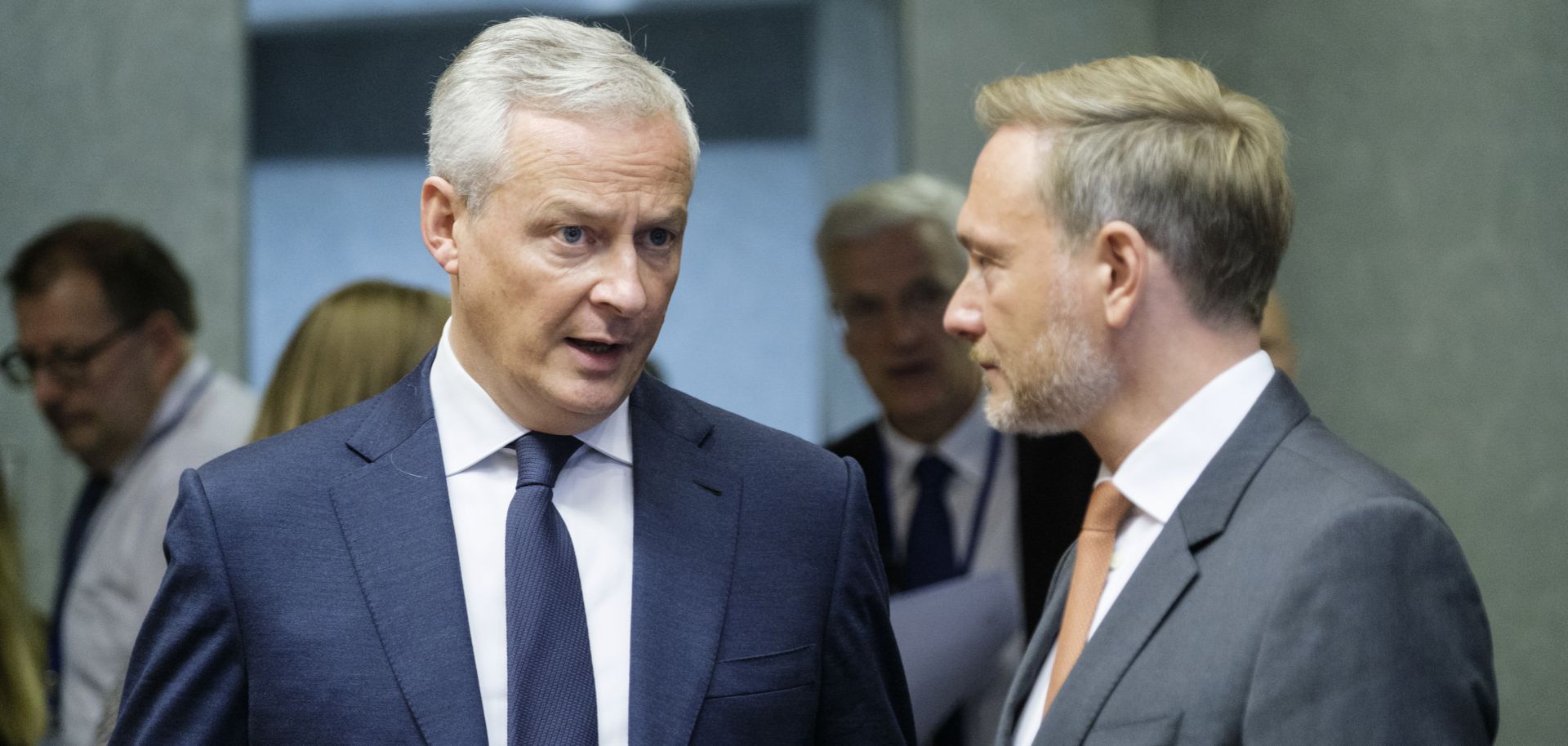
French Economy and Finance Minister Bruno Le Maire (left) talks with German Finance Minister Christian Lindner (right) before a Eurogroup meeting in Luxembourg on Oct. 3, 2022.
France and Germany's proposed plan to counter the U.S. Inflation Reduction Act (IRA) by unlocking additional intra-EU state aid is unlikely to drastically reduce the risk of companies leaving Europe due to high energy prices and, if unmatched by dedicated EU funds, could lead to distortions in the EU single market. On Dec. 19, France and Germany issued a joint statement outlining their strategy for how to react to the U.S. IRA, which introduces $369 billion worth of tax cuts and other benefits for green technologies (like electric vehicles) that are made in the United States. The Franco-German strategy has two parts. On the one hand, Paris and Berlin are urging the White House to extend the IRA's benefits to European companies (similar to what the United States does for Canadian and Mexican companies); and on the other, they're calling on Brussels to develop its own ''green industrial policy.'' Notably, France and Germany want the European Commission to speed up the approval process for state aid for low-carbon technologies, so that national governments can provide tax credits and subsidies for green-related industrial sectors without the commission delaying the process. Berlin and Paris also want to cut in half the time to approve Important Projects of Common European Interest (IPCEI), which allows two or more EU member states to jointly back innovation projects without breaking the bloc's state aid rules.
- The joint Franco-German statement calls for state aid to certain sectors not to be approved in advance, as current rules require prior approval by the European Commission.
- France's economy and finance minister Bruno Le Maire and Germany's economy minister Robert Habeck will travel to the United States in early January to negotiate changes to the IRA with the White House that would allow European companies to benefit from U.S. subsidies. In early December, U.S. President Joe Biden suggested during a meeting with French President Emmanuel Macron that the United States would consider some concessions within the IRA to European companies, though the White House has yet to make any formal announcements.
The Franco-German strategy confirms their sense of urgency to respond to the IRA and, at least under the Biden administration, is unlikely to trigger U.S. retaliation. The joint statement is a compromise between Germany, whose priority is to obtain exemptions from the IRA, and France, whose priority is to relax EU subsidy rules so that governments can help their industrial sectors. This also confirms that the European Union is progressively becoming more willing to enter a subsidies race with the likes of the United States and China, and to channel state aid to certain sectors of its economy (primarily related to innovative green technologies). The fact that these subsidies could be financed through a combination of state resources and existing EU funds (at least initially) is a victory for Germany, which is opposed to allowing the European Commission to issue extra EU-denominated debt on behalf of member states. Still, the commission is currently working on a so-called ''EU Sovereignty Fund'' that would eventually involve joint EU debt (France's preferred option). The European Union may not be able to obtain U.S. concessions for European companies under the IRA, as doing so would involve contentious reforms to U.S. legislation. However, the bloc's plans to match U.S. green subsidies will not most likely not trigger any retaliatory measures from the United States, at least under the Biden administration, as the White House has indicated that it supports EU subsidies. But this could change under a future Republican administration that sees such subsidies as discriminatory against U.S. companies operating in the bloc.
- France, Germany and other EU countries fear the IRA tax credits and subsidies (which are conditional on U.S.-manufactured content) will hurt Europe's industrial base — especially at a time when sky-high energy prices are already eroding the global competitiveness of European manufacturers.
- German Chancellor Olaf Scholz recently said to be cautious about responding to the IRA through EU-funded subsidies for European companies. Germany's fiscally-conservative finance minister, Christian Lindner, has also taken an explicit stance against a response that would involve any form of joint EU borrowing, emphasizing instead that it might be ''useful'' to ''bundle existing instruments'' at the EU level to resolve the issue and welcomed ''more flexibility in economic aid for subsidies.''
- During her State of the Union address in September, European Commission President Ursula von Der Leyen proposed creating a ''European Sovereignty Fund,'' which she later said would be formally presented next summer.
EU subsidies will only slow, rather than prevent, Europe's overall deindustrialization caused by high energy prices and, if not accompanied by increased financial support from the European Union, risk enhancing existing economic imbalances among EU member states. An overhaul of EU state aid rules that simplifies procedures and speeds up permitting processes would enable EU governments to boost public investment in the bloc's green energy sector. However, while this would partly offset the impacts of the IRA, it would not balance out the overall pressure on the continent's industrial base caused by pervasively high energy prices. This means that EU subsidies would at best mitigate, not reverse, the deindustrialization of European economies, particularly for energy-intensive sectors. Moreover, should regulatory changes in the European Union not be accompanied by EU-wide funds to finance support for green projects, individual member states will be left to bolster their own industries against increased U.S. competition. Without a continent-wide strategy, wealthier governments with the financial resources to assist their own industries (such as Germany and, to some extent, France) will be in a better position to offer large-scale subsidies to their domestic companies at the expense of smaller countries in the bloc, thus enhancing existing imbalances within the EU single market. This, in turn, may widen the north-south economic gap and lead to diverging political interests regarding the direction of further economic integration in the bloc, which could eventually see the union itself be called into question.
- Throughout 2022, a combination of rising energy prices and uncertainty about future energy supplies has forced companies in energy-intensive sectors such as steel, fertilizers, plastics and ceramics manufacturing to reduce or halt their activities across Europe.
- In September, the president of the German steel federation WV Stahl warned that unless the German government and the European Union do more to mitigate the impact of high prices, ''a winter of de-industrialization threatens us in Germany.'' In October, German conglomerate BASF announced plans to reduce its presence in the country and move some of its operations to China because ''the significant increase in natural gas and power prices over the course of this year is putting pressure on chemical value chains.''
