
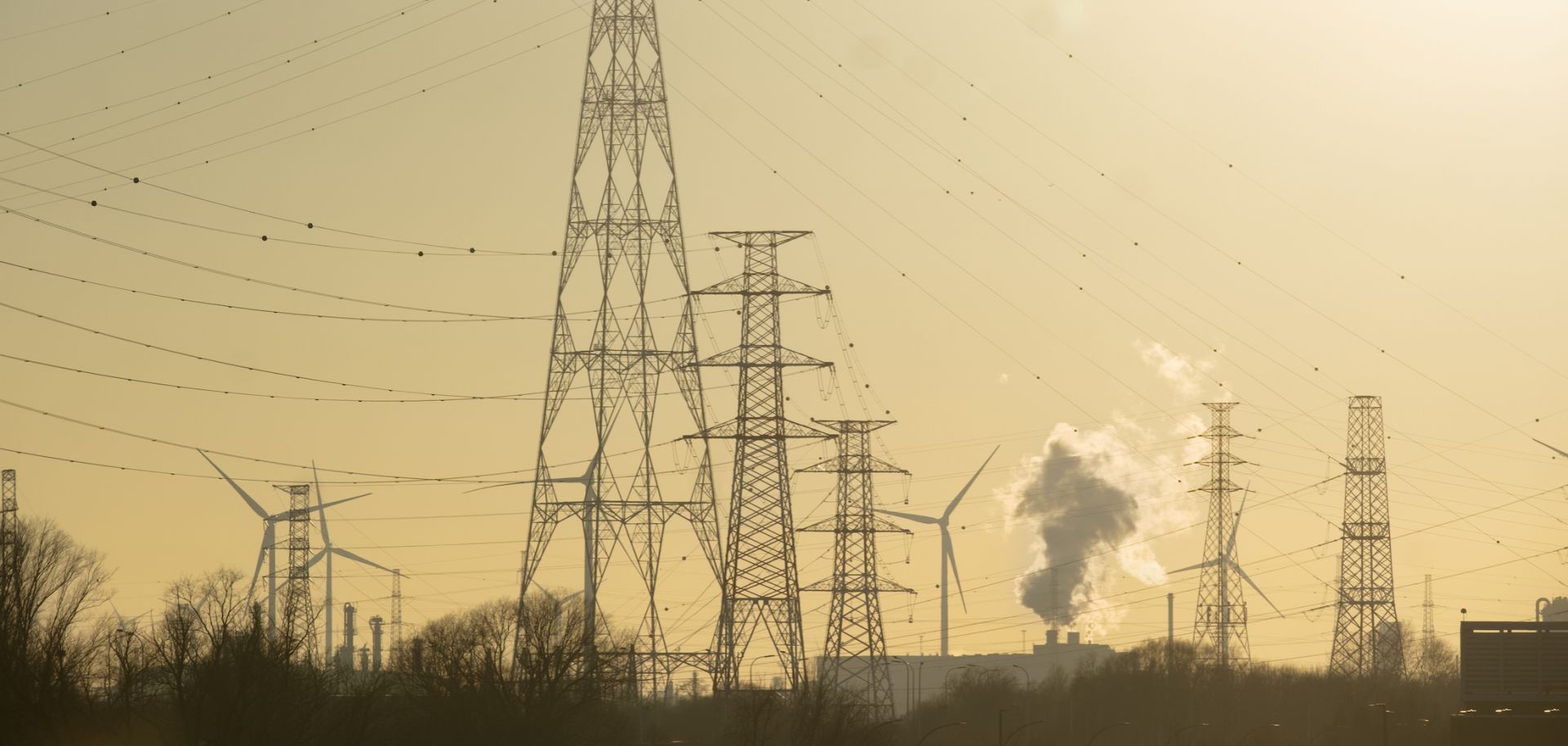
Transmission towers are seen in Antwerp, Belgium, on Feb. 7, 2023.
The European Union's proposed electricity market reform seeks to reduce short-term price volatility for customers while boosting investments in renewables, avoiding major overhauls that would risk disrupting the market. On March 14, the European Commission presented its proposal for reforming the bloc's electricity market in an effort to reduce consumers' exposure to volatile natural gas prices and ensure that the ongoing increase in low-cost renewable electricity generation translates to lower energy bills. The commission's plan aims to increase renewable energy's competitiveness vis-a-vis gas, as well as incentivize the use of private long-term contracts between producers and consumers to shield the latter from severe spikes in natural gas prices like those experienced in 2022. It also seeks to encourage the development of innovative solutions in energy storage systems and demand response mechanisms that would help balance the electricity grid to more local, flexible renewable energy sources and reduce the need for fossil fuel-fired power plants. In addition, the reform proposes establishing mandatory regional virtual hubs for trading forward contracts (i.e. contracts to buy/sell electricity at a specified price in the future) across all EU countries to increase price transparency and ensure the cross-border transmission of electricity. Finally, the proposal strengthens EU energy regulators' role in cross-border investigations to protect consumers from market manipulation.
- The proposal requires countries to use more fixed-price, long-term electricity contracts, including two-way contracts for difference (CfD), forward contracts and power purchase agreements (PPA). These contracts lock in stable, long-term power prices that are unaffected by short-term market volatility for future state support for renewable power generation.
- On March 14, European Energy Commissioner Kadri Simson said Brussels is also set to announce further steps to make the temporary energy-saving measures the bloc approved last year permanent, including a 15% natural gas demand reduction target during winter months and a mandatory 5% reduction target during peak electricity hours.
Brussels initially promised to radically transform the European Union's electricity market during the peak of Europe's energy crisis in mid-2022, but the recent fall in energy prices has reduced the bloc's sense of urgency to do so. Currently, power prices in the European Union are set by the final generator needed to meet overall demand, which most often is a gas-powered plant — meaning natural gas price spikes directly impact electricity prices. Brussels pledged to revamp this pricing mechanism in October after Russia's Ukraine-related gas cut-offs sent European energy prices (and electricity bills) soaring over the summer. The energy price shocks brought on by the disruptions to the bloc's Russian gas supplies significantly increased the cost of living and doing business in Europe, straining household budgets and curbing industrial production. Even Germany, which had previously opposed any market intervention, conceded the need to change the market's pricing system to contain skyrocketing electricity prices. But after peaking in August, gas prices in Europe have fallen sharply in recent months thanks to a combination of factors, including an unseasonably warm winter, strong liquified natural gas (LNG) imports and reduced demand. And as a result, households and businesses' electricity bills have also fallen, which has eased the political pressure on the European Commission to deliver a proposal to structurally overhaul the bloc's electricity market.
- Natural gas prices in Europe have fallen drastically since hitting an all-time high of over 300 euros per megawatt-hour (MWh) in August 2022, with month-ahead contracts on the European gas benchmark Dutch Title Transfer Facility (TTF) currently trading below 50 euros per MWh. As of March 15, gas prices in Italy, Germany and France were 109 euros, 71 euros and 81 euros per MWh, respectively — down from 537 euros, 465 euros and 600 euros per MWh on average for August.
- Prior to the war in Ukraine, 40% of the natural gas consumed by EU countries was supplied by Russia through pipelines.
EU countries and the European Parliament still need to approve the proposed reforms before they can enter into force, portending negotiations that will likely last several months. The European Commission's proposal promises a more competitive and integrated EU electricity market by introducing long-term contracts and other measures aimed at infusing greater certainty into energy bills and boosting investments in the renewable sector. But it falls short of decoupling natural gas and power prices, which the commission initially promised to include in its reform last year, avoiding deeper reforms to the electricity market design that were requested by countries like Spain and France. Instead, the European Commission opted for lighter adjustments to limit price volatility, as requested by countries such as Germany and the Netherlands, which warned major changes could disrupt markets and scare off investors. The proposed measures have been welcomed by environmental groups and renewable energy industry associations, which feared a radical reform would have reduced the profit margins that the bloc's current market design grants green energy producers. But the reform could still prove divisive among member states which may delay its implementation. The proposal will now be debated by the European Parliament and national governments in the coming months, both of which will need to approve the reform before it enters force. This process could take several months, as some countries will likely still have reservations about the lack of more sweeping structural changes to the bloc's electricity market.
- Long-term electricity contracts between suppliers and clients already exist across the European Union, but their use is limited and varies across countries. The commission's reform proposes making these contracts mandatory for all new renewable and nuclear energy projects that entail state subsidies, while excluding state support for fossil fuel-powered generators. By providing the necessary financial guarantees, these measures are designed to encourage investments in the bloc's renewable energy sector, which is key to achieving the European Union's goals of reducing its reliance on Russian fossil fuels and achieving net-zero carbon emissions by 2050.
- In a joint letter published on Feb. 13, Germany and six other EU countries called for a more cautious approach that preserves the current market setup, arguing that any major interventions would disincentivize investment by creating even greater uncertainty in the market.
- Spain welcomed the commission's proposal, but also said it would work to ''enrich it'' once it assumes the EU Council presidency in the second half of the year.
