
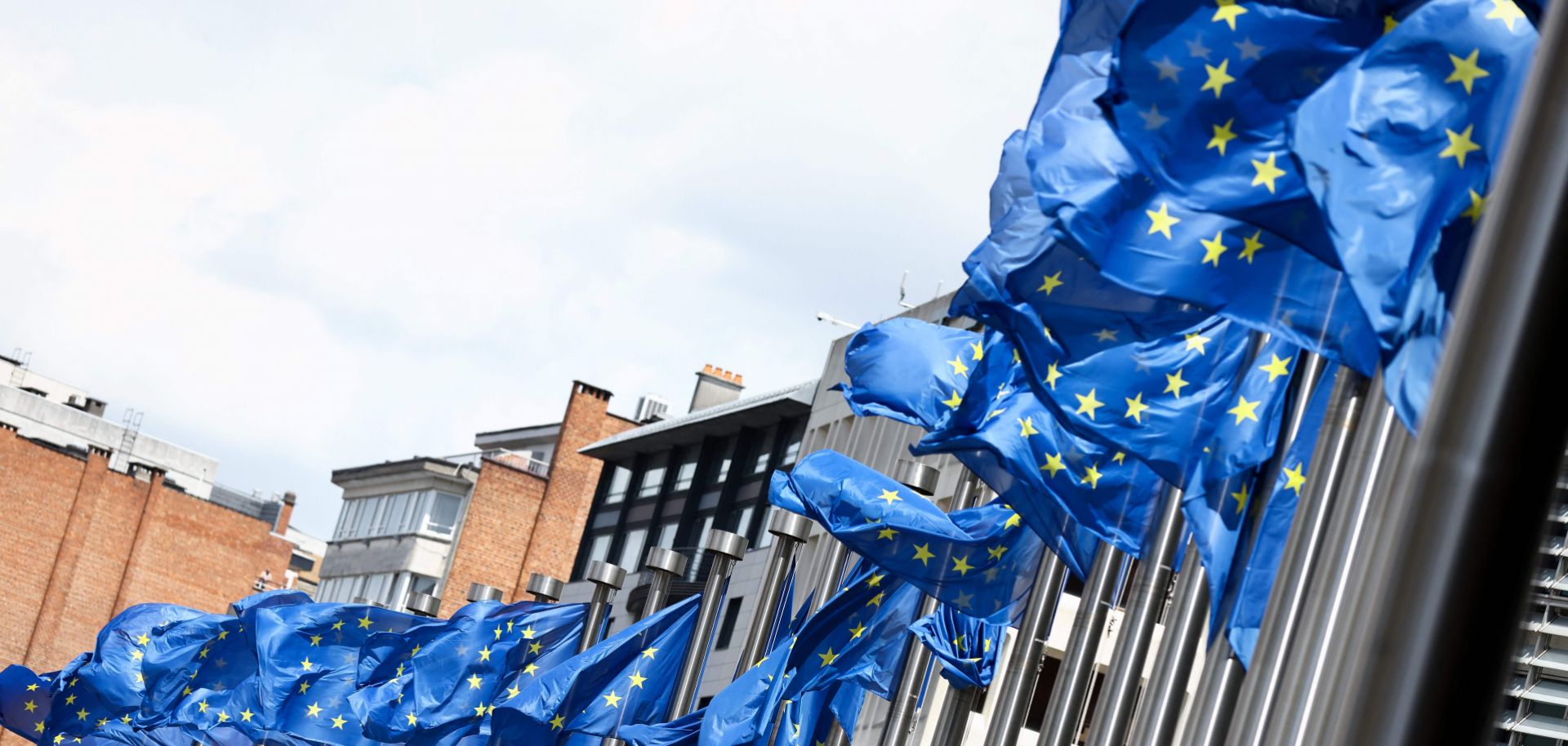
European flags fly in front of the European Commission's headquarters in Brussels, Belgium, on June 12.
On Aug. 29, German Chancellor Olaf Scholz gave a speech at the Charles University in Prague where he presented his vision for the future of the European Union. In the core part of the speech, he said that Russia's invasion of Ukraine was a wake-up call for the European Union to revise the way it adopts policy, arguing that the bloc should use majority voting instead of unanimity to decide on issues like taxation and foreign sanctions. Scholz's speech confirmed Germany's alignment with France on this issue, as French President Emmanuel Macron has also repeatedly criticized unanimity. But it also underscored the extent to which the continental bloc is struggling to streamline its decision-making process to compete against more centrally-governed rivals such as China or Russia, a problem that is only likely to become more acute in the future as geopolitical competition intensifies.
Entering the Unanimity Trap
The issue of unanimity has always been problematic in the European Union because it gives individual member states excessive bargaining power during negotiations on areas such as foreign policy, taxation and enlargement. Hungary's recent threat to veto an EU-wide embargo on Russian oil unless it was granted exemptions was only the latest in a very long list of governments pledging to veto EU policy to defend their national interests. To make things more frustrating, veto threats within the European Union are sometimes not even connected to the issue under discussion. Poland, for example, has vetoed a plan to implement a corporate tax reform to protest the European Commission's delay in the disbursement of money from a COVID-19 recovery fund.
Critics of unanimity argue that it makes EU foreign policy extremely inefficient, as the bloc faces institutional constraints that the other large global powers (notably Russia and China, but to some extent also the United States) do not have to deal with. The more the European Union is constrained by its voting mechanisms, the argument goes, the more reactive it will be to global events and the slower it will be to rise to the challenges of growing geopolitical competition. The defenders of unanimity, for their part, argue that this voting mechanism is an insurance policy for small EU member states that would otherwise be hostage to decisions made by the bloc's traditional heavyweights — Germany, France and, to a lesser extent, Italy. Unanimity, from this perspective, makes the bloc more democratic because each vote (and therefore each national interest) counts.
The problem for Macron and Scholz is that Franco-German cooperation is a necessary, but not sufficient, condition for reforming the European Union. Replacing unanimity requires amending the EU treaty, which in turn requires unanimity. This means that small EU member states are likely to oppose opening a treaty reform that could diminish their leverage within the bloc. And so, the European Union is trapped in a catch-22 situation that in a previous analysis I called the unanimity trap.
In recent years, the unanimity trap has forced EU leaders to become more creative in overcoming veto threats. Some crucial decisions, such as the creation of a permanent bailout fund for the European Union in 2012, were taken as intergovernmental treaties between most, but not all, the member states. Other decisions were taken by changing the legal nature of the issue (by, for example, labeling a tax reform, which requires unanimity, as a competition issue, which requires a qualified majority). In fact, the creation of the eurozone — the European Union's largest social, political and economic reform in the past three decades — was taken using a legal mechanism known as ''enhanced cooperation,'' according to which some EU governments are allowed to move forward with the integration process while others are given more time to catch up. But even in this case, the ultimate goal was that eventually, all the member states would converge (for example, the countries that are not currently in the eurozone are expected to adopt the common currency at some point in the future).
But these circumventions create several problems. The first is that intergovernmental treaties and legal pirouettes are not sustainable solutions for the European Union's institutional shortcomings. Intergovernmental treaties are time-consuming and create legal structures that run parallel to those of the European Union, making the bloc's institutional landscape even more complicated than it already is. The limitations of legal relabelling are more obvious, as there is only so much creative thinking that European Commission lawyers can do to change the label under which some issues are voted.
This leaves us with enhanced cooperation, which is France's preferred course of action. Macron has repeatedly said that a handful of EU member states should not be a drag on the integration of the rest. But Germany is not as convinced about the merit of this strategy, primarily because most of the countries that would be left behind under the French proposal are in its backyard. Germany is concerned about the prospect of a less prosperous, less democratic and more unstable Central and Eastern Europe that is no longer leaning toward the West.
Exiting the Unanimity Trap
This leaves the European Union with only a few options to exit the unanimity trap. The first is treaty change. A point could be made that geopolitical crises are the main driver of European integration. After all, the European Economic Community (the European Union's predecessor) was born out of World War II and the modern EU and the eurozone were born after the end of the Cold War. From this perspective, the war in Ukraine should push the European Union toward becoming a federal state on issues such as foreign policy and defense to better compete against the likes of Russia and China. But while many EU governments, probably led by France, will make this argument in the coming years, treaty change will remain elusive because the smaller member states will continue to be skeptical of any reforms that weaken their position within the bloc. Moreover, in peripheral EU member states, the proposal of treaty change could boost euroskeptic sentiments that denounce alleged Franco-German imperialism, while in core member states, it could stoke nationalist sentiments that oppose transferring additional national sovereignty to unelected officials in Brussels.
Against this backdrop, the European Union's most likely course of action is accelerating the current trend of relying on mechanisms to deepen integration between some member states while others choose not to participate. This will have contradictory effects on the European Union. On the one hand, it will allow some member states to move forward with plans to make the bloc's decision-making more centralized and efficient, especially when it comes to foreign and security policy (there is very little a smaller group of countries can do on trade-related issues without violating the treaties). But this will come at the cost of a smaller, and therefore less influential, bloc that no longer represents 27 countries and roughly 500 million people.
The European Union could overcome this risk if it manages to eventually convince the opt-outs to join the vanguard of countries deepening their cooperation — but that is a big ''if.'' The eurozone is a good precedent for this, because it evolved from 12 to 19 countries in the course of two decades, with Croatia set to join in 2023 and Bulgaria and Romania currently making progress in their accession process as well. However, the eurozone has also faced its fair share of crises and repeated questions over its long-term sustainability. In particular, this strategy will only work if Germany and France (and potentially Italy) agree on strategic policy directions, because the process of European integration cannot continue if its core geopolitical alliance weakens. Berlin and Paris currently agree on the urgency to reform the bloc, but it is not a given that this alignment will be perennial (especially as sovereignist sentiments are strong in France and, though to a lesser extent, Germany).
While it offers hope of a way to exit the unanimity trap, this strategy also poses an existential threat to the European Union, as the bloc could become so internally fragmented that collective action is no longer possible. If varying degrees of integration become the norm, a more flexible approach to membership could result in the exact opposite of what it was meant to achieve by making the European Union even more chaotic and vulnerable to pressure from its more cohesive rivals. And this may not be apparent until it is too late, meaning that the recipe to streamline decision-making by circumventing the unanimity trap could therefore be the European Union's undoing if it becomes the norm and not the exception.
