
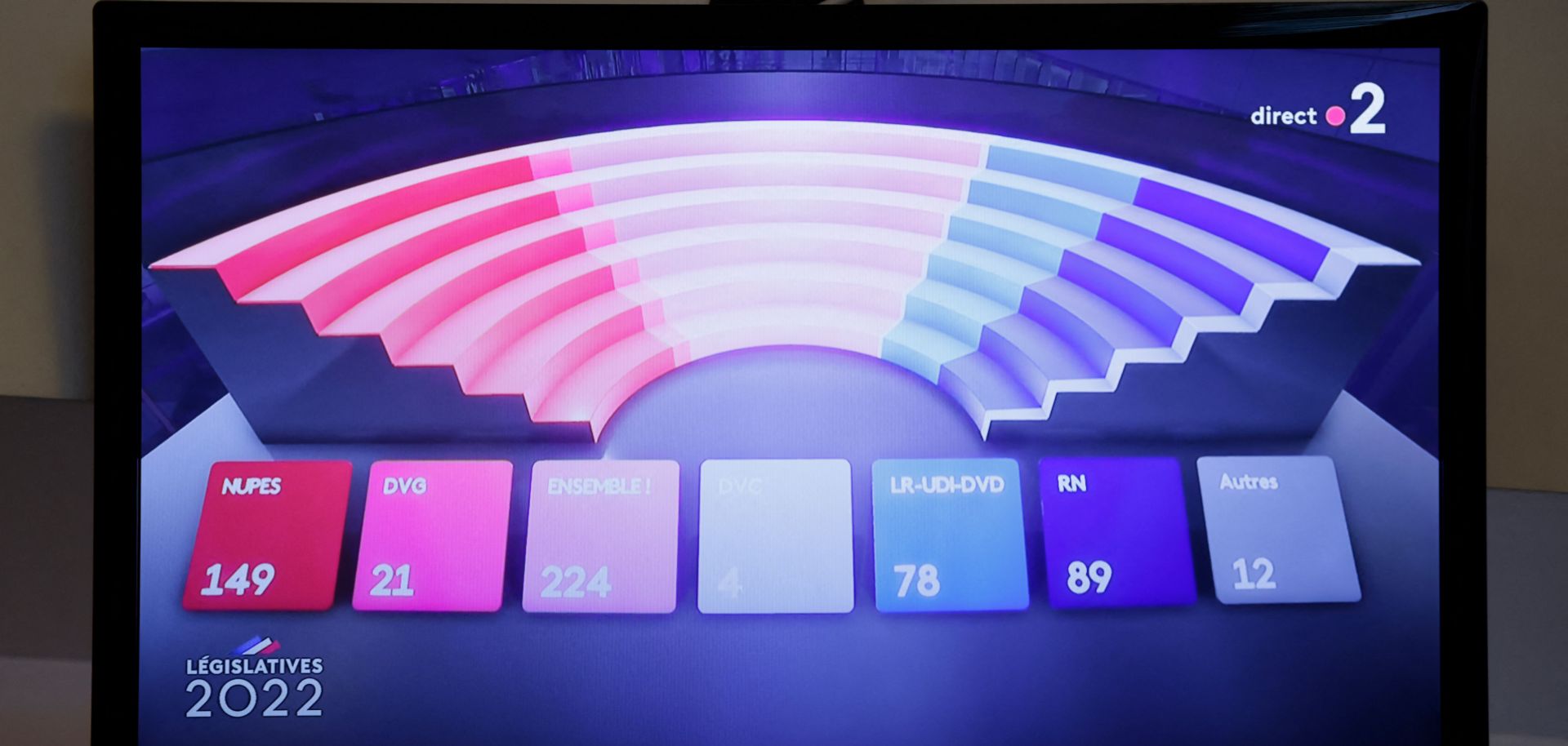
A photograph taken on June 19, 2022, shows a TV screen displaying the first results of the second round of France's parliamentary elections at a hotel in Paris.
French President Emmanuel Macron’s failure to retain control of the National Assembly has triggered a phase of political uncertainty that will impede his reformist agenda, which could, in turn, weaken his foreign policy credibility and slow down France's economic growth. On June 21 and 22, Macron is meeting with representatives from the main political parties in the National Assembly after the second round of legislative elections on June 19 produced a fragmented legislature where no single party controls an absolute majority. Ensemble, the coalition of centrist forces that backs Macron, obtained 244 seats, which is very far from the 289 seats needed to control an absolute majority. Meanwhile, NUPES — a coalition of left-wing forces — won 131 seats while the far-right National Rally won 89 seats.
- France has a semi-presidential system in which presidents are in charge of foreign and security policy and have broad domestic powers. But the National Assembly is at the heart of the legislative process. The parliamentary body also has the power to depose prime ministers and other ministers through motions of confidence, which explains why presidents must appoint prime ministers that have the National Assembly’s support.
Macron will have to negotiate support from the opposition to pass legislation, which is likely to happen on a case-by-case and transactional basis, increasing the possibility of stalled or incoherent policymaking. Members of Ensemble have suggested that they will reach out to members of France’s conservative Republican party, with whom it shares some policy views, to try to form a stable government coalition. But the Republicans are internally divided over the issue, and a formal coalition may not materialize. Without one, Ensemble will have to reach out to different opposition parties depending on the policy issue. Ensemble is likely to rely on the Republicans for business-friendly reforms aimed at reducing red tape and making France more attractive to foreign investors. But in exchange, the Republicans will ask for concessions on issues such as adopting a tougher position on immigration and security. Ensemble, meanwhile, is likely to receive support from some left-wing forces on issues like the energy transition. But this is likely to also come in exchange for additional public spending to help low-income French households cope with the country’s current cost of living crisis. Making concessions to the right and the left is likely to result in a weak government that struggles to keep a coherent policy trajectory as it constantly seeks to overcome roadblocks from both camps.
- On June 21, Christian Jacob, the head of the Republicans, said his party will not enter a formal coalition government with Ensemble. While this could be a negotiation tactic to secure prominent positions in a future government, it also shows that it will be hard for Ensemble to even reach deals with forces that are ideologically similar.
- The opposition has enough seats in the National Assembly to trigger no-confidence motions against the French government. Already, members of La France Insoumise — one of the members of NUPES — have threatened to hold a vote of no confidence against Macron’s prime minister Elisabeth Borne when she presents her government program on July 5. Even if the government survives these votes because of discrepancies between opposition parties, the constant threats will consume Ensemble’s time and energy and derail the legislative process.
- The opposition will also have the power to launch parliamentary investigations and take bills to the constitutional court, which could delay or even block the legislative process.
- If the political paralysis becomes unsustainable, Macron has the power to dissolve the National Assembly and hold an early legislative election. However, an early vote (especially if it happens too soon after the June elections) would not necessarily guarantee a better performance by Ensemble.
Many of the concessions are likely to involve increasing public spending on issues that are dear to the right and the left, which will undermine investor confidence as France struggles to reduce its fiscal deficit and lower its growing debt burden. Among other compromises, Macron will likely have to significantly water down, or even abandon, a plan to make France’s pension system more sustainable by raising the retirement age and eliminating special benefits for some professions, which could raise concerns among foreign investors about Paris’ commitment to budgetary discipline. France’s debt-to-GDP ratio, which was around 98% before the COVID-19 pandemic, jumped to around 115% by 2022. France’s fiscal deficit, meanwhile, is currently around 7% of GDP. Adding to these pressures, the European Central Bank’s upcoming interest rate hikes and the phasing out of bond-purchasing programs will likely result in higher borrowing costs for most eurozone countries, including France. Investor uncertainty about the French government’s plans to reduce its debt burden and keep a balanced fiscal deficit would result in higher borrowing costs. In a low probability but high impact scenario, this could trigger a debt crisis in France, especially if there is also a debt crisis in other eurozone countries like Italy or Spain.
Domestic problems could force Macron to increase his focus on internal affairs; insufficient political support at home could also reduce his foreign policy’s credibility abroad. While Macron will remain in charge of France’s foreign policy, the fragmentation of the National Assembly will consume his time and energy, which could take both away from his foreign policy agenda. Moreover, Macron’s credibility abroad will be weaker when it comes to issues that require votes in the National Assembly (such as the ratification of free trade agreements or the enlargement of the European Union or NATO) because the president will no longer be in a position to guarantee them. Finally, as a part of his constant negotiations with the right and the left, Macron will have to factor in the interest of political forces that range from mild euroskepticism (as is the case with the Republicans) to outright hostility vis-a-vis NATO and the European Union (as is the case with the National Rally and some members of NUPES).
