
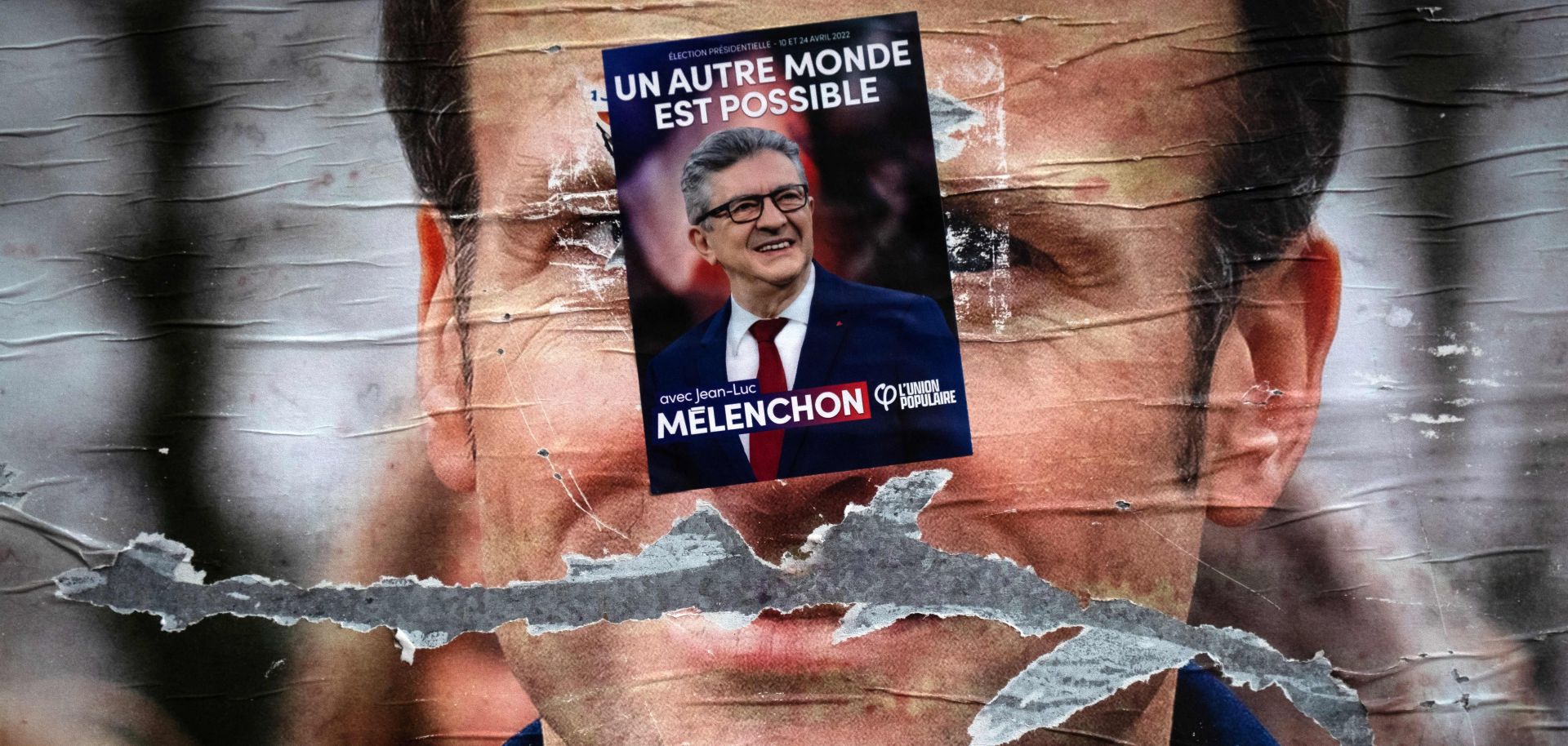
A campaign flyer reading "another world is possible" in support of far-left presidential candidate Jean-Luc Melenchon covers a vandalized poster of French President Emmanuel Macron in Paris, France, on April 19, 2022. Melechon lost the presidential election, but he may be elected prime minister if his opposition alliance takes control of France’s National Assembly.
The coalition behind President Emmanuel Macron is expected to remain the main force in the French National Assembly in upcoming legislative elections, but on the off chance a far-left coalition takes control, it would challenge Macron's ability to implement reforms at home and weaken his influence abroad. France will hold elections to appoint the 577 members of its National Assembly on June 12. In the constituencies where no candidate receives an absolute majority and a vote equal to 25% of the registered electorate, a runoff election will take place on June 19 between the candidates that received at least 12.5% of the votes. The legislative elections will take place shortly after the presidential election in April, where the incumbent centrist Emmanuel Macron secured a second five-year term after defeating far-right leader Marine Le Pen. Opinion polls suggest that the alliance of centrist political parties that back Macron will remain the largest group in the National Assembly, which would ensure political continuity and enable the president to move forward with his policy agenda. However, the possibility of the left-wing opposition controlling the lower chamber of parliament and disrupting Macron’s plans cannot be ruled out.
- According to opinion polls, the New Ecologic and Social People's Union (NUPES), an alliance of left-wing and environmentalist political parties led by former far-left presidential candidate Jean-Luc Melenchon, is polling at 24-26%. Meanwhile, President Macron’s Ensemble Citoyens alliance of centrist and conservative parties is polling at 25-26%. Recent polls suggest that support for NUPES is on the rise, which is probably connected to the rise in the cost of living in France and NUPES’ pledge to increase public support for households.
- France’s two-round voting system means that there is not a direct connection between a party’s national popularity and the number of seats it ends up securing in the National Assembly. An Ifop-Fiducial opinion poll published on June 7 projected that NUPES will obtain between 195 and 230 seats, while Ensemble Citoyens will obtain between 250 and 290 seats. In order to control the National Assembly, a party or coalition needs at least 289 seats.
In the unlikely outcome that the opposition wins control of the National Assembly, Macron's domestic reform agenda will be compromised and severe political paralysis could ensue. The National Assembly is France’s core legislative body, as the Senate has more limited policymaking powers. If Macron’s allies fail to obtain an absolute majority in the National Assembly, it would impede the president’s reform agenda, which includes changes in the pension system to make it more sustainable and policies to deregulate the economy to make it more attractive to foreign investors. Support from the National Assembly is also needed to appoint a prime minister. According to the French constitution, the prime minister focuses primarily on domestic issues while the president’s main role is on foreign policy and national security. When both leaders belong to the same political alliance (as has been the case for the past two decades), the prime minister tends to take a backseat to the president, who becomes the central figure in both domestic and foreign policy. Should NUPES take control of the National Assembly and elect a prime minister, the bloc is likely to clash with Macron, severely disrupting the domestic policymaking process — especially if NUPES elects Melenchon, whose left-wing, pro-state intervention and euroskeptic views contrast sharply with Macron’s deregulation and pro-EU views. Alternatively, Macron’s allies could secure a simple majority of seats in the National Assembly but need support from smaller parties to reach an absolute majority. This would force Macron’s allies to negotiate legislation with the opposition (most likely with the center-right Republican Party), The risk of political paralysis, however, would be much weaker than in the case of NUPES controlling an absolute majority, as there would be some degree of policy consensus between Ensemble Citoyens and the Republican Party.
- While Macron selects the prime minister, he cannot dismiss his designee. Moreover, the National Assembly must still ratify the president’s nomination. Should NUPES win control of the National Assembly, Macron will thus have little choice but to appoint a prime minister that NUPES backs. Macron has said he will not nominate Melenchon for the position, which could create a constitutional crisis.
- France’s president has the power to suspend the implementation of laws passed by the National Assembly and request another reading, but can do this only once per law. Should NUPES control the National Assembly, this means Macron would only be able to delay, but not block, legislation he opposes.
- The French constitution also gives the president the power to bypass the parliament, but only during extraordinary circumstances (for example, during a severe security or health crisis) and for a limited period. Should Macron try to use this power to pass regular domestic policy, the decision could be legally challenged and overturned by a court.
- The president has the power to dissolve the National Assembly as well. This means that in the case of a prolonged political paralysis due to clashes between Macron, the National Assembly and the prime minister, Macron would have the option of dissolving the National Assembly and holding an early legislative election. But this course of action would not necessarily result in Macron’s allies winning the legislative election, which could prolong the political stalemate.
A NUPES-controlled National Assembly would weaken Macron’s influence over global affairs, including EU reforms and the war in Ukraine. In theory, an opposition-controlled National Assembly should not interfere with France’s foreign and security policy, as both are within the president’s prerogatives. Regardless of the outcome of the upcoming election, Macron will still be able to decide policy on issues such as EU sanctions against Russia or France’s relations with the United States and China. Moreover, while some of the members of the NUPES alliance support drastic foreign policy changes, such as taking France out of NATO, control of the National Assembly would not give them the power to unilaterally make such changes. However, an opposition-controlled National Assembly would still impact France’s foreign policy. For one, it would force President Macron to consume significant time and energy on domestic affairs, taking both away from foreign policy decisions. But more importantly, it would weaken France’s credibility when it comes to implementing foreign commitments at home. Many EU decisions (on issues ranging from energy to taxation) require member states to implement policy domestically, which would become much more difficult with a rebel National Assembly.
- While Melenchon is critical of France’s membership in NATO and the European Union, some of the members of his NUPES alliance (such as the Socialist Party) support both entities. This has forced Melenchon to tone down his rhetoric and suggests that a serious move to exit either bloc is unlikely, even if NUPES somehow pulls off a massive victory in the upcoming election.
- A NUPES victory could, however, weaken market confidence in France’s ability to reduce its debt burden and cut down its fiscal deficit, as the alliance is campaigning on the promise of significant increases in welfare spending to cope with the cost of living crisis in the country. Among other things, NUPES supports lowering France’s retirement age, increasing taxes for large multinationals, increasing the minimum wage and creating a “regulated and supervised” economy, as well as reintroducing a wealth tax that Macron scrapped during his first presidential term.
