
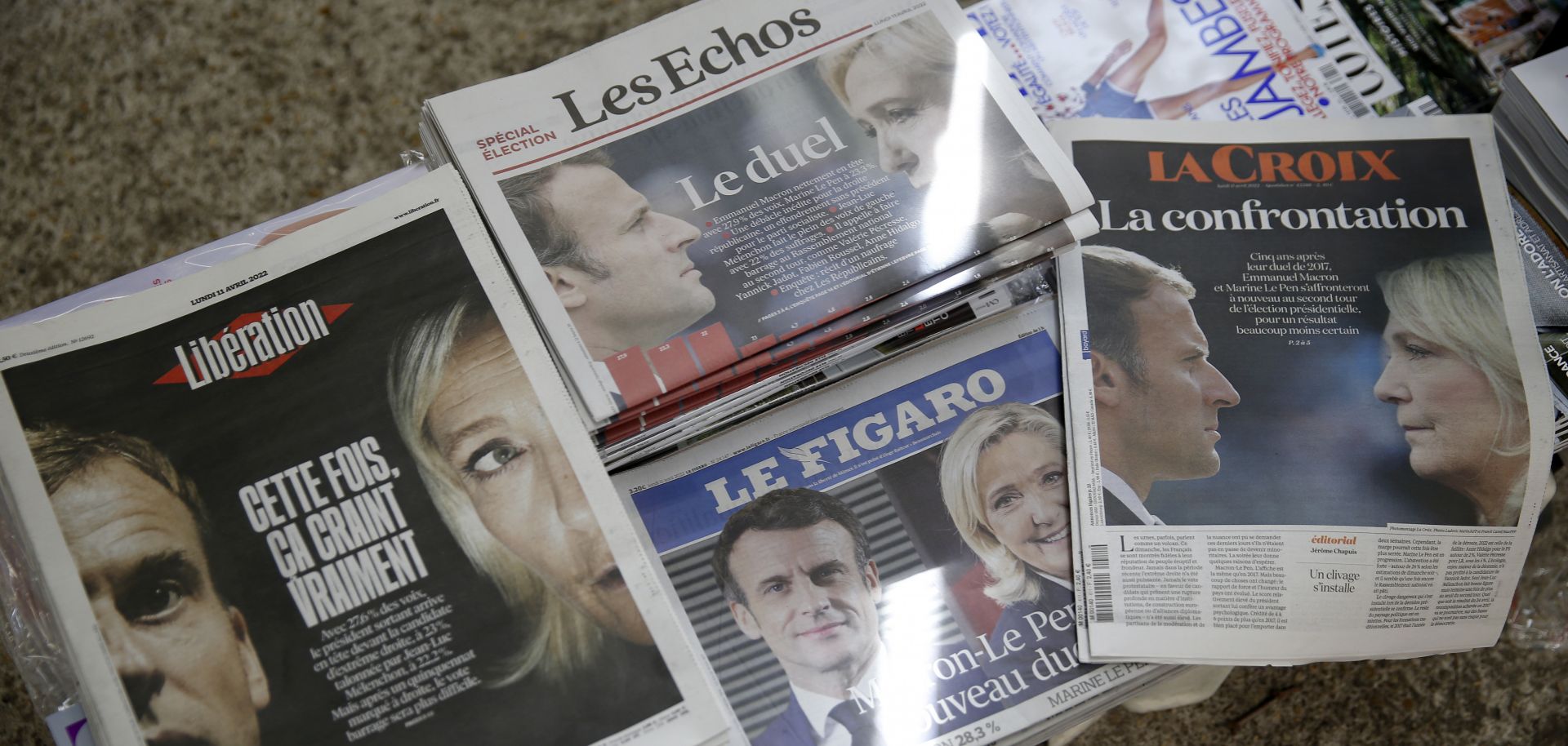
Photos of French President Emmanuel Macron and right-wing candidate Marine Le Pen are displayed on the front pages of French newspapers at a newsstand in Paris on April 11, 2022, after Macron and Le Pen won the most and second-most votes, respectively, in the first round of France's presidential election.
After the first round of France's presidential race, Emmanuel Macron's reelection is the most likely scenario, which would ensure domestic and foreign policy continuity. However, a disruptive far-right victory is still possible and the results demonstrate growing polarization that will complicate future governing. Centrist incumbent candidate Macron received 27.8% of the vote in the first round of France's presidential election on April 10, followed by right-wing candidate Marine Le Pen with 23.1%. The two candidates will face each other in a runoff election on April 24. Far-left candidate Jean-Luc Melenchon, meanwhile, came in third place with 22.2% of the vote, followed by far-right candidate Eric Zemmour with 7.1%. After the election, the conservative candidate Valerie Pecresse (4.8%), the green candidate Yannick Jadot (4.6%) and the socialist candidate Anne Hidalgo (1.7%) all called for their supporters to vote for Macron in the runoff election. Melenchon asked his supporters not to vote for Le Pen, without offering explicit support for Macron, while Zemmour said he will vote for Le Pen.
- The April 10 election showed that France's traditional conservative and progressive parties (Les Republicains and the Socialist Party, respectively) are on the brink of disappearing, as a significant number of voters opted for far-right and far-left options. This confirms the growing polarization of the French electorate, which will make it difficult for the country to reach a national consensus on structural reforms, such as reforming the pensions system.
- About a quarter of the electorate did not cast a ballot in the election. This relatively low turnout also shows that a significant number of French voters are disenchanted with the current political options, which could see the emergence of even more radicalized parties in the future.
While polls suggest that Macron will win the April 24 election, a victory by Le Pen cannot be ruled out. Macron already faced Le Pen in the runoff of the 2017 presidential election. However, while he won that runoff election with 66% of the vote, current polls suggest that this upcoming election will be much narrower. In fact, some surveys have Macron winning by only 51%, while even the most optimistic put him at only 54%. In the next two weeks, Macron and Le Pen will compete for people who voted for Melenchon in the first round. While Le Pen is very unpopular among most of the far-left voters who supported Melenchon, many also dislike Macron, which means that a significant number of them could abstain from voting altogether. On April 20, Macron and Le Pen will hold a televised debate that could prove crucial for the election. In fact, Le Pen's poor performance against Macron in a debate before the 2017 presidential runoff is one of the reasons she lost the election by such a wide margin.
A Le Pen victory would disrupt the policymaking process in the European Union and increase uncertainty about the future of the eurozone. Should he win a second term, Macron would maintain France's prominent role in the European Union and preserve close cooperation with Germany while also keeping France fully integrated with NATO. A second Macron presidency is likely to combine high levels of public spending to cope with the rising cost of living and to increase France's self-sufficiency in areas such as energy and manufacturing with an attempt to deregulate the French economy to make it more attractive to foreign investors. A Le Pen presidency, by contrast, would severely disrupt the functioning of both the European Union and NATO. Unlike her 2017 presidential campaign, Le Pen has stepped back from calling for France to outright exit the European Union. Her current campaign has, however, included promises to reduce France's financial contributions to the European Union and reintroduce border and customs controls, which would still greatly impede the functioning of the EU internal market and the passport-free Schengen zone. She has also promised to remove France from NATO's command structures, which would weaken the military alliance at a time of high global tensions. A Le Pen victory would also increase financial uncertainty in the European Union, as the future of the eurozone would be put into question.
- After the April 24 runoff presidential election, France will hold an election in June to appoint the members of the National Assembly, the lower house of the French Parliament. The legislative election, which will also be held in two rounds, will be crucial for the appointment of France's next prime minister (who shares some executive powers with the president), as well as for the new government's ability to pass legislation. Whichever party wins the French presidential election usually goes on to win the National Assembly election since the two votes are held so close together. However, should the presidency and the lower house of parliament fall under the control of different parties, it could severely disrupt the policymaking process in France, as the presidential administration and the National Assembly could try to block each other's policies.
