
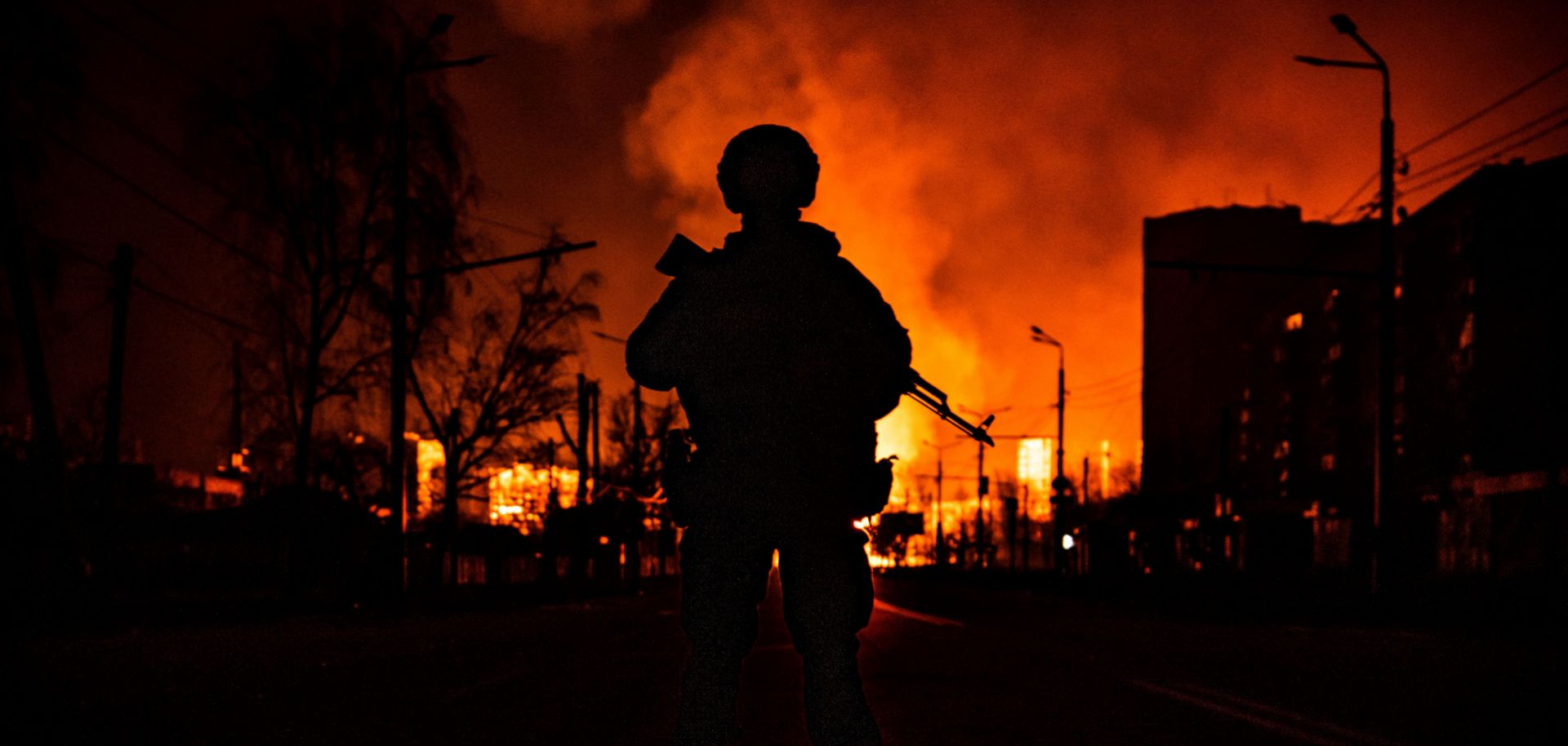
A Ukrainian soldier’s silhouette is seen in Kharkiv on March 30, 2022, as a gas station burns behind him after Russian attacks on the city.
Choosing the top five most geopolitically significant events of 2022 is no easy feat. Russia’s (re)invasion of Ukraine clearly stands at the top of the list for the myriad of immediate and lingering implications, though events in and of themselves are rarely as significant as the broader trends and shifts they reflect.
That is why, in compiling the below list, we focused on the events over the past year that had the furthest-reaching impacts (both geographically and temporally) and/or represented key shifts in greater global patterns. There were, of course, numerous “honorable mentions,” but we were ultimately able to narrow it down to these final five:
The Most Geopolitically Significant Events of 2022
5) The Artemis I Mission (Nov. 16-Dec 11, 2022)
NASA successfully launched the Artemis I rocket on Nov. 16, sending an uncrewed Orion space capsule to the moon that returned to Earth on Dec. 11. The mission was the first major launch under NASA’s Artemis lunar exploration program, which aims to send astronauts back to the moon by 2025. The Artemis program represents a revival of the global space race, as well as the United States’ attempt to shape the future norms and governance of lunar and extra-terrestrial exploration and exploitation. The race to return to the moon has been underway for several years, drawing both nation-states and private industry into a mix of cooperative and competitive initiatives that go far beyond simply landing a person on the lunar surface for the first time since 1972. The next space race is looking at lunar orbital space stations that can facilitate lunar exploration and a potential staging point for future manned Mars missions. It’s also looking at lunar and asteroid resource exploitation, space-based manufacturing and biomedical engineering, and (less publicly) the increasingly important role of space in national security. The expansion of the private space industry is granting numerous new players access to the final frontier by making it cheaper and easier to venture beyond Earth's atmosphere. But while we may have “slipped the surly bonds of Earth” (to quote the 1940 poem penned by the Canadian airforce pilot John Gillespie Magee), we have not slipped the bonds of terrestrial politics and international relations — making an update to the 1967 Outer Space Treaty all the more important. As space becomes more crowded with geopolitical rivals and new entrants, it will not only drive technological breakthroughs and competition, but challenge global governance models.
4) Russia and Ukraine Sign Turkish-Brokered Grain Deal (July 22, 2022)
Turkey’s brokering of the grain export deal between Russia and Ukraine over the summer eased a major constraint on global food security instigated by the war in Ukraine. But it also highlighted Turkey’s expanding role as an activist middle power, as Ankara pursues its own interests and exploits new opportunities provided by the return to a multipolar world. Over the past few years, Turkey has intervened in the Caucasus (largely replacing Russia as the primary foreign influencer), continued to assert its interests (militarily) in Iraq and Syria, stepped up its involvement in the Eastern Mediterranean, threatened to hold up NATO expansion, and integrated Russian-made air defense systems while still retaining its military ties to Europe and the United States. Ankara has also sold armed drones to Ukraine and promoted the trans-Caspian route as an alternative for China’s Belt and Road Initiative after the Russian invasion of Ukraine threatened the transit corridors through Russia and Belarus. In addition, Turkey has managed to simultaneously work with (and frequently against) the United States, Russia, China and Europe, all while asserting itself as an important regional power. Turkey’s actions highlight how middle powers are navigating the gaps and seams between the big powers to better position themselves and secure their own interests in an increasingly multipolar world system. Indeed, Indonesia, Brazil, Poland, Japan and India have also started taking a more active role within their regions and beyond in an effort to insulate themselves against big power coercion and mounting pressure from China, Russia, the United States and the European Union to pick a side.
3) Eurozone Inflation Reaches 10.7% (October 2022)
European inflation rates continued to climb in 2022, driven by post-COVID-19 supply chain disruptions amid uneven economic openings, and exacerbated by additional disruptions following Russia’s invasion of Ukraine and constraints on Russian energy imports. While Europe’s programs to buy liquified natural gas (LNG) and delay the shuttering of hydrocarbon-powered energy plants have likely ensured energy supplies through the winter, these programs came at a cost; high food, fuel and commodity prices, as well as government actions to manage fuel supplies, reinforced European deindustrialization trends and contributed to rising political nationalism that has seen the European Union compromise on its "strategic autonomy" and accept more national and regional protectionist measures. Across the Atlantic Ocean, the United States’ Inflation Reduction Act — an amalgam of legislation aimed at responding to rising costs, national supply chain security and climate issues — highlighted the potential impact of protectionist policies even on allies, raising challenges from Europe and South Korea, among others. Globally, U.S. interest rates and localized political instability have seen many national currencies fall against the U.S. dollar, raising the risk of future debt crises in several developing (and even a few developed) nations, all while China’s uneven COVID-19 recovery suggests Beijing may be less than generous with its own outbound foreign assistance through at least 2023.
2) Chinese Military Exercises Around Taiwan (Aug. 4-9, 2022)
In response to U.S. House Speaker Nancy Pelosi’s Aug. 2-3 visit to Taiwan, China held two consecutive sets of military exercises around the island, including live-fire exercises at multiple locations, ballistic missile tests, numerous aerial incursions across the Taiwan Strait median line, and anti-submarine and "sea assault" operations. The exercises marked a significant escalation from Beijing’s typical responses to what it portrays as political provocations by Taipei and Washington, and in doing so set a new baseline for future coercive responses. China’s actions accelerated regional security cooperation trends, with the Philippines approving new U.S. military facilities under the Enhanced Defense Cooperation Agreement and stepping up military exchanges with Japan, South Korea and Japan increasing defense cooperation dialogue, Australia reemerging as a key regional defense actor, and European countries committing to additional regional maritime patrols. In response to the Chinese exercises, several other countries also sent political representatives to Taiwan, blunting Beijing’s political message. Additionally, Washington agreed to increase key arms sales to Taiwan, and U.S. President Joe Biden, while claiming no change to U.S. policy, said the United States would intervene in a Chinese invasion of Taiwan. Beijing's military exercises also motivated the United States and other nations to accelerate their partial decoupling of key technologies and supply chain connections from mainland China.
1) Russia Announces 'Special Military Operation' and Invades Western Ukraine (Feb. 24, 2022)
The Russian invasion of Ukraine was the most geopolitically significant event of the year, raising the specter of nuclear war, driving NATO expansion, testing the continuity of global norms and European unity, and impacting energy prices and food security well beyond 2022. Russia’s poor performance revealed an underlying weakness that leaves the country vulnerable to its neighbors, particularly Turkey and China. Finland and Sweden, long holdouts of integrated security, applied for NATO membership, expanding NATO’s northern flank and perhaps solidifying a split in post-Cold War cooperative Arctic governance. Western European countries reinvigorated defense spending and cooperation, driving greater interest in both NATO and European defense concepts, though their debates also highlight differences between the states on the Russian frontier, which prefer NATO, and those in Western Europe. Global response to the war also highlighted the realities of multipolarity, as the United States and its key European partners were unable to garner universal cooperation to economically counteract Russia, at times even from key partners like India and Hungary. Europe’s energy dependence on Moscow triggered a rapid shift in European energy supplies and future plans, altering the infrastructure and future of energy imports, delaying some green energy goals, and expanding LNG supply chains. The war also revealed strains in the Russia-China relationship, and Moscow’s battlefield setbacks, coupled with strong Western economic counters, may push Russia to become increasingly dependent on China. And mere months after the five permanent members of the U.N. Security Council signed a new statement on the prevention of nuclear war and arms races, Moscow’s less-than-subtle threats reopened the prospect of the use of nuclear weapons. These threats placed U.S. nuclear forces on their highest level of alert in decades and strengthened the perception in many non-nuclear states that nuclear weapons may be a necessary deterrent, as fear of expanded nuclear conflict appears to have limited Europe's and the United States' willingness to fully counter Russia’s actions in Ukraine. The revival of attention to nuclear security has only been compounded by China’s recent nuclear "breakout" and the challenges facing future arms control regimes that must take into account three, rather than two, major nuclear powers.
