
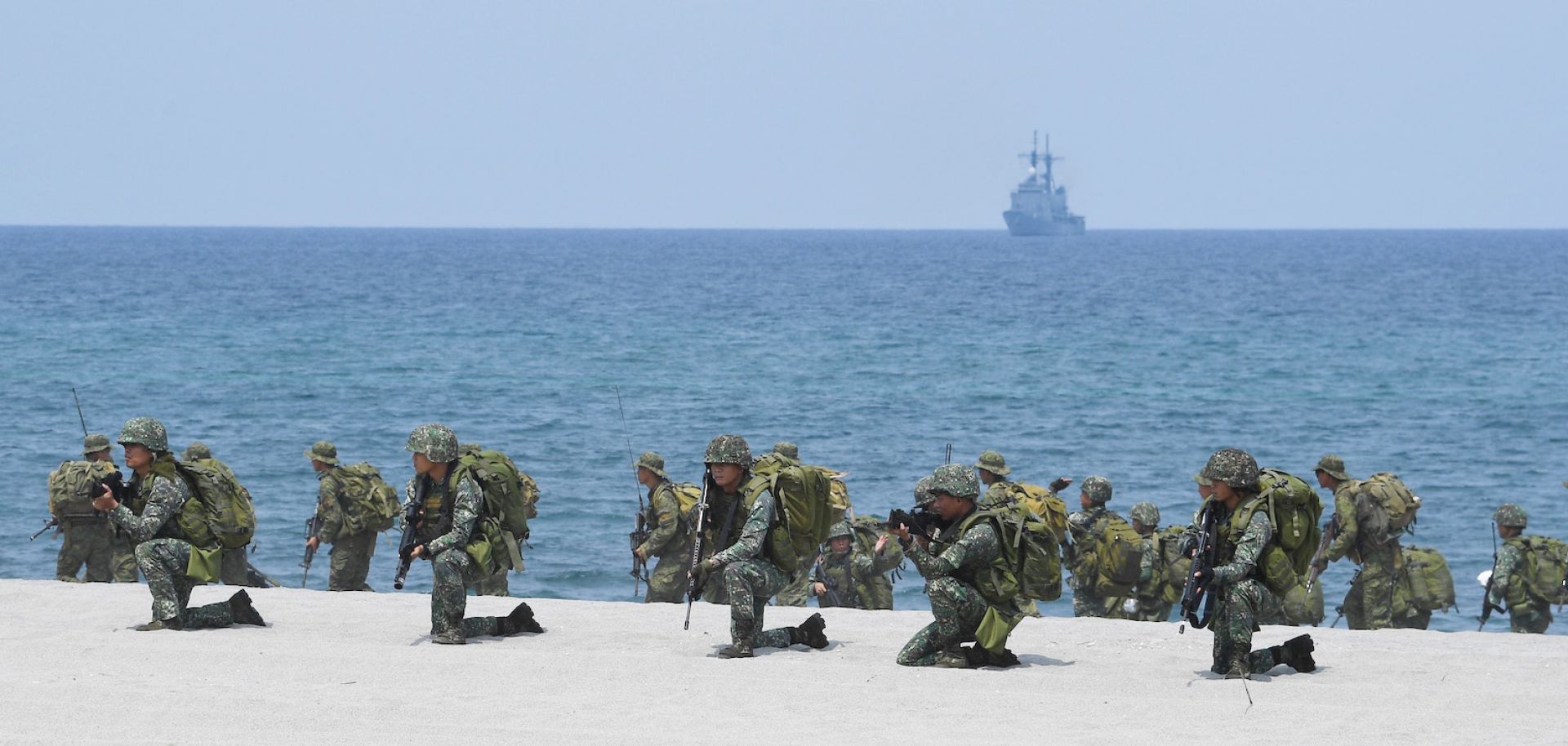
Philippine marines take part in a joint military exercise with their U.S. counterparts at a training camp northwest of Manila in May 2018.
The Philippines' ongoing rapprochement with the United States provides clarity as to Manila's foreign policy but also exposes the country to a combination of threats and offers from China. On Nov. 8, the Philippines' Department of National Defense announced plans to work closely with the United States to accelerate projects under the two countries' Enhanced Defense Cooperation Agreement (EDCA), which allows the United States to constantly rotate troops in the Philippines, use Philippine bases for prolonged stays, and build and operate facilities in-country with its own personnel. As part of this renewed cooperation under the EDCA, the Philippines' Department of National Defense announced that it would upgrade and repair the five military bases that the United States maintains in the Philippines under the agreement while ''exploring new locations [for additional military bases] that will build a more credible mutual defense posture.'' The full implementation of the EDCA would imply de facto permanent basing of U.S. troops in the Philippines, representing a notable shift in Manila's foreign policy and military stance since the beginning of former Philippine President Rodrigo Duterte's 2016-2022 term. Also on Nov. 8, Philippine President Ferdinand Marcos Jr. pledged to modernize the country's armed forces to be ''ready for all eventualities,'' including territorial defense, an indirect reference to potential conflict with China in the disputed South China Sea or over neighboring Taiwan.
- The Philippines and the United States signed the EDCA in 2014, but the agreement stalled under Duterte. It expands the longstanding 1999 Visiting Forces Agreement under the U.S.-Philippine 1951 Mutual Defense Treaty.
- To enhance interoperability, Manila has agreed to as many as 500 joint military exercises scheduled for 2023, up from 300 this year. In recent years, U.S. allies Japan, South Korea and Australia have participated as observers in the Balikatan, Salaknib and Kamandag wargame exercises. Japan is likewise exploring signing a Visiting Forces Agreement with the Philippines.
- The Philippines has not hosted permanent U.S. bases since Clark Air Base and Subic Bay Naval Base closed in 1991 and 1992, respectively. But there were extended U.S. deployments in the country from 2002-2007 as part of Washington's war on terrorism.
The Philippines has gradually realigned its security interests with those of the United States because of stalled progress on the South China Sea dispute and unrelenting Chinese incursions. While former President Duterte was vocally pro-China and anti-United States, China's underdelivered promises on initiatives crucial to his domestic agenda, as well as heightened Chinese aggression, forced Duterte to reassess his foreign policy in July 2020. From then on, he slowly tilted back toward Washington and started exerting a more proactive policy with respect to the country's maritime claims. Before Marcos assumed office in June 2022, the United States was unsure of his position toward China, but he has continued Duterte's trajectory by taking a less accommodating foreign policy position toward China, describing their maritime dispute in the South China Sea as ''China claiming territory that belongs to the Philippines'' and making reference to the country's ''American partners'' who share and promote the same view.
- Hundreds of Chinese maritime militia vessels unceasingly operate in the disputed South China Sea daily, and the Philippines has filed 405 diplomatic complaints about Chinese incursions in its claimed waters since 2020.
- On July 25, Marcos vowed to not give up ''even one square inch of territory to foreign powers'' before legislators.
- On Sept. 6, the Philippine ambassador to the United States said the Philippines would let U.S. forces use the country's military bases in the event of a U.S.-China conflict over Taiwan if doing so benefited the Philippines' own security.
- On Sept. 23, Marcos and U.S. President Joe Biden met on the sidelines of the United Nations General Assembly, where Marcos sought deeper security collaboration with the United States. This was followed by a Sept. 29 meeting between defense chiefs to discuss implementing the EDCA.
- On Oct. 26, the Philippines' Foreign Secretary Enrique Manalo said his country is counting on the United States to defend its sovereign rights, and a senior U.S. defense official revealed the next day that U.S.-operated EDCA sites in the Philippines will expand from five to ten, pending approval from the country's foreign and defense ministries.
The Philippines' decision to ensconce itself in U.S. security architecture exposes the country to security risks, particularly in the case of a conflict with China. The EDCA is an executive agreement without senate ratification, which means Marcos could rescind it on his own. The unilateral decision to reverse eight years of stalling the 2014 pact is thus intended to rapidly boost the Philippines' security collaboration with the United States. This is particularly provocative as some of the existing and potential bases are located in areas optimized to contain Chinese naval power. The Philippines is also reinforcing its status as the United States' most deeply entrenched security partner in Southeast Asia. In the case of an eventual U.S.-China conflict over Taiwan, China's People's Liberation Army would likely prioritize targeting U.S. regional bases — including those in the Philippines. Though intended to serve as a deterrent, de facto permanent U.S. basing in the Philippines could thus have the opposite effect. The Philippines' role in U.S. plans to defend Taiwan — along with its position near the southernmost point of the first island chain — further risks making the Philippines a target of Chinese attacks in the case of a greater U.S.-China conflict over the island.
- Several existing and potential EDCA bases are strategically positioned to target China: Basa Air Base and Antonio Bautista Air Base face the contested South China Sea; potential sites in the northernmost Mavulis and Fuga Islands face Taiwan, with Mavulis less than 90 miles away.
- The ''first island chain'' — a term coined to reflect U.S. Cold War defense doctrine in 1951 — runs from the Russian Kamchatka Peninsula to the Malay Peninsula. Taiwan is a major link in the chain. Restricting Chinese naval power within this region is a critical element of the United States' containment strategy.
China will likely use a combination of economic incentives and threats to deter the Philippines from further strengthening its relations with the United States. Despite the Philippines' decision to move closer to the United States, deep economic cooperation with China leaves the door open for further balancing initiatives. Having possibly achieved some security leverage, the Philippines may use the U.S.-China competition to play one against the other and could offer to reduce U.S. security ties in exchange for economic considerations. But Marcos has pledged to keep South China Sea issues central to his administration's foreign policy, likely portending a continued stalemate on the issue and indicating that security will remain a top priority. Economic issues such as fishing and joint oil and gas exploration in the disputed maritime region will likely still drive Beijing's response and Manila's calibrations going forward. Beijing may feel inclined to deny Manila favorable provisions on these issues to pressure the Marcos administration to disentangle from U.S. security architecture. But China and the Philippines will likely maintain their mutually beneficial economic and infrastructure projects, such as an October agreement to tighten semiconductor supply chains by building corresponding industrial parks in each country. Beijing cannot afford to abandon Manila because it is a valuable trade partner — especially as China looks to broadly insulate its economy from the West and compete for strategic influence in the first island chain. The Philippines, for its part, also cannot afford to lose out on key infrastructure projects.
- China is financing up to 90% of the Philippines' $350 million Samal Island-Davao City bridge project.
- In early January, Marcos will visit Beijing to meet with Chinese President Xi Jinping at China's request.
