
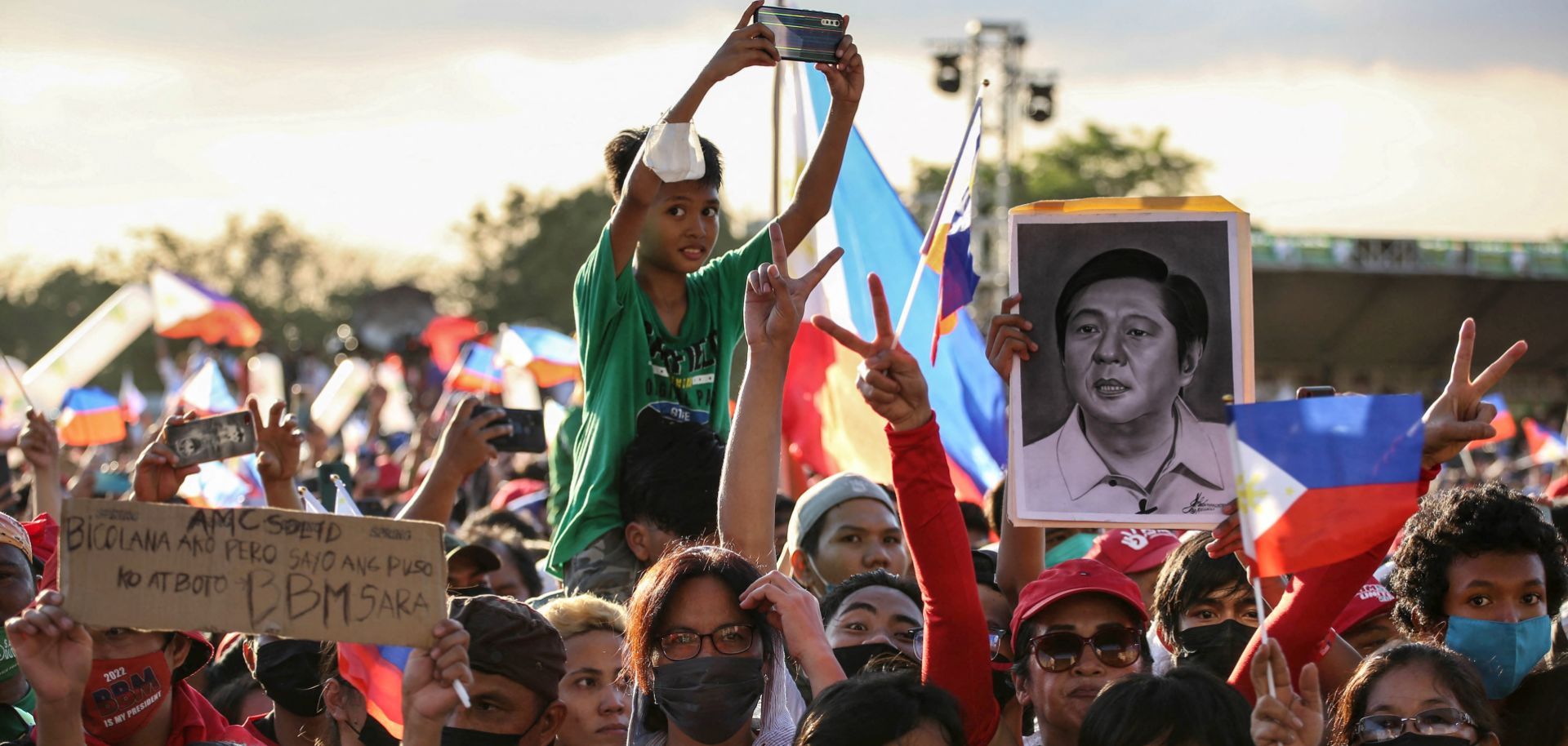
Supporters of Philippine presidential candidate Ferdinand Marcos Jr., son of the country's late dictator, attend a campaign rally in a Manila suburb on April 24, 2022.
Ferdinand Marcos Jr.'s expected victory in the Philippines' upcoming presidential election would result in a significant degree of domestic and foreign policy continuity. A surprise victory by his main rival, however, could see Manila develop closer ties with the United States and a more hawkish stance on China. The Philippines will hold a general election on May 9. Ferdinand Marcos Jr. — the son of the country's late dictator Ferdinand Marcos Sr. — is the leading candidate. Marcos Jr. is running for president in an alliance with current Philippine President Rodrigo Duterte's daughter, Sarah Duterte, who is running in a separate election for vice president. The country's current vice president, Maria Leonor ''Leni'' Robredo, is also a contender for the presidency, along with Senator Manny Pacquiao and Manila Mayor Isko Moreno. Stagnant wage growth, rising inflation, government corruption, the future of Duterte's current war on drugs, and the Phillippines' post-COVID economic recovery are of most concern to Philippine voters, and have thus been at the core of presidential candidates' campaign platforms. Foreign policy issues, meanwhile — namely how the next president will handle China's increasingly aggressive maritime activity — have largely taken a backseat to these domestic issues.
- Marcos Jr. is polling at nearly 56%, with Leni Robredo polling at around 25%, followed by Moreno (8.5%) and Pacquiao (7%). In the vice-presidential race, Sarah Duterte is in the lead as well, polling at 55%.
If she wins the presidency, Robredo would likely shift domestic politics away from Duterte's focus on law enforcement, adopt a tougher stance on China and have a warmer attitude towards the United States. Domestically, a Robredo victory would likely limit Duterte's ability to guide domestic policy and play kingmaker in politics. Robredo would likely focus on tackling poverty, healthcare and education, and drug rehabilitation rather than punishment, in addition to combating terrorism. In tackling drug use in the Phillippines, Robredo's approach would likely also focus more on rehabilitation compared with her predecessor's focus on punishment. In regards to foreign policy, Robredo claims she will force Beijing to acknowledge the 2016 U.N. tribunal ruling that rejected China's expansive South China Sea claims under the U.N. Convention on the Law of the Sea (UNCLOS). The Phillippine navy, however, cannot take action against Chinese aggression in the disputed waterway without the backing of the U.S. navy due to the U.S.-Philippine defense pact. This would grant the United States more influence over the Robredo administration compared with the current administration, which may enable Washington to negotiate new defensive agreements with the Philippines to counter Chinese threats in the South China Sea.
- Robredo has been an outspoken opponent of Duterte's war on drugs, and has reiterated that the Philippines needs to focus on drug rehabilitation rather than prosecution.
- Any move by Robredo to ''force'' Beijing to acknowledge the 2016 U.N. ruling upholding the Philippines' South China Sea claims would require firm support from the U.S. military. The Philippine navy has around 24,500 active personnel, 82 combat vessels and 25 aircraft. The Chinese navy, by contrast, has nearly 300,000 active personnel, over 530 combat vessels and nearly 650 aircraft. This mismatch of naval power means the United States would likely be willing to provide such assistance.
If Marcos Jr. wins the election, Duterte's ''tough on crime'' domestic policies would likely remain in place, as would the current administration's more friendly approach to China and cooler attitude toward the United States. A Marcos Jr. victory would very likely maintain Duterte's political influence over new policies, specifically surrounding the war on drugs and the ethnic conflict in Mindanao. In regards to foreign policy, Marcos Jr. has refused to condemn China's maritime activity and South China Sea claims. Instead, he has insisted that the Philippines has a ''good relationship'' with Beijing, despite a lack of Chinese infrastructure investment and carving of Philippine maritime territory. This means that under Marcos Jr., the Philippines would likely maintain the current state of relations with China unless there is a drastic incident that forces his administration's hand. Such warmer relations with China would impede the United States's ability to improve relations with the Philippines, specifically regarding military cooperation.
- When interviewed by CNN in 2021, Marcos Jr. indicated he would continue Duterte's war on drugs with the same vigor, but ''perhaps in a different way,'' which could mean he'd focus more on education surrounding drugs. Additionally, he said he would not help the International Criminal Court investigate accusations of human rights violations in the country.
- During his time as a senator in 2012, Marcos Jr. opposed a bill proposed by then-President Benigno Aquino to create the Bangsamoro Autonomous Region in Muslim Mindanao, claiming certain parts of the legislation were unconstitutional. When interviewed on the subject again in late April, Marcos Jr. said the Philippine government had done everything it could to create peace in Mindanao. This indicates his administration would be unlikely to engage in dialogue with ethnic rebels in the region, which could impede domestic security and stability if tensions flare up and active hostilities restart.
- The Duterte administration's ''good relationship'' with Beijing stems from its refusal to capitalize on the 2016 U.N. ruling rejecting China's South China Sea claims. Duterte had hoped fostering friendlier ties with Beijing would attract Chinese infrastructure investment, though such investment has yet to materialize.
