
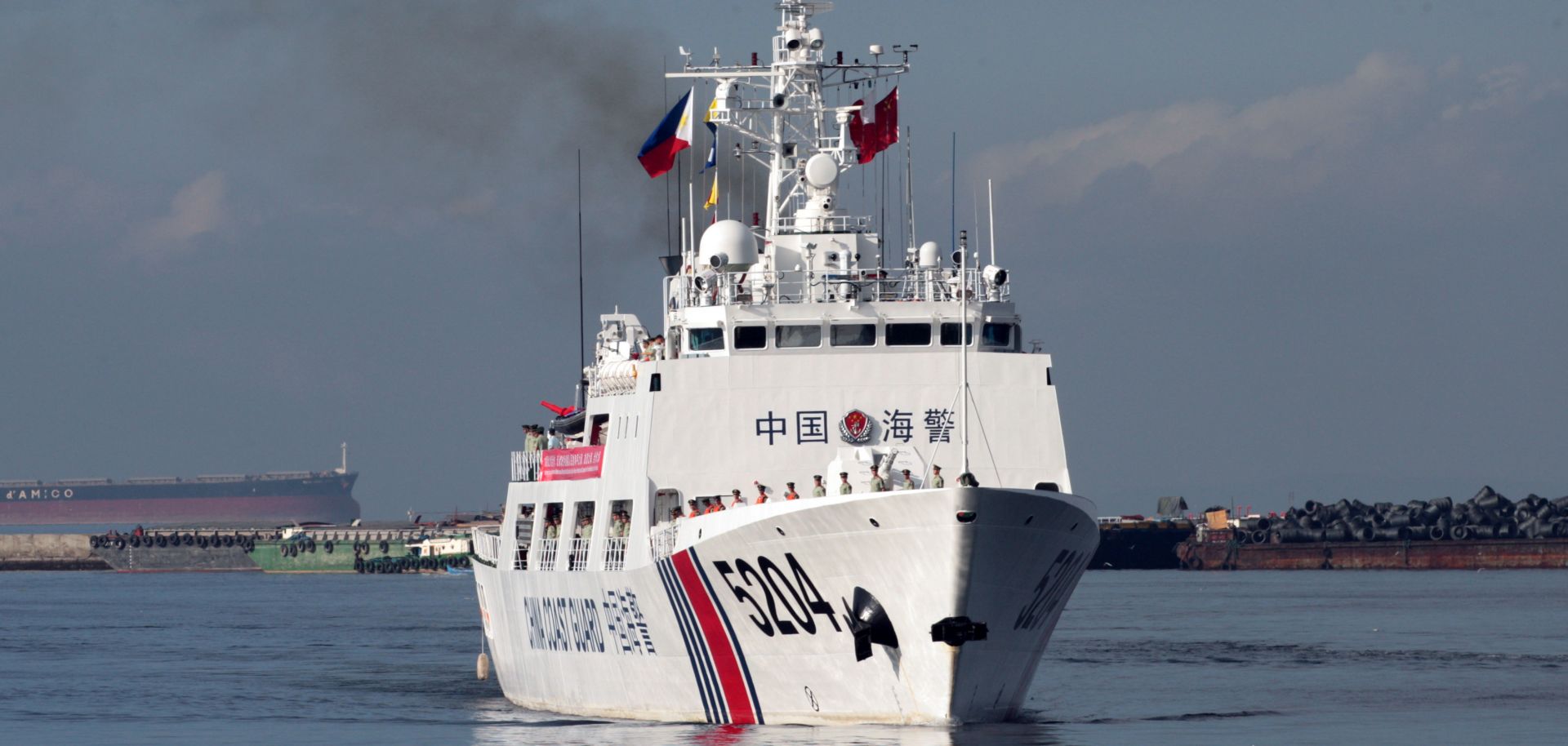
A Chinese coast guard ship prepares to anchor at the Manila port in the Philippines on Jan. 14, 2020.
The latest incident in the South China Sea is reinvigorating attention on the U.S.-Philippine Mutual Defense Treaty (MDT), which pledges U.S. assistance if the Philippines comes under attack, and Washington’s role in the Indo-Pacific. On Nov. 16, three Chinese coast guard ships blocked two Philippine resupply ships from reaching the Philippine-occupied but Chinese-claimed Ayungin Shoal, also known as the Second Thomas Shoal or Renai Jiao, in the South China Sea. The incident comes as the United States and the Philippines are shoring up relations, which have been periodically strained under Philippine President Rodrigo Duterte. It also comes shortly after the declaration of candidates for the Philippine presidential elections, which are scheduled for May 2022. In response to the blocking of the two ships, Philippine officials and politicians — including several of those candidates — asserted that any action against Philippine public vessels falls within the scope of the Mutual Defense Treaty, though most fell short of calling for a U.S. intervention at this time.
- Manila protested the latest Chinese action, which Beijing declared was justified and legal after the Philippine vessels allegedly trespassed Chinese waters.
- The Philippine military has occupied the Ayungin Shoal since intentionally grounding a ship on the reef in 1999 amid an earlier round of competition with China over reefs and islets in the South China Sea.
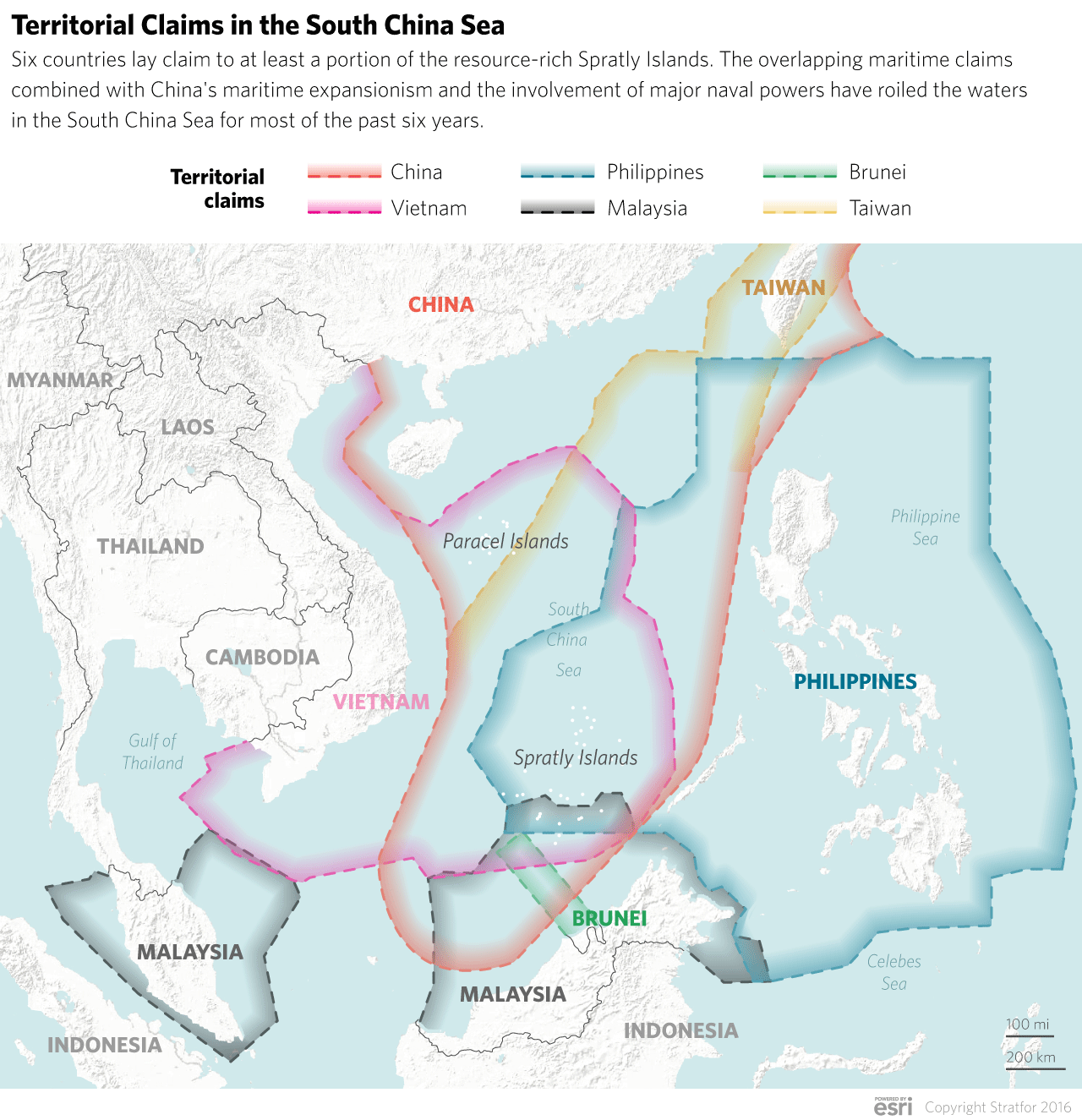
Philippine claims in the South China Sea (or what it calls the West Philippine Sea) were already a key issue ahead of next year’s elections, but this incident appears to ensure Manila’s return to a more assertive policy. During Duterte’s presidency, Manila took a more accommodative approach to China, with the president seeking Chinese investment in return for setting aside disputes in the South China Sea. Duterte also threatened to end the Visiting Forces Agreement with the United States, accusing Washington of failing to defend Philippine interests and of straining Philippine-Chinese relations without providing any benefits to Manila. But the promised China-funded economic development ultimately proved underwhelming, and Beijing never softened its assertive claims in disputed waters. As a result, Manila has started shifting back to a stronger stance against Chinese claims in the South China Sea. In recent months, there has also been a series of U.S.-Philippine dialogues, healing the rift between the treaty allies and reinforcing the value of defense cooperation.
- In 2016, the Permanent Court of Arbitration in The Hague ruled that Chinese claims to the so-called nine-dash line were invalid and that China’s occupation of reefs and islets in the South China Sea did not give Beijing territorial waters. The ruling was seen as a victory for the Philippines, which sought to reverse Chinese occupation and island-building and regain access to key reefs for Philippine fishing vessels.
- Duterte promised to set aside the landmark South China Sea ruling, easing tensions with China. His policies were controversial, particularly as the president often admitted the Philippines had no power to secure its maritime claims in the region — something that appeared an admission of defeat.
- In February, Duterte formally notified the United States of his government’s intention to terminate the Visiting Forces Agreement, which is the framework under which U.S. military personnel operate in the Philippines on a rotational basis, allowing for the implementation of other deals such as the Mutual Defense Treaty. The Philippine government delayed and ultimately rescinded the threat of termination.
With Philippine-U.S. defense relations revived, and Manila reaffirming the MDT, future incidents in the South China Sea could test Washington’s risk tolerance and willingness to confront China more directly in the contested waterway. Philippine officials have said they intend to send coast guard ships and fisheries vessels to escort further resupply runs to Ayungin Shoal. But if China continues to intervene, Manila may call on Washington to intercede. The United States has rarely intervened directly in a standoff between Chinese vessels and those of a U.S. ally or partner, which would be seen as escalating the broader U.S.-China defense competition. However, an activist Indo-Pacific policy, combined with lingering questions of U.S. commitment, may lead to more direct U.S. action in future stand-offs. Washington is likely to use the coast guard initially, as a way to reduce the potential for escalation. But more frequent confrontations will probably eventually force the United States to demonstrate its commitment to its allies, raising the likelihood of a more direct standoff between the U.S. and Chinese navies. This will intensify the need for dialogue with the Chinese to establish de-escalation protocols while increasing the potential for miscalculations or accidents in the near term.
- Over the past three or four years, the United States has affirmed its commitment to backing its allies and partners when challenged, while still claiming it doesn’t pick sides over the disputed islets. This has included new assurances of U.S. support for both Japan over the Senkaku/Diaoyu islands, as well as for the Philippines over disputed reefs in the region.
- Washington’s actions in the South China Sea have so far primarily been through statements and joint maritime training. The United States has also routinely conducted so-called Freedom of Navigation Operations (FONOPs) in the South China Sea over the past decade, with U.S. Navy vessels sailing through waters the United States asserts are international, despite Chinese claims to sovereignty.
