
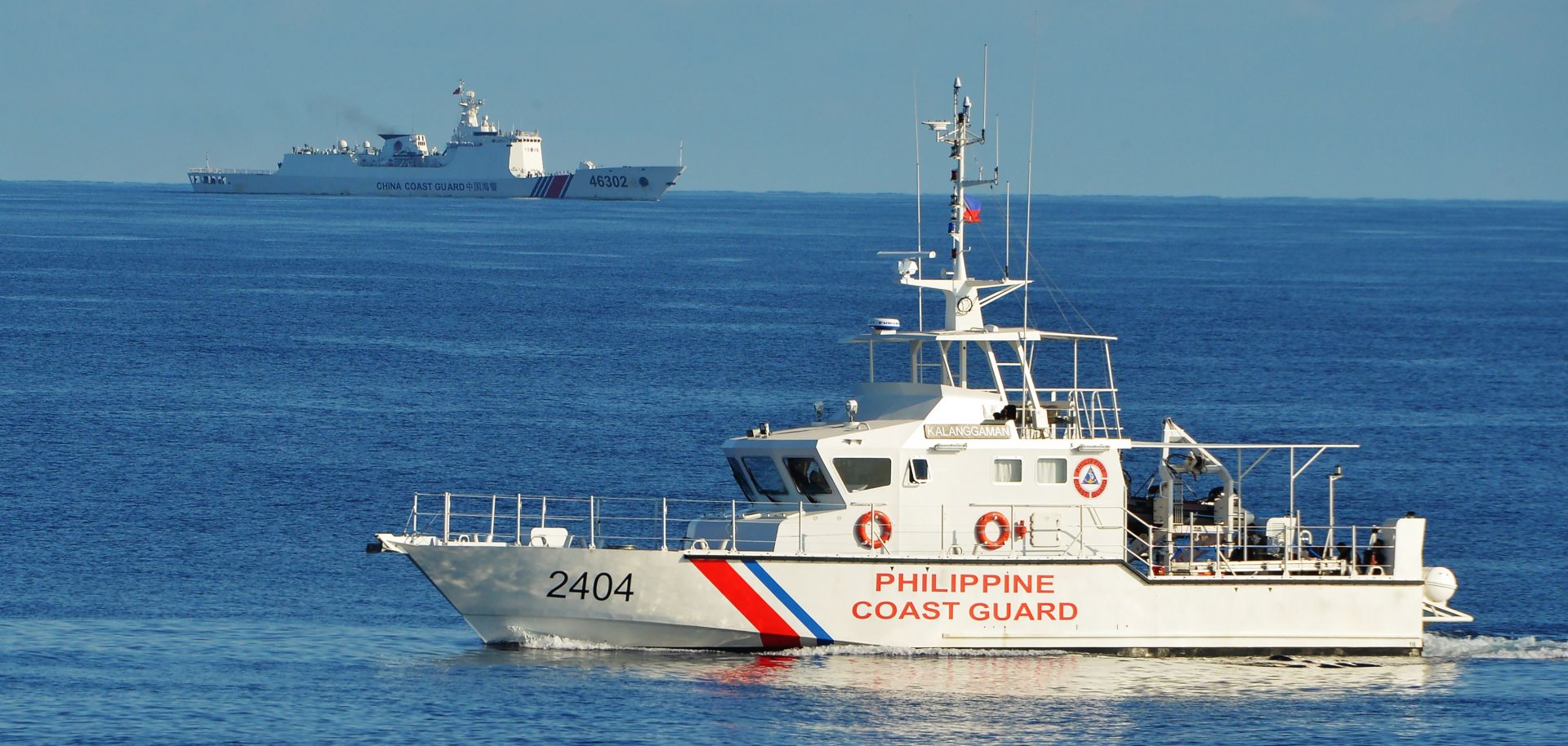
Philippine and Chinese coast guard ships sail past each other in the South China Sea on May 14, 2019.
Philippine President Rodrigo Duterte’s South China Sea policy is becoming less conciliatory toward China, as he tries to balance growing pressure from within his administration to revitalize Manila’s security cooperation with the United States against the need to preserve his country’s economic ties with Beijing. The Duterte administration has recently made a number of statements emphasizing the Philippines’ extensive maritime dispute with China. This suggests a notable shift in Manila’s approach toward China, as the Philippine government has largely avoided making points of contention with Beijing since 2016. However, there appear to be divisions between the president and key members of his cabinet on the matter.
- On Sept. 22, Duterte gave a U.N. General Assembly address that touted the importance of the Philippines’ 2016 arbitration ruling, departing from his past public position by saying the ruling is "now part of international law, beyond compromise and beyond the reach of passing governments to dilute, diminish or abandon.”
- The country’s foreign secretary, Teodoro Locsin, has also emerged as a confrontational figure, making statements about China that appeared to contradict the softer approach advocated by Duterte. On Aug. 26, Locsin said that Manila would invoke its Mutual Defense Treaty with the United States if China attacked a Philippine naval vessel. On Sept. 21, he then said that the Philippines would not support China’s stance that an ASEAN Code of Conduct on the South China Sea should keep out third party countries (such as the United States).
- Since taking office, Duterte has consistently avoided pursuing the Philippines’ 2016 Permanent Court of Arbitration win, a verdict which rejected China's expansive South China Sea claims under the U.N. Convention on the Law of the Sea (UNCLOS). Instead, he has deemphasized the Philippines’ maritime disputes with China in the interest of attracting economic and diplomatic support from Beijing.
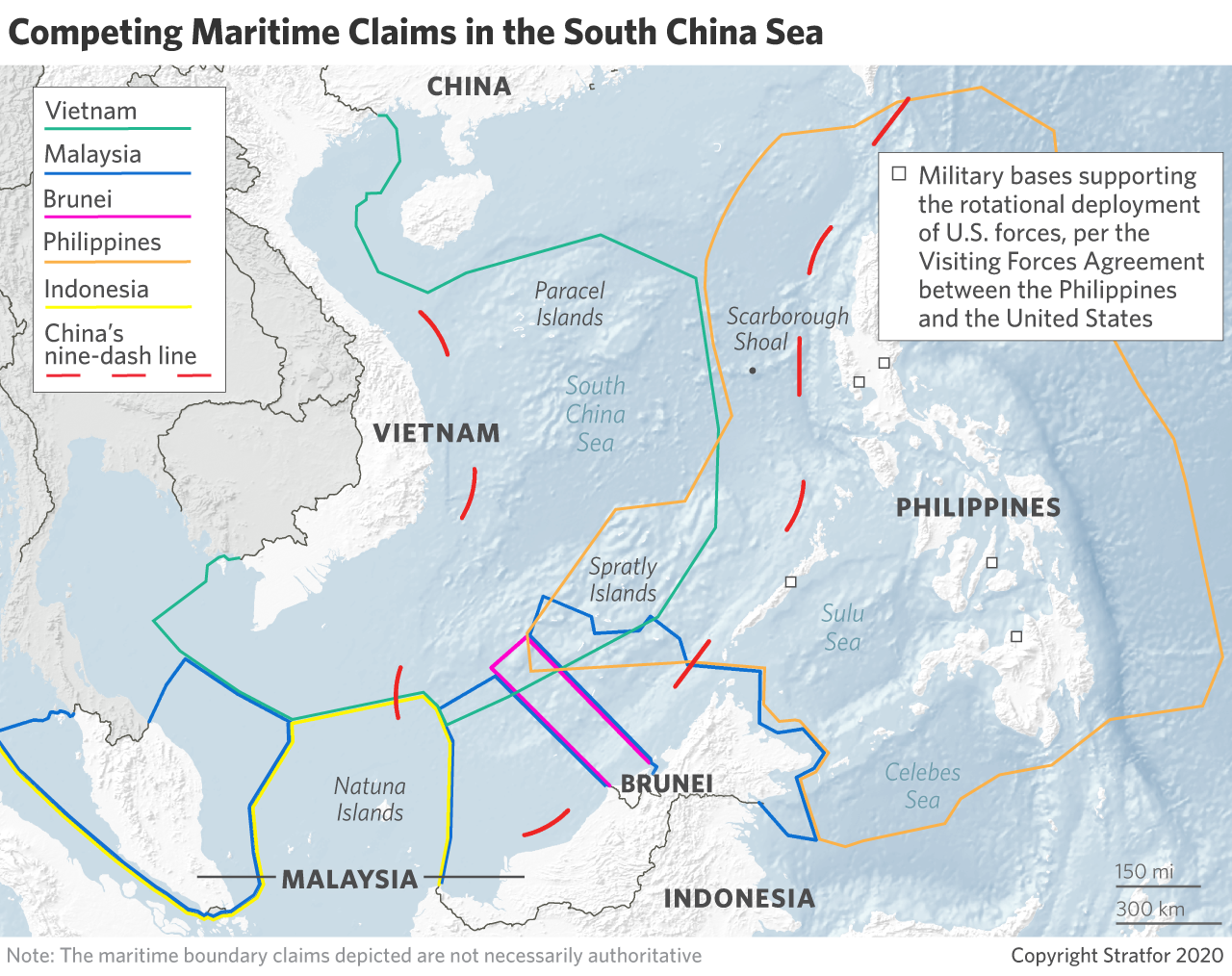
These reversals suggest that Duterte’s slipping popularity amid the COVID-19 crisis has made him more willing to address the concerns of his administration’s more military-focused elements. Throughout Duterte’s tenure, Philippine security officials have consistently pressed behind the scenes for the country to maintain its U.S. alliance and shore up its South China Sea maritime claims. Leaks suggest that the military has been dissuaded from patrols in the South China Sea to avoid inflaming tensions, and has expressed concern that buildups by both China and Vietnam outpace those of the Philippines on disputed features. While still touting his nationalist credentials, Duterte has argued that China’s military preeminence in the South China Sea, combined with the U.S. failure to defend the Philippines under previous administrations, left Manila little choice but to compromise with Beijing. Duterte’s South China Sea policy has long been difficult to stomach for both military leadership and rival political players, but his high levels of domestic political popularity had enabled him to resist calls for change. Political setbacks due to the economic and health impacts of COVID-19, however, appear to have now changed Duterte’s calculus on the matter.
- With under two years left before the expiration of his single term, Duterte’s approval ratings have dropped from nearly 90 percent in 2019 to under 65 percent. As a political outsider, Duterte faces uncertainty in terms of anointing his successor, and risks becoming a lame-duck president if he cannot cement the position of an ally such as his daughter, Davao City Mayor Sara Duterte-Carpio, ahead of 2022 elections,
- The Philippines is still battling the largest COVID-19 outbreak in Southeast Asia, with over 309,000 total cases and nearly 5,500 deaths as of Sept. 29. Philippine economic growth in 2020 will show a sharp reversal from 2019’s nearly 6 percent growth. The Asia Development Bank projects the Philippine economy will shrink by 7.3 percent this year, which would mark the country’s worst economic contraction since World War II, as well as the second-most severe region behind Thailand.
- In February, the Philippine government notified the United States that it planned to terminate the Visiting Forces Agreement (VFA), a key pillar of their military alliance. But in June, the Duterte administration reversed course by announcing it would delay any consideration of suspending the agreement until February 2021, with the potential for another six-month extension.
- On Aug. 28, Locsin recommended that the Philippines follow Washington'ss lead and blacklist certain Chinese firms directly involved in Chinese military projects in the South China Sea, including subsidiaries of the massive China Communications Construction Company. On Sept. 1, however, the president’s office announced it would not stop domestic infrastructure projects that involve these Chinese companies, saying Manila is "not a vassal state of any foreign power.”
- On June 10, Philippine Defense Secretary Delfin Lorenzana traveled to the disputed Thitu Island in the South China Sea alongside top military officials for a ceremony to launch a $26 million beach ramp at the strategic feature. However, on Aug. 3, Defense Secretary Delfin Lorenzana said that Duterte had issued a standing order that the Philippine navy would not participate in any U.S.-led South China Sea exercises and would refrain from any drills outside of 12 nautical miles from Philippine shores.
Tangible shifts in Philippine behavior in the South China Sea will nonetheless occur slowly, as Manila recognizes that the United States would not necessarily back up efforts to antagonize China in the South China Sea. The Philippines also sees little value in chasing its South China Sea arbitration victory in an international arena where China has massive support and could retaliate economically — or even militarily. Manila also recognizes that the United States would not necessarily back up efforts to overly antagonize China in the South China Sea, setting up a tripartite dynamic of action and reaction between the Philippines, the United States and China. Even as the United States increases pressure on China on a range of fronts, including the South China Sea, Washington has no interest in defending maritime counterclaimants to China outright. Instead, the United States is playing a more reactive role to China’s already-in-place military positions, working to shore up claimants’ military capabilities and to increase U.S. presence in the waters.
This will set up a tripartite dynamic of action and reaction between the Philippines, the United States and China that will prompt Manila to reemphasize its U.S. relationship while maintaining less robust outreach to China. Such moves would leave China with less support in its negotiations with the Association of Southeast Asian Nations (ASEAN) and its efforts to keep third countries such as the United States out of the disputes to deal with claimants one-on-one. Beijing can counter by expanding economic outreach, even as Philippine politics might tilt the balance in one direction or the other.
- With a return to economic growth critical for the Philippines as a whole and for Duterte’s political fortunes, in particular, China represents a major driver of growth, particularly given its early exit from COVID-19 and its economic recovery. China is a key trading partner at over 17 percent of the Philippines’ trade, compared with the U.S. share of 10.3 percent. And although massive flows of Chinese investment have not yet lived up to expectations, China’s Belt and Road Initiative and deep pockets mean it is far more likely than the United States, or even other allies such as Japan, to help the Philippines overcome its infrastructure deficit and development gaps.
- Even when the Philippines made harsh rhetorical statements about the United States, it still maintained a strong security relationship with Washington. Although Duterte threatened to cancel all military exercises with the United States in September 2016, the two sides have continued to carry out drills, with over 300 U.S.-Philippine exercises in 2019 along. The siege of Marawi City by Islamic State-aligned terrorists in 2017 required critical U.S. counterterrorism support for the Philippines. Since then, the United States has continued to provide military support amid the chronic and open-ended unrest in the Southern Philippines, which China cannot replace. The Philippines' first guided-missile frigate also participated in the U.S. Rim of the Pacific Exercise 2020 (Rimpac20) from Aug. 17-31 in Hawaii.
