
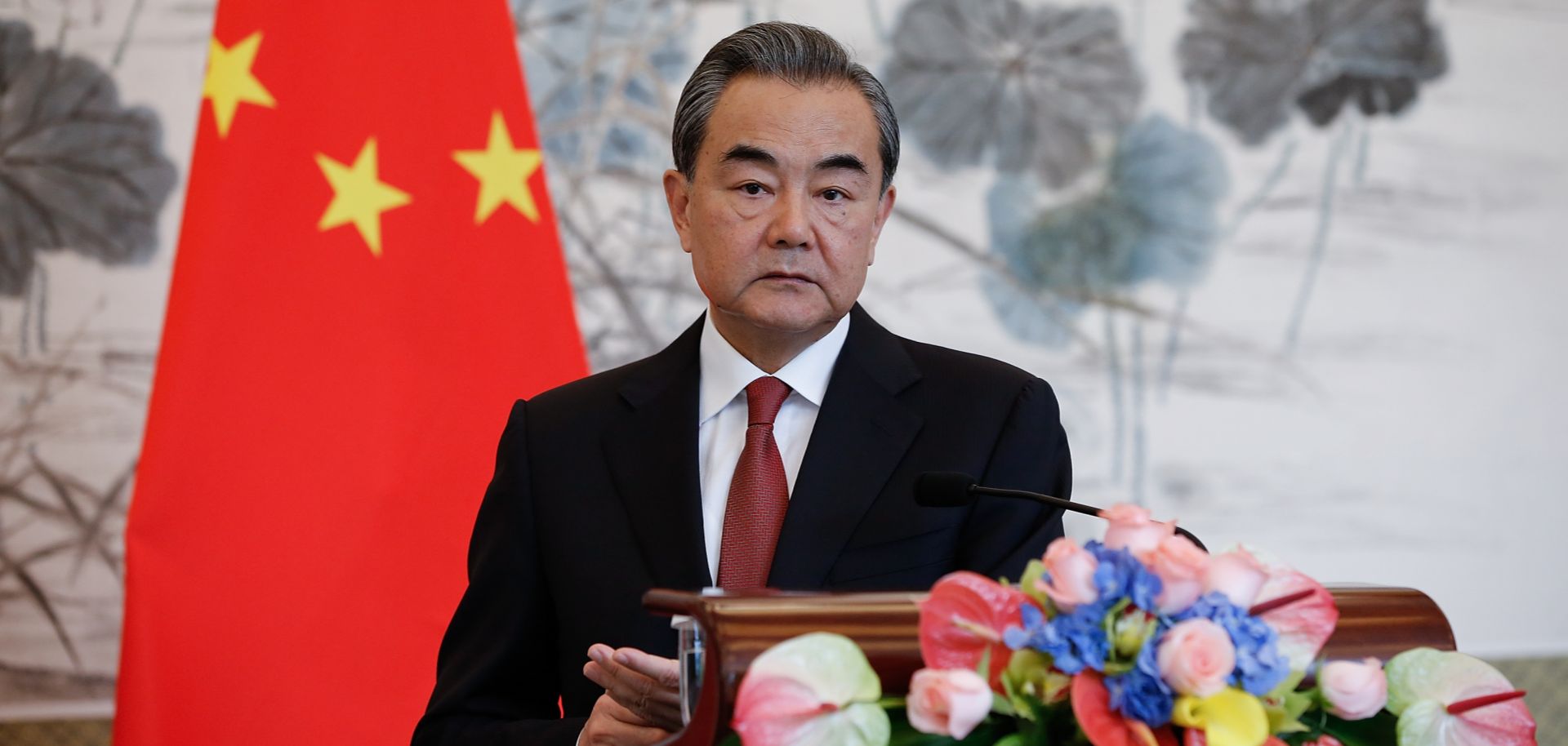
Chinese Foreign Minister Wang Yi holds a press conference with his Pakistani counterpart (not pictured) in Beijing, China, on Sept. 8, 2017.
China’s modest debt assistance to Pakistan, one of its closest partners, shows how Beijing’s domestic economic and financial struggles are reducing its willingness to bail out the growing number of debt-distressed developing countries. On June 24, Pakistan’s finance minister Miftah Ismail announced on Twitter that a consortium of Chinese state banks had agreed to give Pakistan’s central bank $2.3 billion in new loans as a means of rolling over $2 billion in previous loans given by China’s central bank to Pakistan’s central bank that was coming due in June and July. The new funds will allow Pakistan to pay off the existing loans without dipping into the country’s dwindling foreign currency reserves. This comes after Beijing agreed to roll over another $2 billion in loans for Pakistan back in March. Global commodity prices and inflation are causing concerns in Pakistan and many other developing countries about their ability to sustain increasingly expensive imports of essential goods (such as fuel and food) without triggering foreign currency crises, like what Sri Lanka is currently experiencing.
- Pakistan is hoping to resume disbursements of a $6-billion loan package from the International Monetary Fund (IMF), signed in 2019, and has recently imposed a one-time 10% “supertax” on key industries to boost state incomes. Once the IMF funds resume, Islamabad will look to other lenders for foreign assistance.
- The IMF in April told the Sri Lankan government that it must restructure debt with major foreign creditors before the IMF will provide relief funds. Chief among those foreign creditors is China, which holds $6.5 billion of Sri Lanka’s debt, or about 10% of the total. But Beijing is pushing back; the ambassador to Sri Lanka Qi Zhenhong stated in May that China supports Sri Lanka’s negotiations with the IMF, but China remains reticent about engaging in multilateral debt restructuring, preferring instead bilateral negotiations.
- A similar dynamic is playing out in Zambia, where the IMF is also looking for assurance of debt relief from foreign creditors before the international institution provides relief. In this case, however, China agreed in May to co-chair a committee of foreign creditors to renegotiate Zambia’s debt with equal burden-sharing. If completed, this process would grant Zambia access to $1.4 billion in IMF relief funds — funds that China’s foreign ministry on June 17 urged the IMF to deliver post-haste. As of late June, however, foreign creditors’ negotiations on Zambia’s debt were still deadlocked.
China’s preferred method of dealing with debtors is to restructure loans, not forgive them, which means extended interest times horizons will cause loans to weigh on debtor countries’ growth, and in rare cases restructuring may lead to loss of national assets. Beijing prefers to restructure its loans on longer timelines when dealing with foreign governments that struggle to honor them; these loans are often given at market or near-market rates (such loans make up a majority of China’s development finance and are distinct from concessional loans or grant aid). This preference is driven by China’s focus on lending to revenue-generating projects (e.g. toll roads), which remain monetizable even under debt distress. The profit motive is also key for Chinese financiers (state banks), which Beijing has tasked with turning China’s excess foreign currency reserves into profitable infrastructure investments, not losing those investments entirely. In addition, China’s many resource-backed loans are designed to bolster its access to critical resources like oil and copper — access Beijing prefers to maintain through restructuring loans. This aversion to debt forgiveness means debtor countries will pay more interest to China in the long term, weighing on their national growth, potentially long after the benefits from the financed projects have ceased (e.g. in energy extractive ventures with limited time horizons). In rare cases, this lack of debt forgiveness may lead countries to sell access to national assets to China (e.g. Sri Lanka’s Hambantota port), prompting domestic political backlash.
- In 2017, state company China Merchants Group paid the Sri Lankan government $1.1 billion in exchange for a 99-year lease on the Hambantota port, which allowed Colombo to repay loans to Chinese banks.
- In 2018, China forgave some existing interest on a 10-year, $4-billion loan for an Ethiopian railway, but extended the loan’s repayment term out to 30 years, providing 20 more years of interest to China.
- In 2020, China agreed to defer payments on an undisclosed amount of loans to Zambia in bilateral negotiations with the African country.
- This past April, Sri Lanka’s opposition leader (and now prime minister) Ranil Wickremesinghe told Republic TV that, instead of offering debt relief, China had offered Colombo another $1-billion loan to alleviate the country’s solvency issues.
China’s modest assistance to Pakistan was driven by strategic considerations and its strong relationship with Islamabad, but other debt-distressed countries are likely to receive less Chinese assistance. Pakistan is an “all-weather friend” of China. The two countries have shared close relations for decades and jointly developed the China-Pakistan Economic Corridor (CPEC), which is the cornerstone of China’s global Belt and Road Initiative (BRI). In addition, Pakistan shares a border with China and two other strategically critical neighbors, India and Afghanistan. A major default and economic collapse on par with that in Sri Lanka could see Pakistan become a center of unrest, inflame fighting with Afghanistan and India, and threaten China’s access via CPEC to the Indian Ocean. Despite these major strategic interests, China’s recent debt restructuring with Pakistan (totaling around $4 billion in rolled-over loans since March) was small compared with the $20 billion support package that former Pakistan Prime Minister Imran Khan requested from China in February. This reduced assistance aligns with China’s withdrawal from heavy BRI financing over the last three years and may suggest Beijing is focusing on protecting its domestic economic health in a difficult year. In comparison to Pakistan, China’s debt restructuring to other less strategically important countries is likely to be even more modest. This bodes poorly for countries like Sri Lanka. Without foreign intervention, a debt restructuring in these countries will merely delay the resolution of their financial struggles. Foreign creditors and the IMF could also provide debt relief without Chinese assurances, effectively subsidizing Chinese loan repayment.
Facing an economic slowdown, China will be even more conservative in responding to sovereign debt crises, weighing the strategic benefits of propping up key partners versus the costs to its commercial interests. Whatever funds Beijing allocates to alleviating foreign debt may come at a high domestic political cost and could further endanger China’s own slowing economy in a tight fiscal year. But in some cases, these costs may still be worth it for Beijing to preserve the stability of strategic partner nations, like Pakistan, especially along China’s periphery.
- China’s economy is on unsteady ground after the COVID-19 lockdowns in April and May. Dropping demand for exports, high commodity prices, and record unemployment all threaten China’s economy in a year when Xi Jinping aims to begin an unprecedented third term as General Secretary of the Chinese Communist Party in the fall. These difficulties will make China even less likely to sacrifice the access to foreign resources and mass employment offered by overseas BRI projects in the name of foreign debt relief.
- In addition, China’s funds for stimulating the economy are drying up as Beijing pushes cities to bolster industrial demand and employment via domestic infrastructure construction through September. Amid this funding squeeze, Beijing may consider expanding its 2022 fiscal budget at the National People’s Congress Standing Committee meeting in August — something China hasn’t done since 1999. These financial struggles will make Beijing leery of excessive foreign lending and forfeiting overseas investment incomes.
- Chinese citizens have previously criticized their government for allocating funds to foreign countries (including for BRI projects) during times of domestic economic hardship, like during the 2008 global financial crisis and the 2015 stock market crash.
