
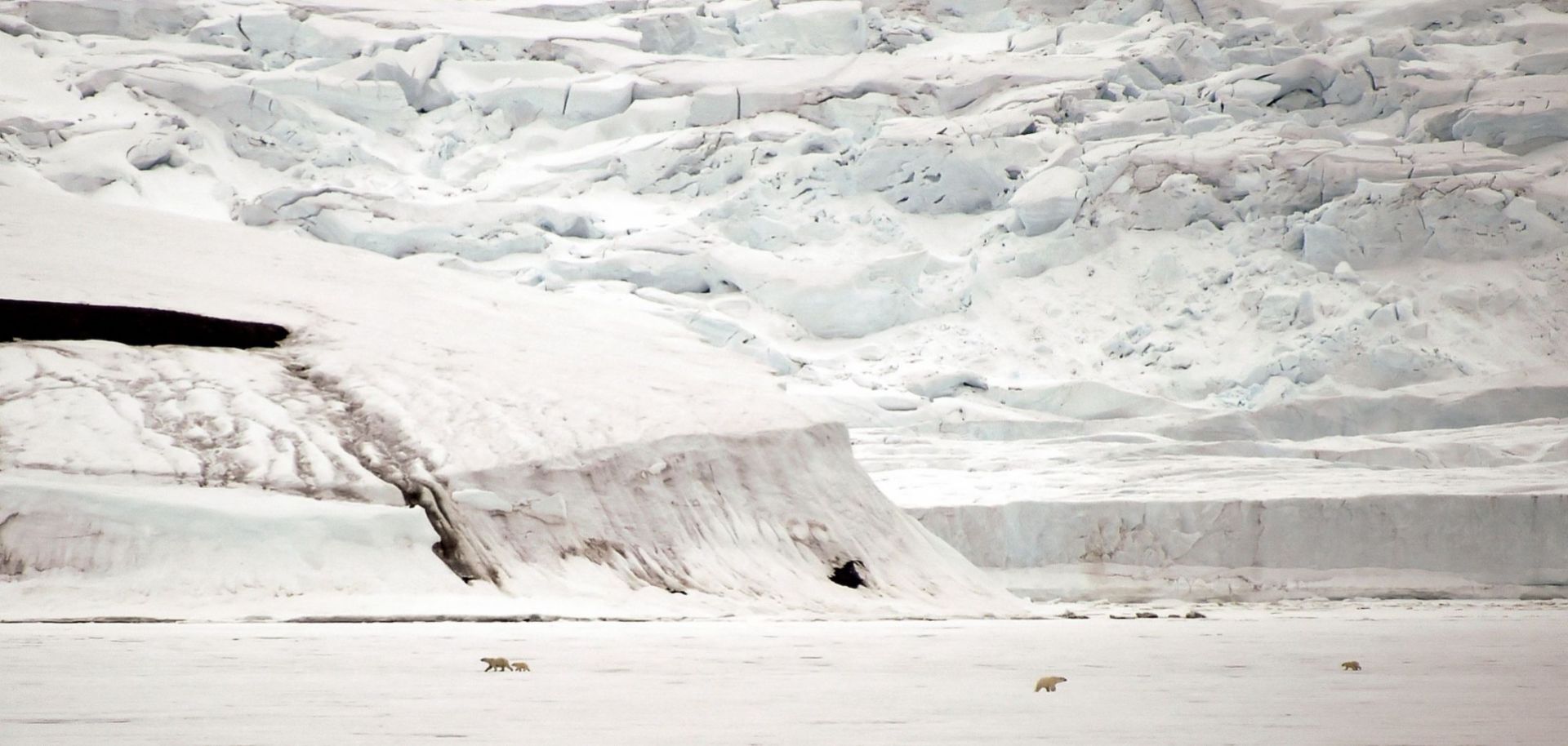
Polar bears in Essen Bay off the coast of Zemlya Georga -- an island in the Franz Josef Land archipelago -- on August 22, 2021.
Following the Russian re-invasion of Ukraine, seven of the eight Arctic Council members (all aside from Russia) suspended participation in council activities, as Russia is currently the Arctic Council chair. Representatives of these nations will meet soon to discuss how to maintain collaborative Arctic governance and determine what level of cooperation with Russia will be necessary, particularly in areas of scientific research and fishery management. But the pause, which is unlikely to be lifted anytime soon, provides an opportunity for China to call for a new Arctic governance structure. Beijing sees this as the moment to further internationalize Arctic governance, giving China a greater say and softening the grip of the eight geographically Arctic nations.
Although international law and norms hold sway in the Arctic, both at sea and on land, the Arctic Council serves as a focused body to collaboratively manage Arctic development and current and future issues (aside from traditional security). Established in 1996 by the eight nations with territory north of the Arctic Circle, the Arctic Council is a post-Cold War creation built around the idea of active and equal participation of all Arctic nations — most notably Russia, which accounts for nearly a third of Arctic land and was at the time transitioning from Soviet-era isolation to a new inclusion in the international system. A year after the formation of the Arctic Council, for example, Russia was invited to join the Group of Seven nations (Canada, France, Germany, Italy, Japan, the United Kingdom, and the United States), another sign of Western attempts to include Russia in the Western-led liberal economic and global order. While Russia was suspended from the then-Group of Eight after its 2014 annexation of Crimea, Russia remained an active participant in the Arctic Council and even took on its second two-year rotational role as chair in May 2021.
While the Arctic Council is dominated by the eight Arctic nations and special representation from Indigenous Arctic communities, the council has slowly expanded through the introduction of official observer states. In 2006 and 2007, China began working with the Arctic Council, seeking to engage with and gain a foothold in future Arctic governance. In 2013, the council finally admitted China as one of six countries granted permanent observer status. Beijing is also active in the Arctic Circle, a forum established in 2013 with much wider membership and participation, where China can drive areas of focus and collaboration and seek to insert its own views of Arctic management and access. For China, both groups, as well as several other international bodies and organizations, provide space for asserting Chinese interests in future Arctic development.
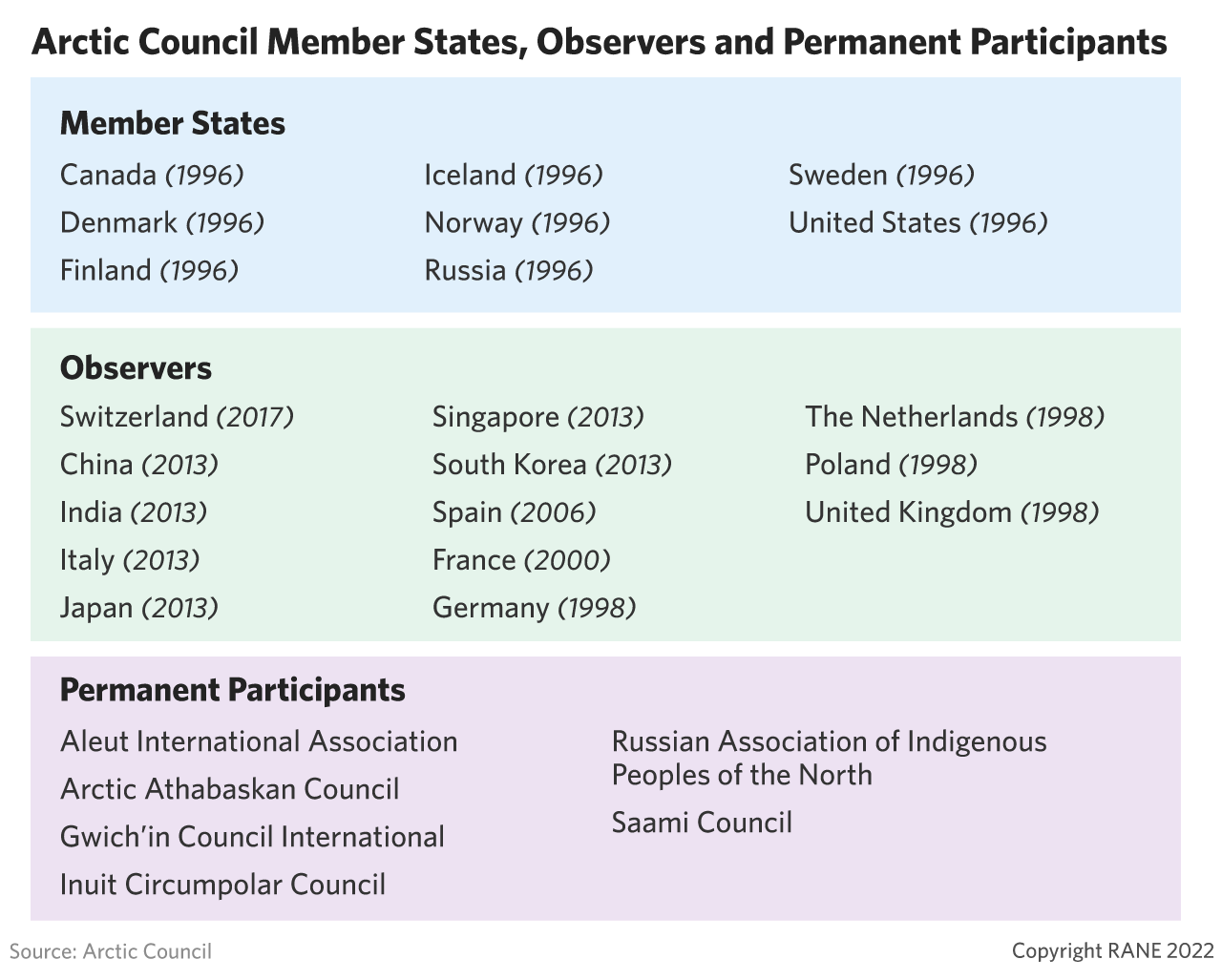
One of Beijing's biggest concerns with the Arctic Council structure is that it locks Arctic management in the hands of the current eight Arctic nations, constraining the roles of all others. In 2018, China declared itself a "near Arctic nation," to both mirth and concern among the Arctic countries. But from Beijing's perspective, the phrase is an assertion of China's right to play a larger role in Arctic governance and future use, whether measured by China's (tenuous) geographic propinquity, its share of the global population (and thus need for resources) or its share of global economic activity (and thus potential contribution to future development).
Beijing asserts that, as the Arctic is a critical aspect of the global climate system, it is in the interest of all nations to play a role in Arctic management. Thus, the Arctic is the common heritage of humankind, a region of global concern and an area of abundant resources that should be more "equitably" accessible to nations beyond the eight Arctic countries. Although China agreed to abide by the current rules and norms in the Arctic as part of its observer status in the Arctic Council, Beijing wants to play a bigger role in shaping future Arctic governance and development. "Internationalizing" Arctic governance would serve several goals for Beijing.
- First, the region is a storehouse of natural resources, including hydrocarbons, critical minerals, abundant fish and other maritime food stocks. As the climate continues to shift, opening new areas of the Arctic, Beijing wants to ensure it has a key role in shaping any future agreements on access to Arctic resources.
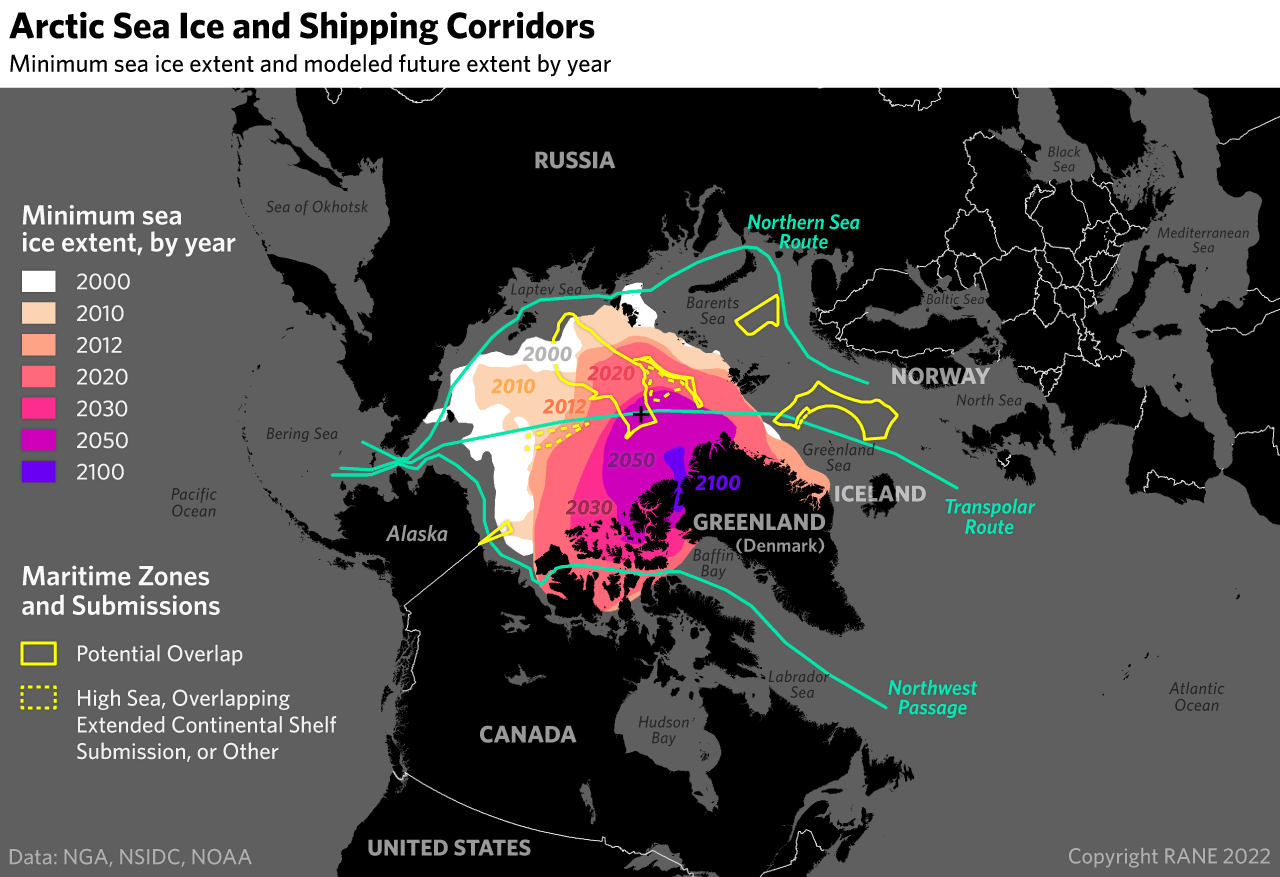
- Second, Beijing sees the area as a key future transit region. China currently cooperates with Russia on its Northern Sea Route, but Beijing counters Moscow's assertion that the NSR is internal Russian waters and instead asserts that the route is an international straight (and thus transit should not be constrained by Russian rules or fees). Beijing is also eyeing the future opening of the Trans-Polar Route, which would bypass either Russian or Canadian claims of internal passage. By keeping active in the Arctic region through scientific, commercial and potentially military presence, China is establishing its "right" to shape any future agreements on Arctic transit. This not only has commercial value for Beijing but also allows China a role in changing the strategic nuclear balance in the Arctic via submarines.
- Third, China sees Arctic governance in a similar context as Antarctic governance — models of international control that are exclusionary, keeping China out due to history or geography, despite China's population and economic heft. Adjustments in one could crack the governance of the other open as well.
- Finally, the polar regions serve as areas for China to take a leadership role in establishing new forms of global governance. The polar areas are, from Beijing's perspective, some of the last global frontiers, along with the deep seas. These are areas where China can focus its efforts to assert its right as a major global power to revise or write new global agreements for access and regulation — agreements that are not necessarily constrained by Western liberal ideologies. These "frontier" areas may also serve as models for China's desire to set the new rules for access to resources in space, including the moon.
Beijing has long argued that current global norms and standards are not globally representative, rather that they reflect a North Atlantic system put in place following World War II that once represented the core of global economic power. But the world has evolved since the 1940s, and the post-World War II order does not match the social, political or economic historical norms of most of the world, which had little say in the past. Therefore, Beijing argues that it is time to begin readjusting these global norms and mechanisms to better represent other countries, not just a handful of European and North American liberal democracies. Cracking Arctic governance would begin eroding the seams of broader global governance.
With the current suspension of Arctic Council actions, China may be positioned to renew its argument for a better and more representative governance structure. The likely move by Finland and Sweden to join NATO would only reinforce China's position, as it would divide the Arctic between NATO nations and Russia — effectively forcing the security dynamic into the equation and making it harder to separate Arctic collaboration from Arctic competition. There are already voices in the Arctic nations wondering whether the Arctic Council can survive the loss of Russia or ever re-engage Moscow. There are also concerns about China trying to internationalize Arctic governance by breaking out of Cold War- and Western-centric mindsets and moving toward a more equitable system of management (meaning one with a greater role for China).
Any move to re-frame the Arctic Council to permanently suspend Russia would embolden China to work with Moscow to promote an alternative forum for global Arctic governance. The West's political constraints make the Russia dilemma nearly insoluble. As an intergovernmental body, the Arctic Council effectively requires the members to either engage with Russia as a state fully on issues of the Arctic, or somehow separate Russian government membership from the actions of specific government bodies and private actors in areas such as science, search and rescue, or fisheries management. The latter seems unacceptable to Moscow, the former distasteful to the United States and many of the European members, particularly with the increased attention to Arctic defense. If the remaining seven Arctic Council members seek to proceed with their own cooperation and hope for a future change after Russia's chairmanship lapses in 2023, they reinforce China's position that the Arctic Council has devolved from a cooperative forum to a competitive one, thus needing to be replaced in the interest of world peace.
Beijing does not need to act overtly to exploit the cracks in the seams of Arctic governance. China may simply call for a greater role for observer states during the current suspension, using cooperation now as a way to strengthen its future influence without overtly challenging the current organization. Beijing could also work through the Arctic Circle, which is often seen as an end-around to the more closed Arctic Council, informally strengthening the Arctic Circle's role and influence while the Arctic Council sits in limbo. In both these cases, China may enlist other interested nations, such as India, which seeks greater Arctic access and continues to walk a careful line of cooperation between Russia and the West.
But at the bolder end of the spectrum, Beijing could simply heighten its Arctic cooperation with Russia, exploiting Moscow's economic losses to gain greater traction in shaping Russian Arctic development and expanding its own presence in the Arctic as an assertion of its right to shape future rules. Or China could even begin making the argument that the breakdown of the Arctic Council and the rising "Cold War mentality" of NATO and Russia make the Arctic Council itself largely moot, and with the urgent need to consider climate change impacts and maintain the Arctic as a "zone of peace and cooperation," it needs U.N. oversight, reformation or eventual replacement.
As the seven other Arctic Council members prepare to meet without Russia and seek near- and mid-term solutions to coordination and collaboration, they will watch China's responses closely. Most Arctic nations remain committed to keeping regional management in regional hands, but the longer relations with Russia remain on hold, the more likely a new, internationalized Arctic governance model becomes.
