
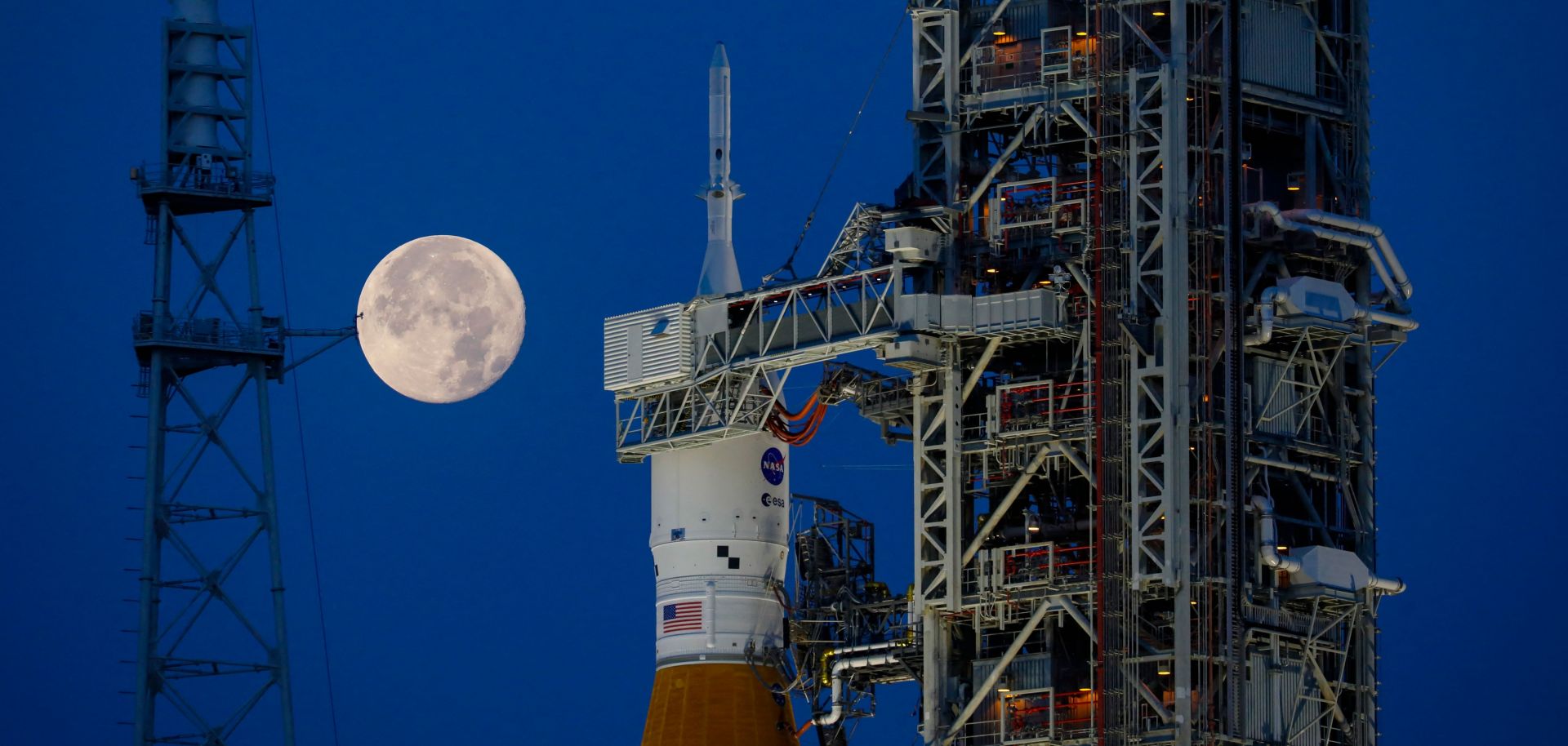
NASA's Artemis I Moon rocket sits on the launch pad at the Kennedy Space Center in Cape Canaveral, Florida, on June 15, 2022.
Editor's Note: The Artemis I launch was delayed after the publication of this article. It subsequently launched Nov. 16, 2022, with the Orion spacecraft completing its first flyby of the moon Nov. 21, 2022, and splashing down in the Pacific Ocean on Dec. 11, 2022.
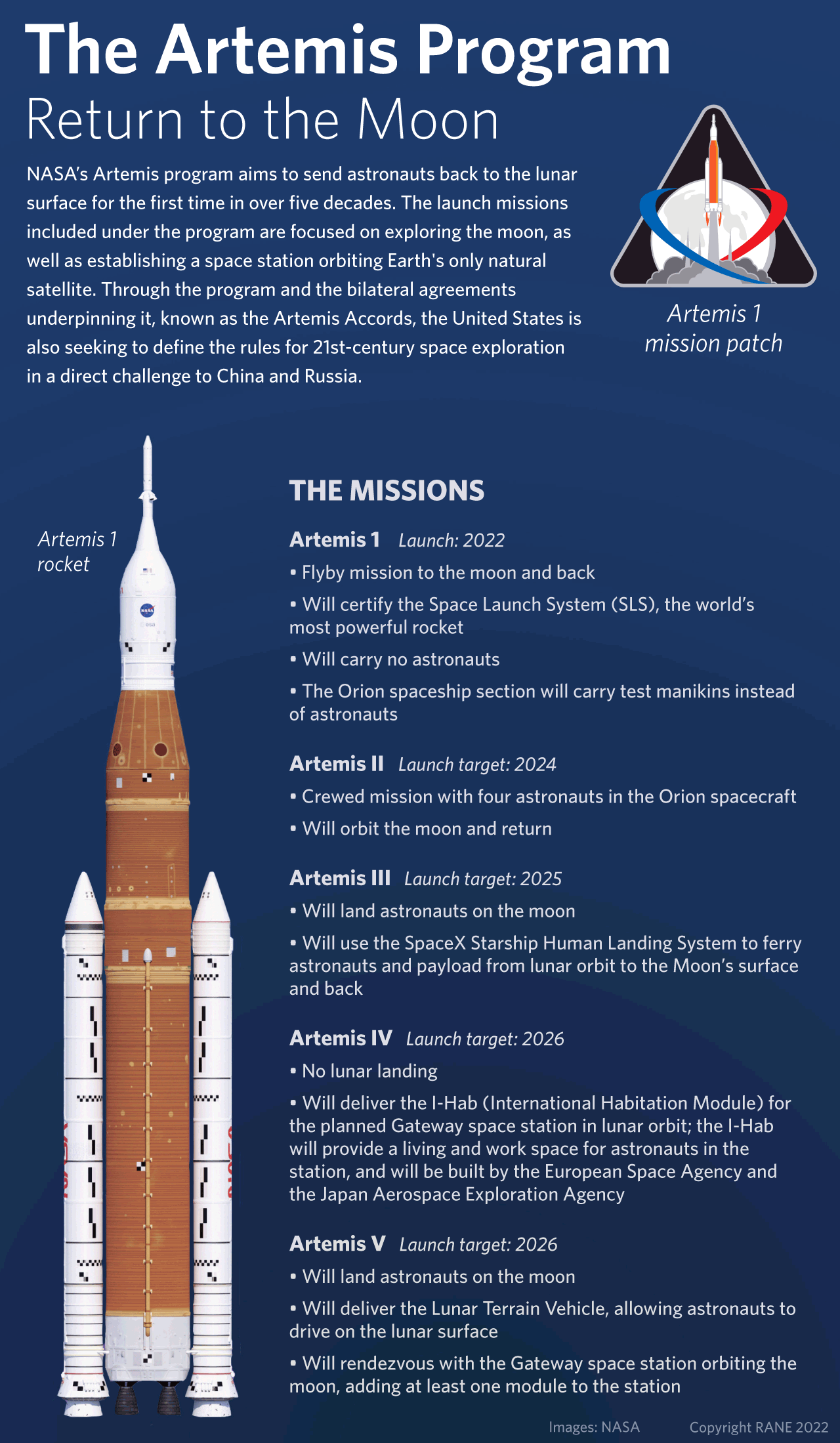
Through NASA's long-awaited Artemis program, the United States is seeking to secure its lead in the new space race, as a combination of technological advancements and the potential for lucrative natural resources on the moon and other planetary bodies draw more countries to venture beyond Earth's atmosphere — with the United States' top geopolitical rivals, China and Russia, being chief among them. After many delays, the first major mission launch under NASA's Artemis lunar exploration program has been scheduled for Aug. 29, with Sept. 2 and Sept. 5 as the backup launch windows. The unmanned Artemis I mission will test the performance of the U.S. agency's new Space Launch System (SLS) and Orion spacecraft in the hopes of certifying their use for future crewed missions.
- The Artemis program, which was created in 2017, aims to launch a manned lunar mission as early as 2025. NASA's last manned lunar mission was the Apollo 17 mission in 1972. The Artemis program builds on the Apollo program by including a space station orbiting the moon that not only would service manned missions to the moon, but potentially to Mars and other destinations.
- There are currently five Artemis missions actively being pursued — all of which will be flown using the SLS and Orion spacecraft. Several support missions are also being done more closely in tandem with commercial launch providers, including SpaceX.
- The SLS is a super heavy lift expendable launch vehicle that is even more powerful than the Saturn V launch vehicle that was used in the Apollo program and it, as well as more powerful variants, will launch each of the future Artemis missions.
- NASA's SLS will be the most powerful vehicle of its kind that has ever been launched into space. But SpaceX's Starship will be more powerful; the company is currently targeting a six-month launch window beginning on Sept. 1 for Starship's first orbital test flight.
The Artemis program comes amid increasing geopolitical competition and interest in the moon by other space agencies. Over the last 15 years, the ambitious Chinese Lunar Exploration Program (CLEP) has demonstrated significant advancements in China's own capabilities to explore the moon, including with orbiter, lander and sample return missions. Although China remains at least a decade away from a manned mission to the moon, in 2021 it signed a pact with Russia to develop an International Lunar Research Station. Realistically, the moon base, if it is ever completed, would not be operational until the late 2030s at the earliest, but shows China and Russia intent on moving in that direction. Manned missions to the moon (or Mars) take decades to develop and while China has been successful in its lunar missions thus far, Beijing still has to make a number of advancements to successfully carry out a crewed mission to the moon — particularly when it comes to long-term habitation environments and landers.
- In addition to its proposed lunar research station with China, Russia is currently slated to launch its Luna-25 in September. The timeline for the launch, however, has been repeatedly delayed and will probably again be postponed due to funding and technological challenges. Nonetheless, the Luna-25 mission aims to revive Russia's lunar program, as the country's last lunar mission was Luna-24 in 1976.
- South Korea, the European Union, India, Israel, the United Arab Emirates and Turkey have also all either been involved in lunar missions in recent years or plan to be in the near future.
The commercialization of space and the reduced costs of robotics and other technologies used in spacecraft, landers and orbiters are making once unthinkable projects scientifically feasible and potentially cost-effective — setting the stage for the next space race. Over the last decade, U.S. spacecraft manufacturer and launch provider SpaceX has repeatedly demonstrated that the first stage of launch vehicles can be repeatedly reused, driving down the costs of launches to Earth's orbit on a per-kilogram basis. SpaceX's demonstration is now leading China and Russia (as well as other countries and private space companies) to develop reusable rockets. Advancements in materials sciences are also making spacecraft lighter. New robotic technologies are making spacecraft cheaper and more advanced as well. This, coupled with the growing importance of technologies based in space for commercial applications on the earth's surface (such as satellite internet services), is creating a much more robust commercial space sector where once-unthinkable projects (like lunar outposts, missions to Mars and the development of natural resources on the moon and the rest of the solar system) will be actively pursued within the coming decades. This makes government-sponsored programs more significant as technologies are developed in coordination with private companies that could be used in those applications. Moreover, it also means that legal structures and government policies around the commercialization of space, particularly beyond Earth's orbit, are more critical.
- SpaceX is currently charging around $1,300 per lb of payload for cargo aboard its Falcon 9 rocket to reach earth's orbit. Comparatively, Russia charges about $8,000 per lb for flights aboard its Soyuz rockets, which debuted in the 1960s. NASA's costs to launch the space shuttle were an estimated $30,000 per lb in 2021, though the high costs for the space shuttle were due in part to the need to reach higher certifications with most flights due to being manned missions. Nevertheless, when SpaceX debuted its Falcon Heavy rocket 2008, it did so at a cost of less than $1,000 per lb.
- Over the last few years, a number of startups have emerged trying to develop resources in space. In May 2022 alone, two startups — Lunar Outpost and AstroForge — raised a combined $25 million in seed funding. Lunar Outpost is developing large rovers for use on the moon, while AstroForge is looking to mine platinum and other metals from asteroids.
- Although the prospect of mining asteroids to bring natural resources back to earth is tantalizing to many governments and space companies, the establishment of lunar outposts (and in the distant future martian outposts), missions to Mars and the development of privately-owned space stations will eventually create a market for in-place resource consumption, where for example mining an asteroid for water is then used on Mars.
With competition intensifying, the United States is trying to entrench its dominance in the emerging new space race by establishing international guidelines for exploring and developing resources on the moon (and eventually elsewhere). The United States and the national space agencies of 21 other countries have so far signed the Artemis Accords, a legal framework for exploring the moon and developing its resources. Other governments seeking to join NASA's Artemis lunar exploration program — including by participating in the Gateway space station — must first affirm their commitment to the rules outlined in the Artemis Accords by signing their own bilateral agreement with the United States. As the global leader in space exploration and the only country that has sent people to the moon, the United States is hoping that by setting the guidelines for how to behave on lunar soil, the Artemis agreements will help ensure that it (and not China or Russia) shapes the norms and standards of future space exploration and resource development.
- Saudi Arabia was the latest country to join the U.S.-led Artemis Accords, which it did in July during U.S. President Joe Biden's trip to the kingdom. In June, France became the 20th country to sign an agreement, which marked a major win for Washington given that France is the largest contributor to the European Space Agency (ESA). Germany, the second largest contributor to ESA, is the next major country the United States is trying to convince to join the Artemis Accords.
- The United States has largely been successful in using its dominance in space to convince other nations to join its programs on its terms. In the immediate aftermath of the Cold War and the collapse of the Soviet Union, the United States reached an agreement with Russia in 1993 to build a space station that would later become the International Space Station.
The Artemis Accords represent a significant development of space law and aim to expand on the principles outlined in the 1967 Outer Space Treaty. However, the pact's treatment of space resources and the establishment of ''safety zones'' has proven to be controversial, with some fearing that it could enable the United States and its allies to effectively claim certain areas of the moon. Keeping in line with the typical U.S. position on related issues of governance, the Artemis Accords call for transparency and interoperability of space systems, and pledge that space should only be used for peaceful purposes. The legal framework also explicitly states that the Outer Space Treaty permits space resource development, reiterating a long-standing U.S. interpretation of the 1967 pact that has not been universally accepted. The United States argues that ''safety zones'' are needed on the moon surrounding mission sites, lunar outposts and other areas as a way to de-conflict activities and ensure that one project's mission is not affected by another. The need for deconfliction is high, as lunar regolith, debris and other byproducts of a project can easily be kicked up and cause damage to another project. But critics of the U.S.-led Artemis Accords argue that establishing such safety zones would effectively carve out areas of the lunar surface for certain countries, thereby excluding other actors, which would then violate the Outer Space Treaty's provision that no country can claim the moon or another celestial body as its territory.
- During the United States' talks with France on joining the Artemis Accords, questions on whether the treaty permitted the use of space resources arose as something that had to be negotiated.
- The space resource strategy outlined in the Artemis Accords has come under scrutiny amid fears that it could effectively trigger a ''gold rush'' between countries seeking to mine the moon's potential lucrative natural resources and minerals, including silica and alumina. To avoid such a ''free-for-all'' competition, Washington's geopolitical rivals (like Russia), as well as some scientists, have argued that the international community needs more time to negotiate a new treaty or U.N. mechanism that regulates extractive activities in space.
- The Artemis Accords also do not mention the 1979 moon Agreement, a multilateral supplement to the Outer Space Treaty that confirms the de-militarization of space. The United States has not ratified the agreement, which protects the moon and other celestial bodies as a common heritage of mankind that therefore cannot be appropriated by any government or corporation.
As space becomes more crowded with new entrants, and as the great power competition with Russia and China heats up, the United States' attempts to impose its own view will collectively fray the international governance of space and spur disputes over what is permitted. The final decades of the 20th century have been defined by cooperation in space. During the second half of the Cold War, even the United States and the Soviet Union maintained a basic level of communication on space-related matters. But that era appears to be coming to an end, with the great power competition on Earth poised to only intensify in tandem with the competition for influence and resources in space. Instead of engaging in multilateral negotiations like they once did, the three most powerful countries in space exploration — Russia, China and the United States — are all pursuing bilateral agreements and/or unilateral strategies. And Washington's attempt to force its Artemis Accords vision on the world is only deepening this trend by sowing further distrust among leaders in Beijing and Moscow. The decreasing level of international cooperation could, in turn, lead to increased militarization and accidents in space by creating an environment ripe for disagreements and misinterpretations. For other countries hoping to someday explore the final frontier, it could also limit access to space resources by forcing them to effectively choose between working with China, the United States or Russia.
- Earlier this month, Russia announced plans to end its participation in the International Space Station once its own space station is operational in the 2030s. Since the Ukraine war began, Moscow's space cooperation with the West has come increasingly under strain. In May, the (since-fired) head of Russian space agency Roscosmos made provocative statements regarding the war, which prompted the European Space Agency to suspend certain key projects it was coordinating with Roscosmos.
- U.S. law explicitly prohibits NASA from working with China. This makes it highly unlikely that Washington and Beijing will ever be able to reach a level of cooperation in space seen between the United States and the Soviet Union at the end of the 20th century.
