
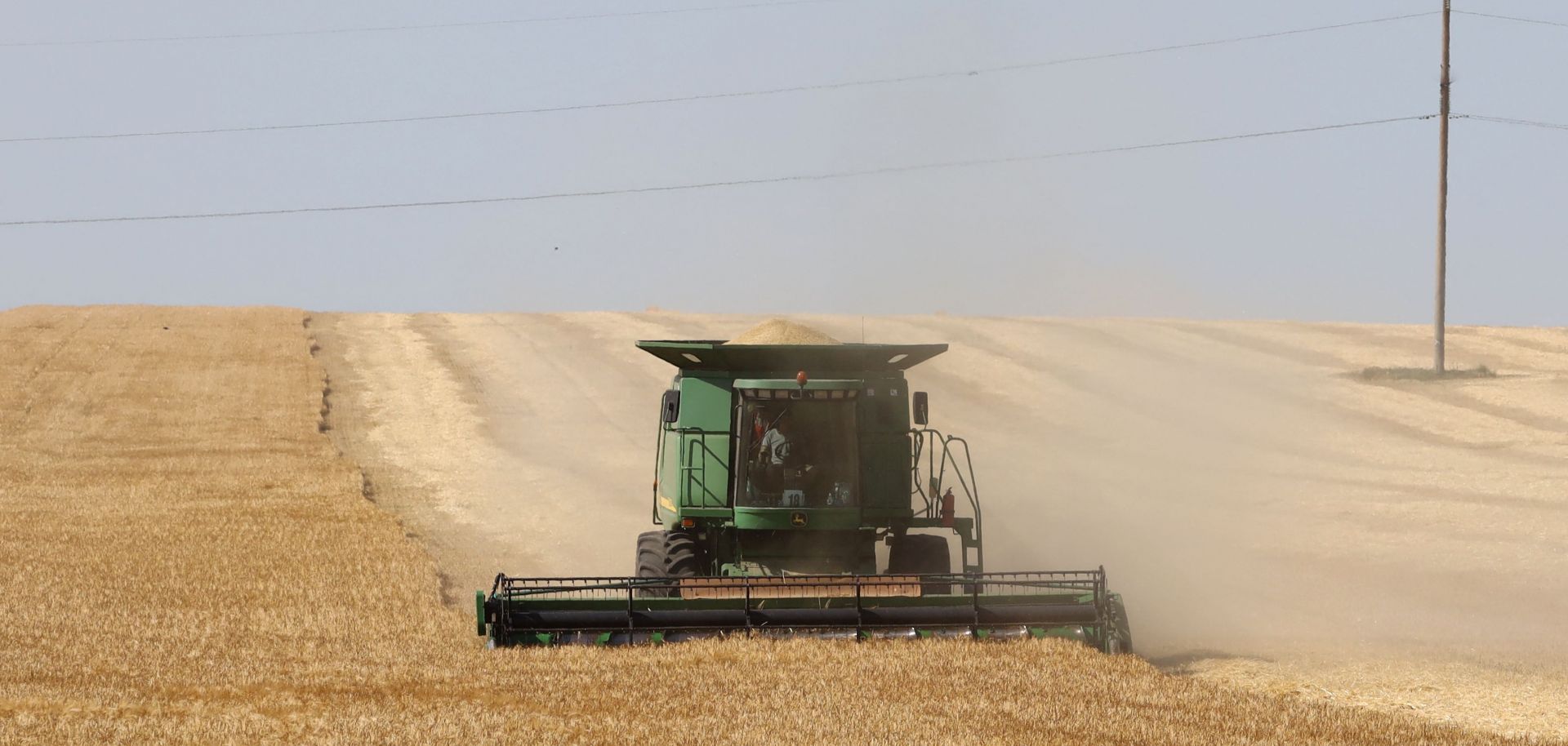
A farmer harvests wheat June 14, 2022, on a field near Izmail, in the Odesa region of Ukraine.
Both Ukraine and Russia are interested in preserving a grain export deal unblocking Ukraine's Black Sea ports, but its implementation will be under constant threat as Moscow considers continued control over Ukraine's grain exports as critical leverage over Kyiv and the West. On July 22, Russian and Ukrainian officials each signed separate agreements with Turkey and the United Nations allowing the export of grain from three of Ukraine's ports on the Black Sea, including the one in the Ukrainian city of Odesa. The deal will be valid for 120 days from the signing date, with the possibility of an extension, and aims to enable Ukraine to export 5 million metric tons of grain per month, near its pre-war average. But on July 23, Russian missiles struck Odesa's port infrastructure, triggering widespread concern that the deal could be canceled. However, Russia did not pledge to avoid attacking the parts of the Ukrainian ports that are not directly used for grain exports, and the strike was likely intended to establish a precedent that Moscow can continue to strike Ukrainian ports without Ukraine backing out of the deal, which would demonstrate Moscow's leverage. Moscow is therefore unlikely to stop strikes on Ukrainian ports, even if it avoids overt attacks on port infrastructure exclusively related to grain exports.
- Ukraine's military said two Kalibr missiles hit a fuel pumping station in Odesa, while Russia claimed the strikes hit a Ukrainian warship and weapons stored at the city's port. Kremlin spokesman Dmitry Peskov said the strike "should not affect — and will not affect — the beginning of shipments" per the agreement.
- On July 24, Ukrainian Infrastructure Minister Oleksandr Kubrakov said that despite the attack, Ukraine was continuing technical preparations for the launch of exports of agricultural products in the coming days. However, the following day, Kubrakov indicated that Turkey and the United Nations' failure to guarantee the security of grain shipments would de facto mean that the deal is not functioning, suggesting that continued attacks on port infrastructure — presumably those that cause damage directly related to grain shipment — could serve as grounds for Ukraine to suspend grain exports.
The deal is crucial for Ukraine's economy and Russia also expects economic and political benefits from it, which increases the probability of its implementation. The deal could allow 20-25 million tons of stored Ukrainian grain from last season to reach global markets in the coming months. This would help slow any rise in global food prices, which would threaten global stability and economic growth. Ukraine knows that rising food prices and inflation from the lack of a deal would contribute to war fatigue in the West, which could result in a slowdown in weapons deliveries and stronger pressure for a cease-fire — particularly as Moscow and European capitals are well aware that associated famine and instability in the Middle East could fuel a renewed migrant crisis in Europe. Russia, for its part, may worry that a global recession could lead to lower oil prices that would reduce state revenue, as high oil prices have so far helped Moscow avoid more acute economic problems stemming from the invasion of Ukraine.
- The deal is critical for Ukraine, whose war-torn economy is expected to shrink by 40-50% this year. A resumption of grain exports could help Ukraine earn as much as $10 billion in export revenue from shipping the 20 million tons of grain currently in silos and an additional 40 million tons next year, according to Ukrainian presidential economic adviser Oleh Ustenko.
- Russia is motivated to deflect accusations that its actions are to blame for rising food prices. Moscow is particularly worried that its current and potential partners in the Middle East, Asia and Africa (where the economic and social impact of high food prices is especially critical) could degrade their neutrality or tacit support for the Kremlin.
But the grain export deal will remain under constant threat as Russia will use provocative actions to signal its leverage over Ukraine and the West. Just as Russia has used dubious grounds to throttle natural gas exports to Europe, it could use dubious grounds to justify continued attacks on Ukrainian ports or damage to grain transporting ships themselves. Russia could claim, for example, that Ukraine is to blame for the attacks, or that one of the other signatories failed to uphold their end of the deal. Moscow could push Kyiv to claim the deal is not functioning, in order to shift blame back to Ukraine for the agreement's failure. Russia may be hoping that, if the deal were to fail, it would cause significant economic damage to Ukraine by denying exports and fueling additional war fatigue in the West, but that market forces would prevent sending prices so high as to completely undermine Moscow's partners.
- Russia and Ukraine accounted for around 27% of all global wheat exports last year. But India, Australia, Argentina and other countries are seeking to boost production and exports of affected grains amid high prices. On July 15, wheat prices finally fell to (and still remain near) their lowest level since Russia invaded Ukraine. While a breakdown of the Russia-Ukraine export deal would likely send prices higher, this recent drop suggests numerous other factors have led to market confidence in other producers' ability to at least somewhat offset the loss of Ukrainian exports, should the deal fall through.
- Russia's ongoing war in Ukraine has yet to notably impact its own grain exports, which Russia actually expects to increase in the 2022-2023 agricultural season. Russia has also facilitated the export of up to 500,000 tons of stolen grain from occupied areas of Ukraine with relatively few complications, adding to Moscow's leverage.
- On July 14, the U.S. Treasury Department released a fact sheet reiterating its previous policy that sanctions on Russia did not apply to certain transactions related to agricultural commodities and equipment. The European Union has also taken similar actions in recent weeks. On June 21, the European Council stated the bloc's Ukraine-related sanctions on Russia do not apply to agricultural and food products, and also do not prevent Russian exports to third countries. On July 19, the European Union then moved to relax those sanctions by introducing exceptions for "the purchase, import, or transport of agricultural and food products, including wheat and fertilizers." The exceptions allow Brussels to approve related transactions with certain banks whose assets have been frozen, if deemed necessary.
