
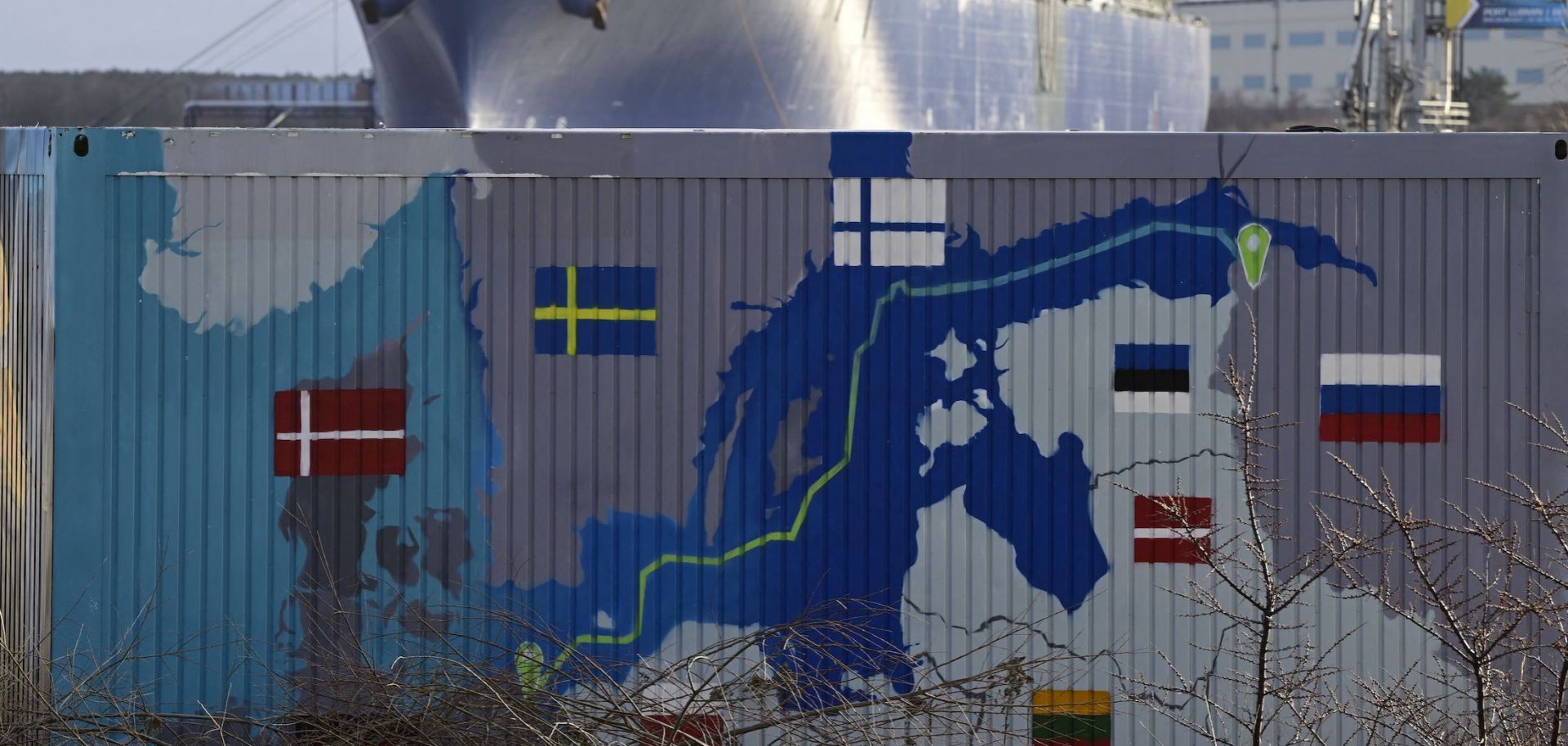
A floating storage and regasification unit (FSRU) is pictured behind a container painted with a map showing the Nord Stream 2 gas pipeline in Lubmin, northeastern Germany, on Jan. 14, 2023.
Allegations that pro-Ukrainian actors were behind last fall's sabotage of the Nord Stream pipelines reduce the perceived Russian threat to European oil and gas infrastructure, but could also undermine Western support for Ukraine. The extent to which this occurs will likely depend on whether the Ukrainian government is believed to have participated in the attack. On March 7, multiple Western news outlets published stories that U.S. and European officials believe pro-Ukrainian saboteurs were behind the September 2022 explosions that severely damaged the Nord Stream 1 and 2 natural gas pipelines, which are operated by Russia's state-owned gas giant Gazprom. Officials reportedly have no evidence to indicate that top Ukrainian leaders, including President Volodymyr Zelensky, directed or were aware of the operation. The anonymous sources cited in these reports say there remain many unknowns and declined to reveal any of the evidence informing their suspicions. However, the same day, Die Zeit and several other German media outlets reported that five men and one woman, all of whom used fake passports and were of unknown nationality, used a yacht hired by a Ukrainian-owned company in Poland to carry out the attacks. The yacht reportedly left a German port on Sept. 6, 2022 (nearly three weeks before the incidents began on Sept. 26) and was returned in an ''uncleaned'' fashion; German prosecutors were supposedly able to find evidence of explosives on a table in the yacht's cabin. On March 8, Germany's federal prosecutor's office confirmed that the yacht had been searched in January.
- In late September 2022, four leaks were detected on the Nord Stream 1 and 2 pipelines that carry Russian gas through the Baltic Sea to Germany. Neither pipeline system was delivering gas to Europe at the time, though were under pressure which led to the leaks. The leaks were soon assessed to be deliberate explosions; they also appeared to be very precisely targeted because the two attacks on Nord Stream 1 occurred just outside of Denmark's territorial waters, while Nord Stream 2 does not go through the country's sovereign territory at all.
- In the wake of the Nord Stream leaks, many Western governments immediately called out Russia as the likeliest perpetrator, accusing the Kremlin of orchestrating an attack as a form of coercive diplomacy against the West for its support for Ukraine. However, despite significant speculation, there has been no publicly revealed evidence clearly pointing toward Russia, which has always maintained its innocence and accused Kyiv and the West of being responsible.
- On March 8, Germany's defense minister warned that it was too early to jump to conclusions, hinting it could have been a Russian false flag operation and that it may not have been ordered by the Ukrainian government.
If Ukrainian nationals were indeed behind the attacks, it would reduce the overall threat that Russia may pose to oil and gas infrastructure in Europe, despite lingering risks. Originally, the speculation that the Nord Stream 1 and 2 attacks were the work of Russia led many to believe that Moscow had demonstrated its willingness to strike energy infrastructure in Europe (even if technically outside of EU maritime territory, as the explosions occurred just beyond Denmark's 12 nautical mile territorial waters). This raised concerns that Russia could carry out sabotage operations against other infrastructure, such as Norwegian or U.K. oil and gas infrastructure in the North Sea or the Baltic Pipe connecting Norway to Poland in the Baltic Sea. But if it turns out that Russia was not behind the attacks, then there is no precedent of Russian sabotage against EU oil and natural gas infrastructure in territorial waters or exclusive economic zones to point to as evidence that the Kremlin is willing to take such risks against NATO or likely future NATO countries, like Sweden. Still, even if the perceived risk to European oil and gas infrastructure is lower, Russian sabotage or accusation of sabotage on natural gas pipelines going through Ukraine remains a distinct possibility, as Ukraine is a war zone and Russian forces have repeatedly attacked critical infrastructure in the country. For southeastern Europe, this represents a continued energy security risk since the Ukrainian pipelines delivering Russian gas to Europe remain in operation (but natural gas delivered through those pipelines also goes to Hungary, which the Kremlin may not want to harm with gas cutoffs for fear of alienating its closest ally in the European Union). Finally, if Russia was not behind the Nord Stream attacks, it does not exclude the possibility of Moscow conducting cyber and/or physical attacks against other European infrastructure in the future, even if the likelihood of this scenario is reduced.
U.S. and European leaders will see the revelations as another sign that the Ukrainian government is failing to constrain its own conduct or that of its citizens. But while this will damage their trust in Kyiv, Ukraine's Western allies are unlikely to significantly scale back their support unless the Zelensky administration is found to be directly implicated. The allegations add to a list of incidents suspected to be the work of Ukraine that Kyiv's Western backers have indicated risked not only alienating European allies but expanding the war — a scenario that NATO countries first and foremost want to avoid. But while these previous incidents drew some concern from Western governments, they were immediately linked to the Ukrainian military and intelligence services. All of the incidents were also significantly less controversial compared with the sabotage of the Nord Stream pipelines, which are infrastructure for delivering gas to NATO countries. As long as the allegations continue to suggest that the attacks took place without the approval of the Ukrainian government, it is unlikely that additional revelations will override the strategic imperatives driving high Western support of Kyiv. If, however, evidence emerges that the Ukrainian government approved the action, it could significantly fracture the United States and other major Western nations' willingness to continue funneling money and weapons into Ukraine. Some Western officials would use Kyiv's involvement in the Nord Stream leaks to argue that a Ukrainian government unwilling or unable to constrain its actions (or those of citizens claiming to act on its behalf) could conduct escalation or unauthorized provocations intended to draw NATO into the war with Russia in order to prevent the West from agreeing to a de-facto Russian victory in Ukraine by not providing sufficient weapons for it to retake more of its territory.
- The incidents involving Ukrainian actions not necessarily approved by the West include the killing of ultranationalist journalist Daria Dugina inside Russia in an apparent attempt to assassinate her father, the strike damaging of the Kerch Strait Bridge linking Crimea to Russia, and drone strikes deep inside Russia that have destroyed Russian strategic bombers (which ultimately served as Moscow's primary argument for suspending its participation in the New START treaty with the United States).
Any Ukrainian involvement in the attack could undermine public support for Western governments' pro-Ukraine stance and embolden anti-war movements. Regardless of whether Kyiv was behind the attacks or if they were the actions of a pro-Ukraine sabotage group with no direct link to the Ukrainian state, media reports connecting the blasts to Ukraine could impact the public perception and narrative of the war in Ukraine across the United States and Europe. While the White House remains staunchly behind Kyiv, there are growing calls from some, mainly Republican, U.S. lawmakers to put upper limits on the amount of U.S. financial and military assistance to Ukraine. The recent news reports could thus not only add momentum to these calls, but also have longer-term impacts on the candidates vying for the U.S. presidency in 2024 elections. In Eastern Europe, support for Ukraine is likely to remain strong regardless of these events, because of the region's higher sense of threat regarding Russia. But in Western Europe, voices calling for an end to EU support for Ukraine could become louder — particularly in Germany, which has seen some of Europe's largest protests against the Ukraine war and Russian sanctions. These types of demonstrations in Germany and other Western European states (like Italy and France) will likely increase in frequency and intensity in the wake of the recent Nord Stream revelations. Such protests have so far had little effect on Western public opinion. But the allegations that pro-Ukrainian actors were behind the September pipeline attacks — combined with even bolder Russian propaganda that can now point to the incident as proof of Western lies about the war — could rally more widespread opposition against supporting Kyiv's war efforts and the country's accession to the European Union, especially if Kyiv's involvement is confirmed.
- At two recent hearings in the U.S. House of Representatives, Republican lawmakers pressed Pentagon officials about where money and military support for Ukraine is going. On March 8, U.S. House Speaker Kevin McCarthy also rejected an invitation from Zelensky to visit Kyiv, arguing that he didn't need to travel there to ensure that Ukraine did not receive a ''blank check.'' In addition, multiple recent surveys show that overall U.S. public support for Ukraine is decreasing, while the percentage of Americans who think their government is giving Kyiv too much aid is increasing.
- Mainstream government parties across Europe will not downplay the significance of the sabotage. But to mitigate the potential for protest and public backlash, they may try to divert attention from it by arguing Russia had already halted natural gas flows through the pipeline and pointing to other direct Russian responsibilities in the conflict, while at the same time casting doubts on any Ukrainian involvement.
- For months, regular anti-war rallies have taken place in Berlin and across several cities in eastern Germany, particularly Leipzig, that have stretched across both far-left and far-right political forces in the country. Before the sabotage incidents in September, German demonstrators had been demanding the reopening of the Nord Stream 1 pipeline to ease spiraling energy prices in 2022. On Feb. 24, marking the one-year anniversary of Russia's invasion of Ukraine, a demonstration against supplying Ukraine with weapons saw 13,000 people take to the streets in Berlin.
- Other countries besides Germany have experienced similar demonstrations, including the Czech Republic, which in September 2022 saw 70,000 protesters gather in Prague to oppose the government's support for Ukraine. Such protests have also taken place in France, Italy and the United Kingdom, but on a much smaller scale.
