
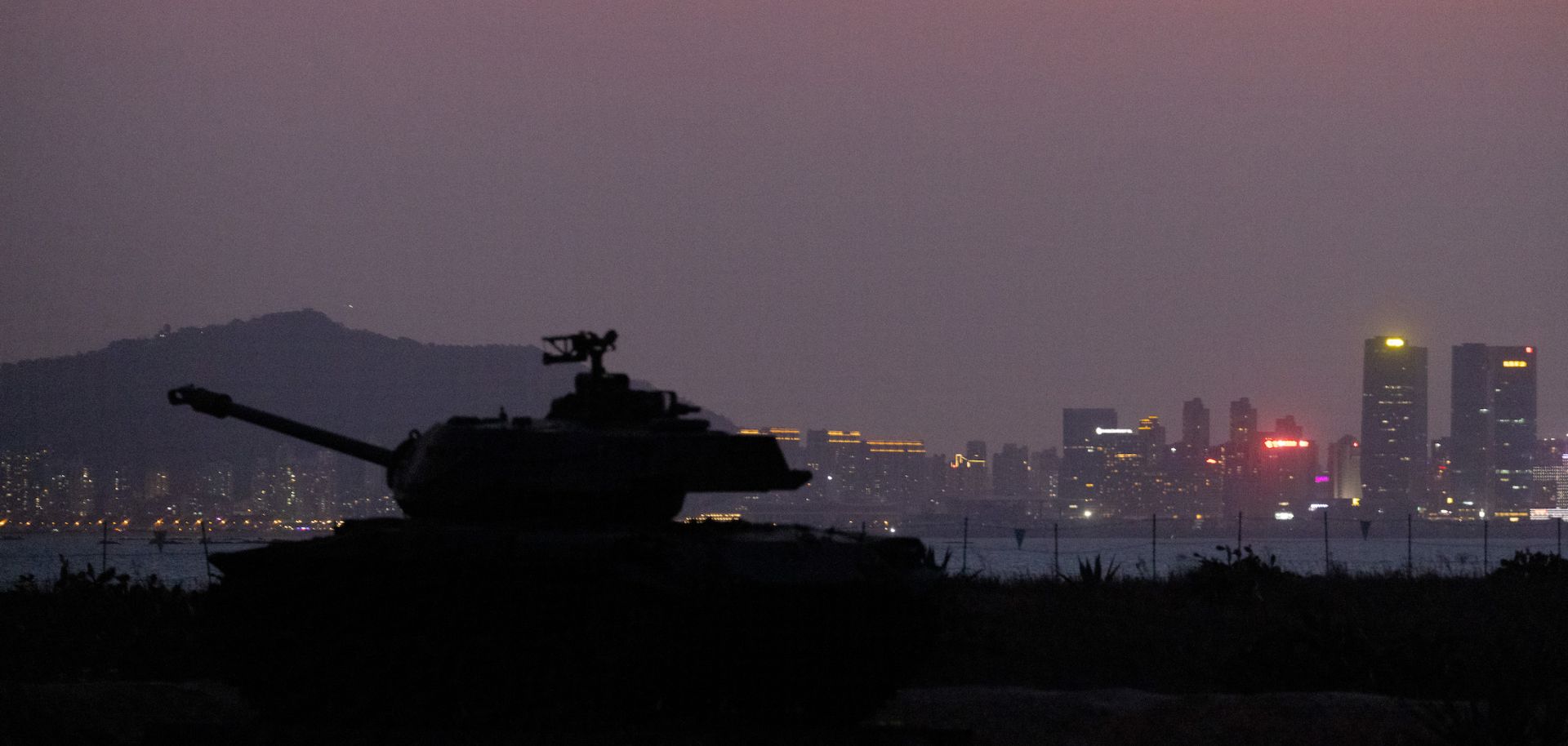
A Taiwanese tank on display for tourists is seen silhouetted against the skyline of the Chinese city Xiamen in Kinmen, Taiwan, an island in the Taiwan Strait that is part of Taiwan's territory.
Editor's Note: This assessment is the third in a four-part series that explores China-Taiwan relations through the lens of economics, politics, military affairs and regional relations. Part one can be found here, and part two can be found here.
China's military development is a crucial indicator of the likelihood and potential success of a Taiwan invasion. However, such an invasion remains unlikely in the next five years as China must still fill key gaps in its military evolution. In the meantime, China's military coercion of Taiwan will fuel the militarization of the Asia-Pacific region and risk scuttling China's diplomatic relations. China is the most dynamic player in the military balance of power in the Taiwan Strait. While the United States already has the most modern and strongest military in the world, its presence in Asia is only a portion of its total strength and its advancement is plagued by bureaucratic largesse, a contentious budgeting process and inconsistent development cycles. The Taiwanese military remains largely dependent on imported U.S. weapons, with a military budget less than one-tenth of China's and an immature indigenous arms industry. China's military has developed rapidly over the last 20 years and looks set to continue doing so over the next 20, which is the key variable to track for understanding the regional balance of power regarding a Taiwan invasion.
China's calculations for taking Taiwan are just as much geographic, both in regard to the strategic value of the island and the military tactics for taking it, as they are political. Taking Taiwan is, in part, a political goal for Beijing, with the Chinese Communist Party (CCP) looking to bolster its ruling legitimacy by uniting China's territory, deterring other restive Chinese regions (like Xinjiang and Tibet) from pursuing independence, and squashing Taiwan's liberal democratic political system, which contradicts Beijing's claim of the incompatibility of democracy with the Chinese ethnic people. The People's Liberation Army (PLA), as the protector of the CCP, is duty-bound to fulfill these political objectives by taking Taiwan. Geography is important, too, with Taiwan strategically located for China's national defense. In Beijing's eyes, if a foreign military power was able to project power from Taiwan (e.g., in the event of a Taiwan-U.S. defense agreement), its navy could split up China's northern and southern coastline, crippling China's ability to field the predominant military in the East and South China Seas and impeding China's north-south maritime trade. Moreover, taking Taiwan would enable the PLA to project maritime and air power beyond the first island chain that links Japan to Taiwan and the Philippines. This would secure near-sea dominance for China and enable the PLA to impede the operations of foreign militaries (especially the U.S. military) in the Philippine Sea, the Pacific Islands and the Western Pacific at large.
- The biggest geographical issue for a potential invasion of Taiwan by the PLA is the breadth of the Taiwan Strait (81 miles or 130 kilometers at its narrowest point), which would require extensive maritime supply chains for a massive landing force. These forces would be subject to monsoon weather, which would likely limit an initial invasion to between May and July or sometime in October. A number of outlying Taiwanese island groups, including the Penghu, Pratas, Matsu or Kinmen islands, could be the first steps for a Chinese invasion. However, taking these islands would alert the world to China's aggressive intentions toward the Taiwanese mainland, so an early strike on these islands would have limited strategic value.
- U.S. rotational forces on the northernmost Philippine island of Luzon and permanent forces in the southwestern Japanese prefecture of Okinawa are both within 350 miles (563 kilometers) of the Taiwanese mainland and would be a priority target for Chinese missile strikes in the initial stages of a Taiwan invasion. In this fashion, Beijing could aim to preemptively knock out U.S. response capabilities, giving the PLA time for a fait accompli against Taiwan. China may hold a similar view toward U.S. forces in South Korea; though technically such forces are bound to operations related to Korean defense, Beijing may view that in a Taiwan war scenario, these forces would also come to the aid of Taipei. Such early strikes would risk immediate declarations of war from the United States, Japan, the Philippines and potentially South Korea. Beijing would need to be confident of its ability to either take Taiwan quickly or fend off an extended Western retaliation campaign in its near seas before launching such strikes.
The Chinese military has been developing equipment to become the dominant military power in the Western Pacific, preparing China to win a war to reunify with Taiwan. The PLA has been on a decades-long campaign to build out a well-equipped blue-water navy such that China can defend its claims to nearby territories like the South China Sea and Taiwan and protect key sea lanes of communication — like the Straits of Malacca and Strait of Hormuz — in the event of a war, though this campaign is still a work in progress. China has been rapidly developing its destroyer class vessels, the muscle of any competent navy, and China's navy claims that its Type 055 is the world's second most advanced destroyer after the USS Zumwalt class destroyer. China has also been developing its carrier fleet, which would be useful for implementing no-fly zones around Taiwan. These, however, have much longer development time horizons, and China's carrier-class is believed to still be years, if not decades, behind the world's best. Anti-submarine warfare platforms are another major priority of Beijing, as any conflict over Taiwan would require cutting-edge ships to keep the Taiwan Strait clear of U.S. submarines to enable the Chinese navy a safe corridor to provide supplies to the landed army. Likewise, a Taiwan conflict would require China to field its own submarine fleet to fend off surface ships. On this account, China's navy has progressed rapidly, with its diesel-electric submarine fleet now the largest in the world. China's nuclear-powered submarine force — necessary for a covert and long-term deterrence presence far from China's coasts — remains underdeveloped comparatively, with the U.S. all-nuclear fleet of 64 vessels far surpassing China's fleet of 12. More important than the navy to China's dual military goals, however, is the PLA rocket force.
- China's military has prioritized developing the quantity and quality of its conventional missile force to enable China to respond to any maritime threat and conduct a successful invasion of Taiwan. China is believed to have the world's largest conventional missile stockpile, with over 2,200 ballistic and cruise missiles, including 1,000 of those within range of Taiwan. Moreover, between 2017 and 2019, China added 11 missile brigades (each with 4-6,000 troops), a 34% expansion in its force strength. China has also devoted heavy and sustained state funding to the latest missile technology, including various forms of hypersonic glide vehicles: super-fast missiles with flight trajectories that are believed to be capable of evading even the world's best missile defense systems.
- China's nuclear missile force is developing, too, with the U.S. Department of Defense projecting that China's warhead stockpile will have grown from 350 in 2022 (already the world's third-largest stockpile behind Russia and the United States) to 1,500 in 2035. U.S. Strategic Command also noted in January that China's combined number of land-based intercontinental ballistic missile launchers (both operational and under construction) had surpassed that of the United States (450) as of October 2022.
China's military doctrine has shifted to a theater-based military, deepened civil-military fusion and re-politicized the military, all of which will increase the PLA's jointness in operations and responsiveness to threats, though its decision-making capabilities may suffer. Beijing's overarching goal for the PLA is to prepare it to fight and win local wars — in China's near seas — in highly informationized conditions (i.e., with information and cyber warfare, constant surveillance and real-time mission coordination). Toward this aim, the most important of the PLA's doctrinal shifts was its change from a branch-based hierarchy (i.e., army, navy, air force) to a "theater"-based one — with local military branches reporting to regional theater commands — which was intended to decrease inter-branch rivalry and strengthen the military's ability to conduct joint operations. This jointness is crucial for a potential Taiwan invasion, which would involve coordinated early cyber and missile attacks, long supply chains connected to key ports as well as major rail and road arteries in China, air force and naval air power coordination for achieving air superiority, naval and army cooperation for a landing force, and cross-branch and inter-theater naval cooperation for patrolling the near seas. Increased jointness has also driven military training at the theater level in preparation for such complex and geographically expansive missions. Despite Beijing's intentions, there is still heavy inter-branch rivalry, as evidenced by the makeup of the Central Military Commission, China's top military coordinating body; four of its seven members are from the army, one is from the navy, one is from the rocket force, and none are from the air force or strategic support force, which is in charge of space, cyber and information warfare. The army remains the most politically powerful among the branches, originating in the civil war that brought the CCP to power and having ousted the Japanese occupation army. In this regard, the army predates the People's Republic of China itself, yet China's navy, air force, rocket force and strategic support force are arguably more important for a Taiwan invasion, which would be the largest amphibious invasion in world history.
- Though not a new concept (dating back to the 1980s), another key doctrine is China's military-civil fusion, which is critical to a Taiwan invasion scenario. This strategy aims to coordinate industrial development and research between the military and civilian sectors, such that both can catalyze the other's advancement, though in practice, the military benefits much more from this partnership. Regarding a Taiwan invasion, military-civil fusion aims to standardize civilian ship, port, rail and other infrastructure design specifications such that the military could quickly mobilize civilian assets for a war effort — e.g., by using cargo ships to transport military assets across the strait — though it is unclear how far along this standardization process is.
- Political reliability has been another priority of the CCP's management of the PLA — whose main responsibility is to defend the CCP, not China — especially since the military reforms of 2015. These reforms increased time spent on ideological training and bolstered the role of Party leaders (e.g., political commissars) in the PLA. This may improve the political reliability of the military, but in times of crisis, such as in the rapidly shifting battlefield realities of a Taiwan conflict, it could hinder decision-making if disagreements arose between the military leaders and the PLA party cadres. Furthermore, as the concept of political reliability is increasingly tied to aligning with Beijing's policy direction, a more loyal military could also fail to accurately inform Beijing of less politically palatable strategic realities in the regional balance of power, giving Beijing a false picture of China's military readiness or the motivations and capabilities of China's adversaries.
Despite this progress, China's main weakness remains its lack of experience in modern warfare. China's last major war was in 1979 when the PLA invaded Vietnam in response to Hanoi's invasion of Democratic Kampuchea (modern-day Cambodia). Since then, the PLA has participated in international anti-piracy operations off the Gulf of Aden since 2008, enabling Beijing to field-test its extended deployment and supply chain operations. China has also increased its participation in U.N. peacekeeping operations, becoming the second largest funder of such operations (behind the United States), and has sent over 50,000 troops to more than 30 U.N. missions, according to China's foreign ministry. Such operations have provided minimal combat experience, but they are valuable for deploying the PLA to work in diverse conditions and mission sets far from China's shores. Still, a Taiwan invasion would be a joint-force operation considerably more complicated than anti-piracy work or U.N. missions. The air force, strategic support force and rocket force are almost entirely untested, though China's accelerated pace of aircraft incursions into Taiwan's air defense identification zone since 2020 has provided modest experience interacting with adversarial air force and naval elements. Training with Russia's military in large and complex exercises has provided additional peacetime experience in various terrains. However, the PLA has little experience conducting some of the most important elements of a major amphibious invasion, like at-sea search and rescue operations, which would be necessary for a Taiwan Strait invasion, not only in the strait itself but also in the Philippine, South China and East China Seas, where Beijing could station one of its few aircraft carrier battle groups to fight for aerial dominance and to deter potential U.S., Japanese and Australian intervention.
China's military appears unready for a Taiwan invasion in the next five years, given the strength of a potential U.S.-led counter-campaign and the steep costs of a hasty attack. Since the Third Taiwan Strait Crisis of 1996 — during which an aircraft carrier battle group led by the USS Nimitz demonstrated U.S. naval superiority by sailing through the Taiwan Strait in response to Chinese missile tests in the waters around Taiwan — China's navy has transformed from a third-rate force into a formidable threat, among the world's top forces. Likewise, the PLA rocket force's missile arsenal now poses the threat of both swarm attacks and precision strikes against all maritime and land targets in China's periphery. But victory in a Taiwan invasion scenario is far from a foregone conclusion, with President Xi Jinping noting that his aim for the PLA is to have the capability (though not necessarily the objective) to take Taiwan by 2027. Despite its rapidly advancing destroyer class fleet, China's navy is still not guaranteed to maintain naval superiority in a Taiwan scenario. Though such a scenario would see a majority of China's fleet face off against only that portion of the U.S. military stationed in the Pacific, the PLA's submarine and carrier fleets — running on deprecated technology — and its anti-submarine warfare capabilities may still be insufficient to counter the U.S. Navy, especially its large and all-nuclear submarine fleet. Furthermore, with the PLA's training and readiness for war still considered subpar, especially given the magnitude and complexity of the world's largest amphibious invasion against Taiwan, it seems unlikely the PLA would invade anytime soon, lest Beijing destroy half of its hard-won navy while imploding China's economy amid the certain Western trade restrictions that would follow. Meanwhile, if the PLA fails to take Taiwan following an invasion, this military defeat could prove an insurmountable political loss to Xi, leading to a change of leadership and a dip in confidence in Beijing about China's national power.
Short of an invasion, China's military coercion against Taiwan risks accelerating the militarization of the Asia-Pacific, while Beijing's ability to fill the gaps in its capabilities will be key indicators for the likelihood of a Taiwan invasion and China's ability to truly become the world's top military. Until Beijing is confident of its ability to complete a fait accompli or successfully face down the U.S. military directly in a protracted war, China will slowly escalate its military coercion against Taiwan (e.g., via aerial incursions, naval deployments and occasional live-fire drills) in an attempt to convince Taipei and U.S. allies in Europe and East Asia that the pace of China's military development, paired with the high costs to human life and the global economy of a war over Taiwan (particularly if such a war involves the threat of nukes), make supporting Taiwanese independence not worthwhile. Though war is not imminent, China's military-focused new standard operating protocol toward Taiwan risks an escalatory spiral; as Beijing leans more on militarily coercive tools, the United States, Europe and U.S. allies in Asia will perceive a greater Chinese threat to regional stability, mobilizing their own militaries to counter China and (in some cases) better support Taiwan. These mobilizations will, in turn, convince Beijing of the need to up the intensity of its military deterrence efforts. Furthermore, the focus by China and the United States on this 2027 date drives greater military development, with Washington intent on countering the looming contingency of a Chinese invasion. This threat perception will catalyze the gradual economic decoupling between China and the West. It also raises the probability of a military collision or other incident in the Taiwan Strait. Although it is unlikely that such an incident would escalate to war, it could impede diplomatic ties between China and the other party involved (most likely the United States or Taiwan) for months or years to come.
- China's escalating military coercion against Taiwan will likely include greater incursions into Taiwan's air defense identification zone, effectively nullifying Taiwan's claims of projecting power beyond its contiguous zone (24 miles, or 39 kilometers, from the coast) and making Chinese air and naval superiority a local reality, albeit in peacetime. China will occasionally conduct live-fire drills to register its dismay with particularly irksome geopolitical developments around Taiwan and may even wield more de facto naval blockades against Taiwan, as it did in August 2022; such blockades have had the effect of bolstering Western and East Asian commitments to improve their own militaries amid a more tangible Chinese threat to regional stability. Thus, to present maximum deterrence without strengthening adversaries' militaries, Beijing will likely show some restraint in using de facto blockades.
