
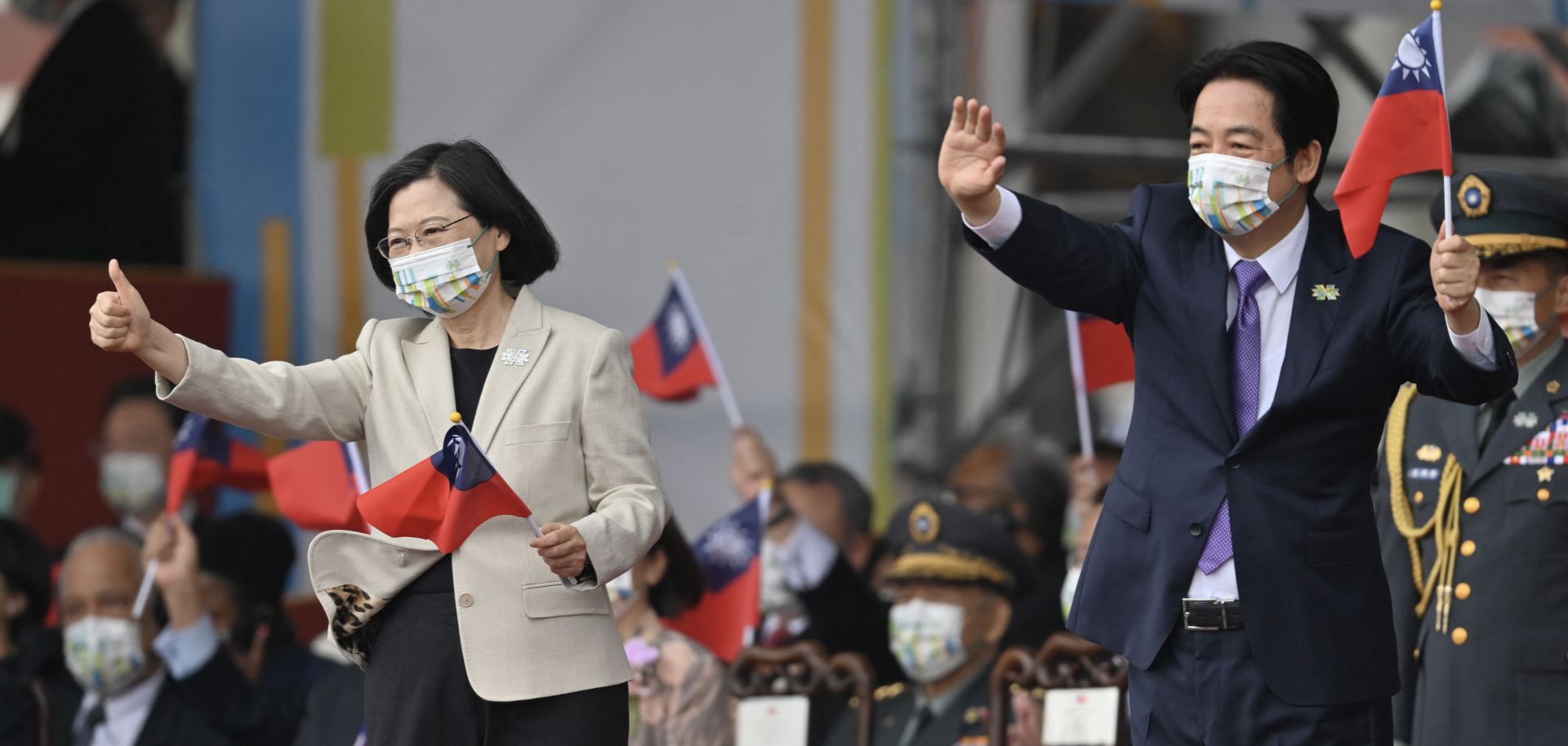
Taiwanese President Tsai Ing-wen (left) and Vice President William Lai attend a ceremony to mark the island's National Day in front of the Presidential Office in Taipei on Oct. 10, 2022.
Editor's Note: This assessment is an update to part two in a series that explores China-Taiwan relations through the lens of Taiwan's economy, politics, military affairs and regional relations. Since the original piece was published in September 2021, much has changed in Taiwanese politics that warrants a reexamination.
Taiwanese politics hinges on issues of sovereignty and economic growth, with an increasingly centrist society constraining the improvement of relations with both the United States and China. Meanwhile, Beijing will continue to wield coercive policies no matter which party governs Taipei. At the heart of Taiwanese politics are two parties looking to redefine themselves in light of a changing society. The ruling Democratic Progressive Party (DPP) and opposition Kuomintang (KMT) are trying to significantly alter their agendas ahead of Taiwan's January 2024 presidential and legislative elections to satisfy the complex demands of a largely politically independent populace that is disenchanted with its limited choices for electoral representation. These demands range from national issues like economic growth and defending Taiwan's sovereignty from Chinese aggression, to local concerns like corruption and public health management.
- The DPP paints itself as the defender of Taiwan's sovereignty against China's political, military and economic coercive efforts. But this stance sometimes places the party at odds with Taiwan's economic growth, as China is the island's top trade partner. The DPP suffered a significant loss to the KMT in local elections held in November 2022, but these elections are often focused on parochial issues like city management of COVID-19 and corruption scandals. Nonetheless, the party's leadership and public image were weakened in November when President Tsai Ing-wen resigned as chair of the DPP following the electoral loss.
- The KMT has been traditionally friendlier to China and acts as the face of Taiwanese business interests, which want to maintain cross-strait relations insofar as they facilitate trade and investment. But the party has struggled to shake its geriatric image among Taiwan's youth. The KMT has also struggled to firm up its noncommittal stance on Taiwanese sovereignty over the last 10 years amid Chinese President Xi Jinping's adamance about pursuing cross-strait reunification — a prospect widely unpopular among Taiwanese citizens. Taiwan's economic downturn may play in the KMT's favor in the 2024 ballot, but sovereignty issues are also more salient in national elections, and success in local elections traditionally does not translate to electoral gains at the national level.
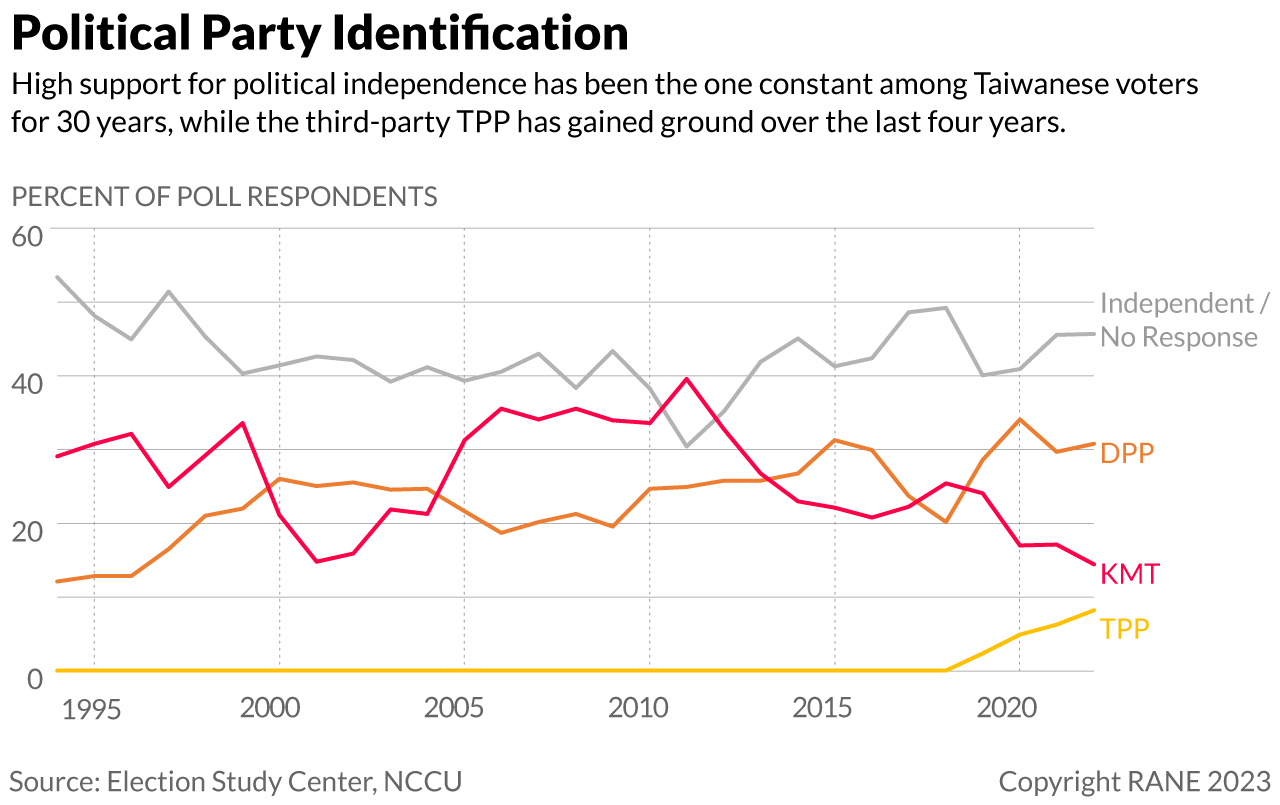
- Taiwan's two-party system has always been somewhat fragmented, with third parties like the Taiwan People's Party (TPP) periodically gaining significant sway in politics. As of 2022, the TPP (which was only founded in 2019) had garnered 8.2% of public support. This is partially driven by the bulk of Taiwanese people identifying as politically independent, wanting to preserve Taiwan's economic prospects and its sovereignty. For TPP leader Ko Wen-je, catering to this broad constituency has meant supporting cross-strait business ties while criticizing China's military aggression.
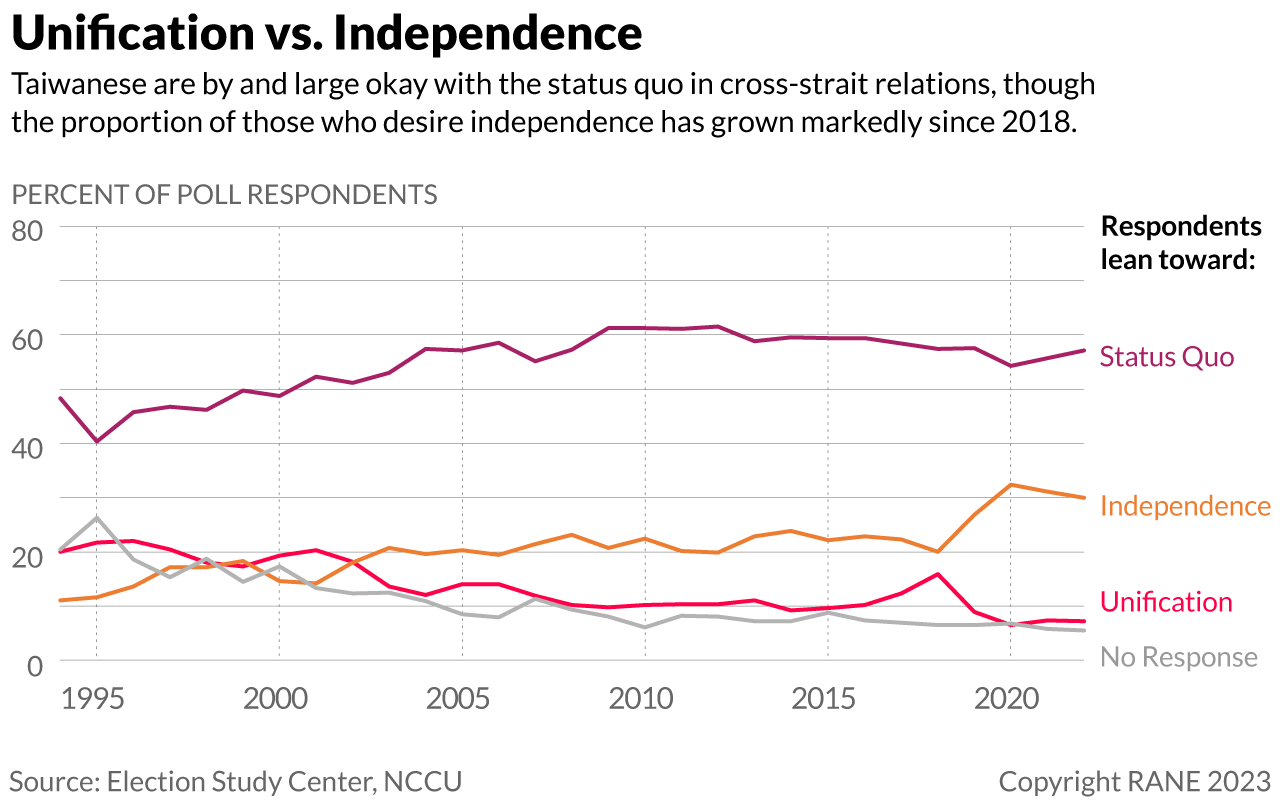
Over the past decade, Beijing's stance toward Taiwan has become increasingly threatening, with President Xi pushing cross-strait reunification on Beijing's terms and leaving Taiwan's political parties with little room for negotiation. Since coming to power in 2012, Xi has publicly asserted that reunification with Taiwan can only take place under China's ''one country, two systems'' governing model, in which Beijing allows limited (faux) political autonomy for regions like Hong Kong, Xinjiang and Tibet. This has broken a decades-old, unspoken agreement between Taipei and Beijing that both would allow the other to maintain their own visions of what amicable reunification might look like. It has also forced the more pro-China KMT into a corner, given that Taiwanese citizens are uniformly opposed to the one country, two systems model. In addition, Xi has directly associated cross-strait reunification with his ''great rejuvenation'' goal of restoring China's place as a leading global superpower, which involves showing the world the supremacy of the socialist model and Chinese ''democratic centralism'' (one-party politics) — systems that Xi has directly contrasted to Western capitalism and democratic liberalism. And he has positioned himself in Chinese Communist Party doctrine as the one and only person who could lead China to achieve this rejuvenation. This ideology and one-man rule stand in direct opposition to Taiwan's healthy democracy and capitalist markets, a rare combination in Asia and a system of which Taiwanese citizens are quite proud. Moreover, in the face of recent DPP presidential wins and Western (especially U.S.) efforts to strengthen ties with Taiwan, Beijing has resorted to greater military coercion in hopes of convincing Taipei to stop pushing the sovereignty issue and convincing the West that closer ties with Taiwan are not worth risking war with China. This military coercion has led many Taiwanese to believe that China is a bully that can't be reasoned with, though some contest that Taipei's efforts to strengthen ties with the West are unnecessarily provocative to China.
- Since former President Ma Ying-jeou (KMT) stepped down and current President Tsai Ing-wen (DPP) assumed office in 2016, Beijing has treated Taipei as a radical government run by ''separatists.'' Since then, China has cut off cross-strait diplomatic channels, shut Taiwan out of international institutions, and poached Taiwan's few formal diplomatic partners. This is despite Tsai's pro-status-quo stance and her efforts to forestall policy actions by pro-independence legislators within the DPP that could provoke China.
- Since 2017, the United States and (to a lesser extent) European partners like the United Kingdom, Germany and France have increased the frequency of their diplomatic visits to Taiwan. This culminated in then-U.S. House Speaker Nancy Pelosi's trip to Taipei to meet with Tsai in August 2022, the first such visit by a sitting House Speaker in a quarter-century.
- In the last three years, Beijing has increasingly wielded military coercive methods against Taiwan. These have included more frequent and larger incursions by People's Liberation Army (PLA) aircraft into Taiwan's Air Defense Identification Zone, amphibious landing drills and positioning PLA Navy vessels off Taiwan's coasts, along with the live-fire military drills conducted following Pelosi's controversial visit in August (which involved missile strikes just outside of Taiwan's territorial waters).
- In August 2022, Beijing published its third white paper on Taiwan (the first update since 2000), which stated that one country, two systems is a basic principle ''for resolving the Taiwan question'' and ''the best approach to realizing national reunification."
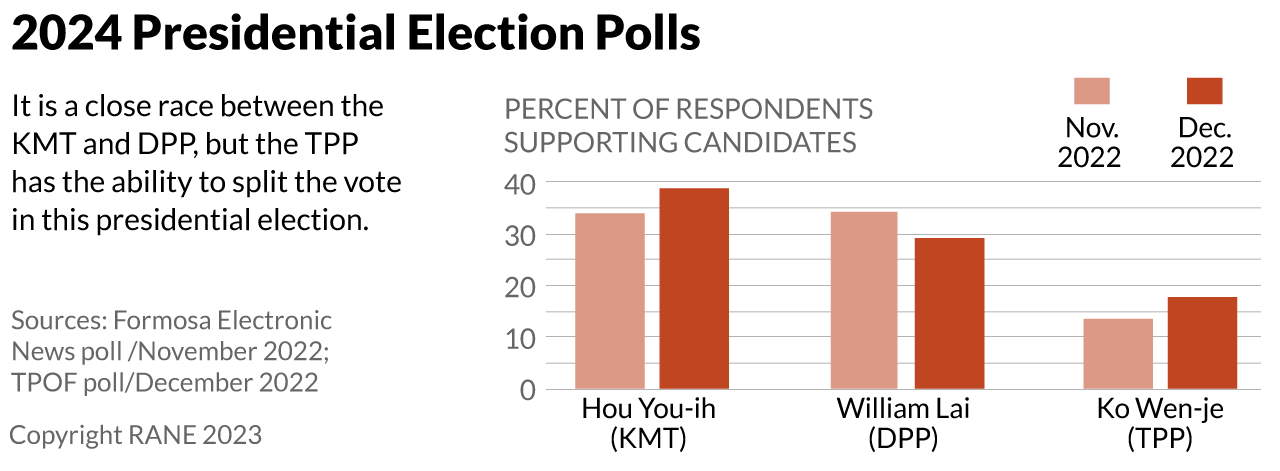
According to polls, Taiwan's next election could produce a divided legislature, which would result in policy gridlock on economic and national security matters. It is far from certain whether likely DPP candidate (and current Taiwanese Vice President) William Lai will be able to beat likely KMT candidate (and current New Taipei mayor) Hou You-ih in the 2024 presidential election. And the TPP's Ko Wen-je could split the vote for either of the two main parties or throw his support behind one of them. A November Formusa poll shows Hou (33.8%) barely losing to Lai (34.3%), but a December poll by Taiwan Public Opinion Foundation shows Hou winning handily (38.7%) over Lai (29%), while both polls showed Ko garnering 14-18% of the vote. If this close race continues, the Legislative Yuan could be divided, with the KMT or DPP reliant on a coalition with the TPP to secure a majority of votes. In light of Taiwan's antagonistic politics, a divided legislature could make passing legislation even harder over the next four years, holding up bills to expand Taiwan's economic ties (e.g. via trade pacts with the United States) or preventing talent poaching in the island's crucial semiconductor sector. Over the next year, several developments could yet sway the election results, including:
- An economic downturn. The DPP could manage the economy poorly and/or get blamed for a slowdown in Taiwanese exports stemming from a global economic downturn over 2023.
- Fumbled messaging on sovereignty. The KMT could lose support if it fails to offer a solid stance on Taiwan's sovereignty for the centrist majority of voters who care more about cross-strait issues in national elections than they do in local ones.
- Increased Chinese aggression. Beijing could scuttle the KMT's chances if it launches more military drills around Taiwan, e.g. in response to a possible visit by U.S. House Speaker Kevin McCarthy to the island. In addition, China could crack down again on Hong Kong (which swayed Taiwan's 2020 presidential election toward the DPP) by, for example, expanding the implementation and enforcement of the National Security Law to target more citizens with trumped-up charges of sedition and subversion.
If the DPP is re-elected in 2024, China will continue increasing military coercion against Taiwan, while a KMT win could bring limited cross-strait cooperation. But in either case, questions of sovereignty would linger and the U.S.-China competition for Indo-Pacific dominance would persist. If the DPP is able to extend its eight-year reign, the prospects for peaceful reunification with China would remain slim to none. To express its dismay over this reality, Beijing would increasingly wield military coercion against the new Lai administration, including increased overflights of Taiwan's Air Defense Identification Zone (ADIZ) and naval drills around Taiwan, as well as live-fire military drills whenever Beijing wished to reprimand Taipei and/or Western capitals for particularly egregious provocations around Taiwan. This would deepen Western concerns about China's military predations vis-a-vis Taiwan and further justify the actions of a growing coalition of countries, led by the United States, to expand their security footprint in the Indo-Pacific and prevent China from achieving regional predominance. If the KMT wins, cross-strait relations would improve, with Hou pursuing deeper trade relations with China and Beijing resuming diplomatic channels. But the lingering question of sovereignty would limit the extent of this rapprochement. Hou, like Taiwan's previous KMT president Ma Ying-jeou (2008-2016), would be bound by the Taiwanese voters' distrust of China to limit any political negotiations that might suggest Taiwan's lack of statehood. Thus, Beijing would maintain economic coercion (especially customs restrictions) and limited military coercion (e.g. ADIZ overflights) as tools of leverage against Taiwan, particularly as Xi ages and becomes impatient with the lack of progress he's seen on reunification since taking office in 2012. The KMT may reduce the pace of diplomatic visits with Western nations as a means of easing tensions with China, but this wouldn't keep the United States (and China) from continuing to prepare for an eventual military confrontation in the Indo-Pacific. Hou's leadership may also reduce Europe's security concerns around Taiwan in the short term, leading to a reduction in European countries' freedom of navigation operations. But the persistence of cross-strait tensions, even under KMT leadership, would still sustain the slow, long-term expansion of the Western military presence in the Indo-Pacific.
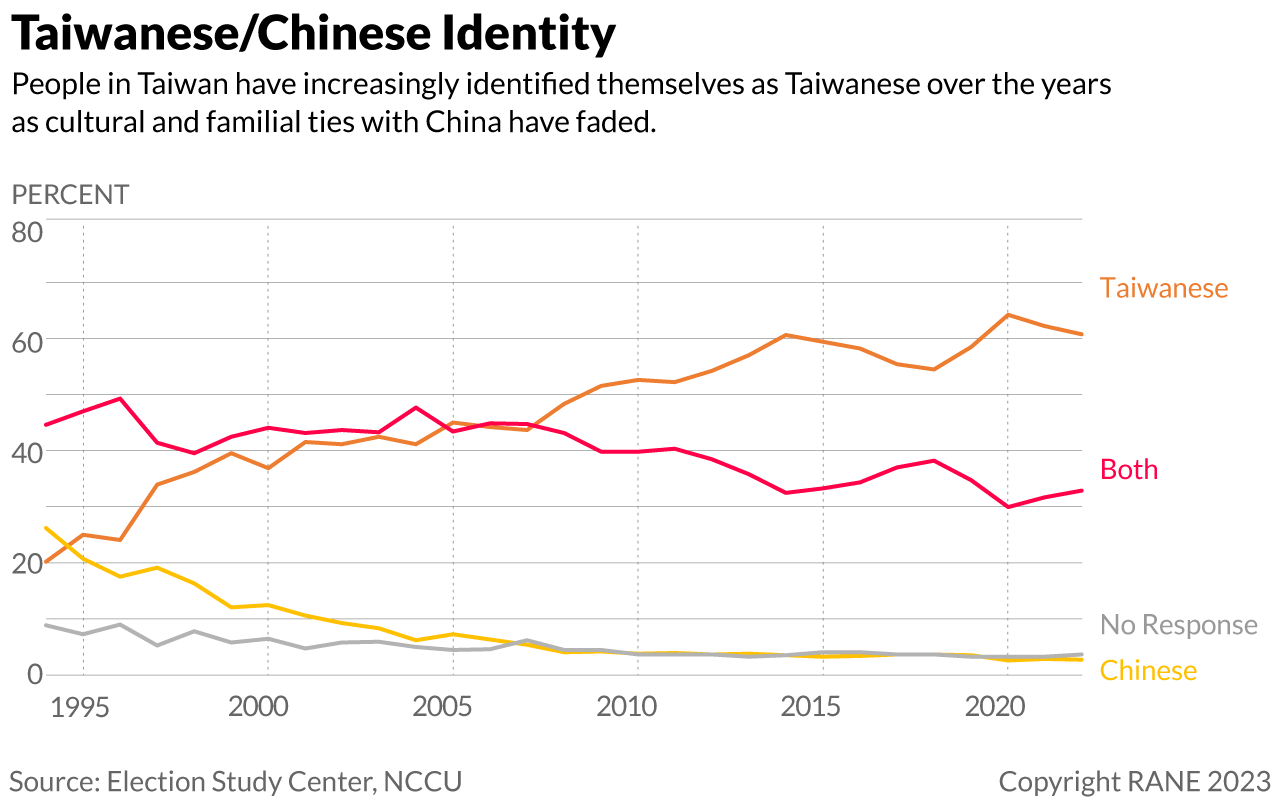
Shifting domestic sentiment and party preferences will prevent the KMT and the DPP from pursuing extreme policies regarding the country's relations with China, making Taiwanese politics a game of pandering to moderates. A steadily growing Taiwanese identity and comparative societal apathy about cultural ties to China, as well as the desire among Taiwanese people to maintain their country's de facto independence, will prevent Taiwan's political parties from growing too close to Beijing. Meanwhile, the rising popularity of the third-party TPP could win it a spot as a minority coalition partner in the legislature. These political and ideological shifts could quash policies that would either provoke or align too closely with China, stopping the DPP from passing pro-sovereignty legislation (e.g. constitutional changes that would reduce references to reunification) and preventing the KMT from making political concessions to China in the midst of trade negotiations. Within this context, any perceived sovereignty concessions made by Taipei could prompt renewed unrest and activist political movements in Taiwan (like the Sunflower Student Movement of 2014, which nurtured a generation of DPP supporters). Besides amplifying the DPP's agenda, this could herald a new freeze in cross-strait relations. These combined constraints will also increasingly force Taiwanese presidents and lawmakers to pitch toward centrist voters, rather than toward hard-liners on either side, in order to get in office and stay in office.
The political imperative of providing economic growth will drive Taipei under any administration to optimize trade and investment ties with both Beijing and Washington, though political sensitivities will complicate this comprehensive approach. Taiwan's need for economic growth will prevent its political parties from adopting a U.S.-style limited sectoral decoupling with China, which is unrealistic given that China purchases nearly 38% of Taiwan's exports as of November 2022. And Taipei's deepening supply chain connections with the United States and Europe, particularly in the crucial chips sector, will require that Taipei nurtures Western ties as well. But any efforts by Taipei to progress on a trade and investment agreement with the United States — a priority of the DPP — could reduce the chances of Taipei expanding similar ties with Beijing, given the latter's stance that foreign trade agreements with Taipei should be negotiated via Beijing. The converse case is likely not true, however; if Taipei pursued expanded trade and investment ties with Beijing first — a key focus of the KMT — and then sought the same with the United States, Washington would engage in bilateral talks to maintain the strategic relationship (but such talks could still ruin Taipei's newly expanded ties with Beijing post hoc). Any failure by Taipei to manage either the sovereignty or economic growth issues could prompt political turnover and potentially even greater support for Taiwan's third parties. And both the KMT and DPP's approach toward balancing economic ties with China and the United States will carry that risk.
