
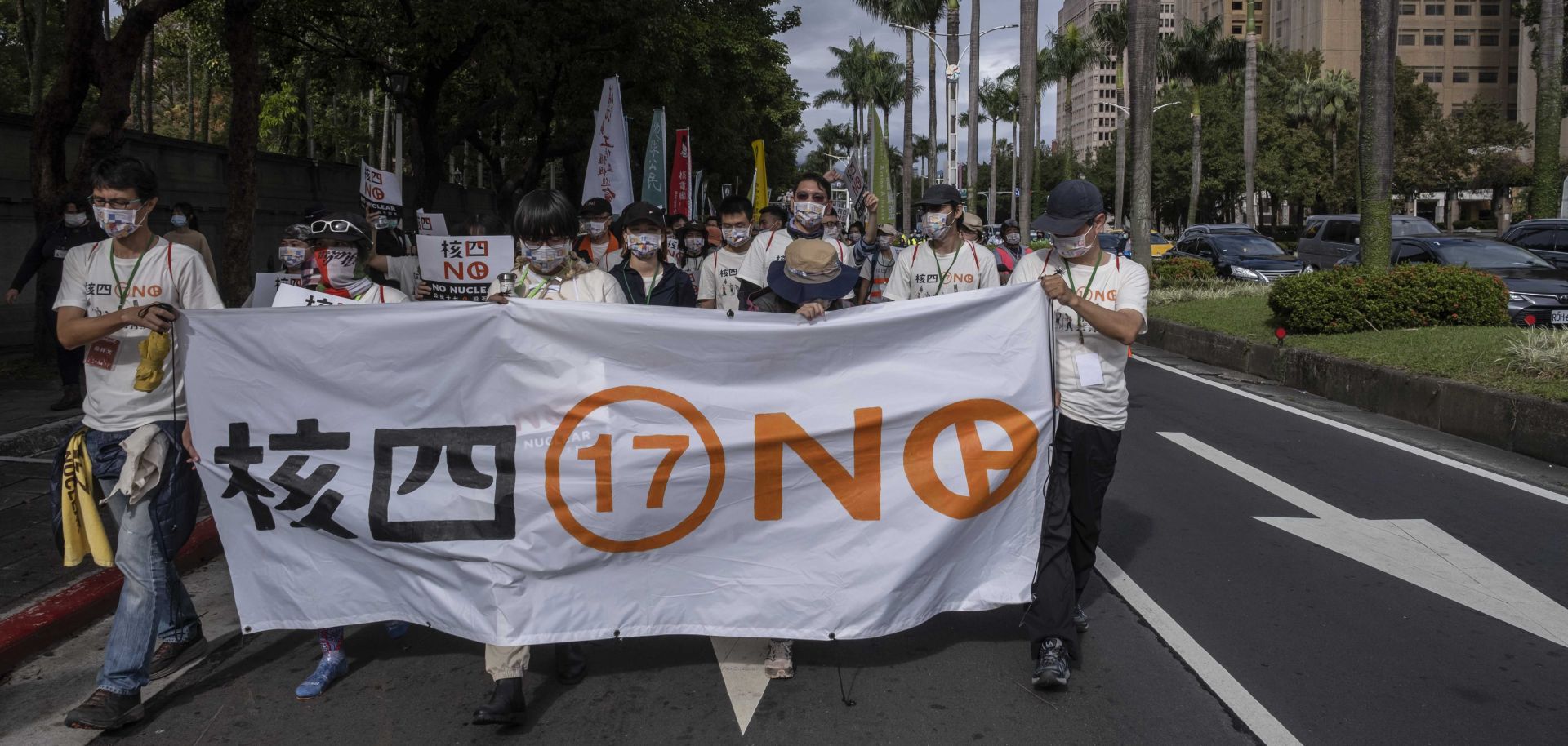
Activists march down a street in Taipei, Taiwan, to protest restarting construction on a nuclear power plant on Dec. 4, 2021.
Taiwan’s recent referendum handed a victory to the ruling Democratic Progressive Party (DPP) — which champions Taipei’s sovereignty — limiting democratic obstructionism and presaging greater prospects for a U.S.-Taiwan trade deal, as well as increased Chinese efforts at political coercion on the island. A four-question referendum in Taiwan failed to pass on Dec. 18 as the number of “no” votes exceeded “yes” votes on all questions and the minimum number of voters (a quarter of the electorate) failed to vote “yes” on any of the measures. The referendum included propositions to restart construction on the Lungmen nuclear power plant, relocate a liquified natural gas (LNG) import terminal project away from the Datan Algal Reef, ban imports of U.S. pork with ractopamine additives, and schedule referendums contemporaneously with national elections. Lin wei-chou, deputy secretary-general of Taiwan’s opposition Kuomintang (KMT) party, which is more pro-Beijing, resigned to take responsibility for the referendum defeat.
- Though Taiwan has a history of referendums, this one was championed by the KMT as an effort to show public dissatisfaction with the DPP.
- The KMT was urging citizens to vote “yes” on all four questions, while the DPP was pushing “no” votes across the board. The final results showed between 51-53% voting “no,” depending on the question, with over 8 million citizens (or around 41% of Taiwan’s electorate) casting votes.
- These referendums have tended to serve as direct democracy tools for the main opposition party to wield in an obstructionist manner against the ruling party by having citizens vote directly on issues for which the opposition has insufficient votes to change in the legislature, resulting in rapid policy oscillations on matters like import barriers and the energy transition.
The results show continued public support for President Tsai Ing-wen’s DPP and limit the obstructionist power of referendums to Taiwan’s democracy. Given the politically polarized referendum — with each party supporting either all “yes” or all “no” votes — the results showed continued support for the DPP and President Tsai, which bodes well for the ruling party in November 2022 local elections.
- The failure to reschedule referendums on national election dates, which would vastly increase voter participation and increase the odds of referendum questions passing, also limits the power of both parties to wield referendums as a more effective tool of policy obstruction via direct democracy in the future, particularly when the legislature and executive branch are in the hands of the same party (like they are right now for the DPP).
- KMT Chairman Eric Chu’s continued leadership of the opposition after the failed referendum suggests an old guard, conservative KMT that continues to emphasize improved trade relations with China, as well as good relations with the United States. This platform will continue to skew farther from Taiwan’s center-left populace, which is wary of Beijing’s influence.
Outside of Taiwan, the referendum will improve prospects for a U.S.-Taiwan trade agreement and prompt Beijing to increase political coercion against Taiwan under Tsai and the DPP. The rejection of a ban on U.S. pork imports removes one of the largest obstacles to a future U.S.-Taiwan trade agreement, which has bipartisan support in the United States. Though trade pacts tend to move at a glacial pace, an eventual deal could help Taiwan reduce its trade dependence on China — a key goal of President Tsai’s, given the potential for political coercion that comes with strong economic ties to China. Continued public support for Tsai’s DPP will also encourage Beijing to further increase its political and economic coercion against Taiwan. In the past, this coercion has taken the form of extensive election interference, bans on Taiwanese goods produced by key DPP constituencies, and leaning heavily on the broader Taiwanese business community to distance itself from the DPP.
- In November, Chinese authorities suggested “pro-independence” businesses in Taiwan would be penalized, including a potential ban from conducting business in China.
- In 2020, China purchased 44% of Taiwan’s goods exports (by value) and 23% of Taiwan’s goods imports came from China, compared with 30% and 12% for Taiwan’s trade with the United States, respectively.
