
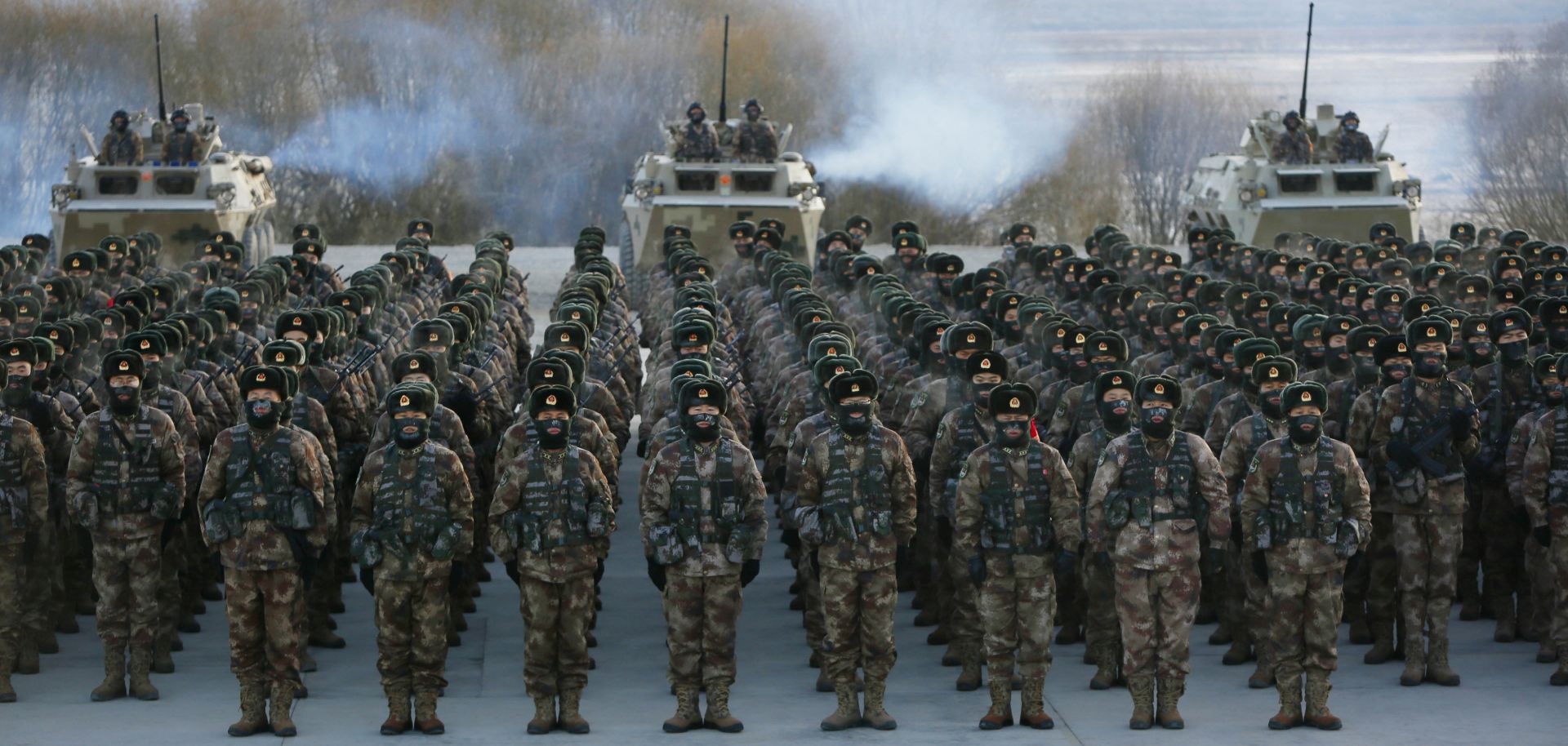
A photo taken on Jan. 4, 2021, shows Chinese soldiers assembling during military training in China's Xinjiang region.
Editor’s Note: This is the first of a two-part column exploring the challenges China would face in a theoretical invasion of Taiwan and the areas where Beijing has already improved its capabilities for such an ambitious military operation. The primary author, Zeke Cooper, is an Applied Geopolitics Fellow at RANE who has conducted significant research on China-Taiwan relations.
We’ve assessed that China is unlikely to invade Taiwan in the next five years. However, as cross-Strait tensions rise, it is important to review the evolution of China’s information and military capabilities, a key factor in forecasting both the likelihood and outcome of any potential conflict. The below analysis is not a full assessment of China’s political will for an invasion, nor is it a full assessment of China’s military capability and capacity. Rather, it’s an exercise to test and challenge our internal assumptions and identify areas for deeper focus.
The Taiwan Question
In August, the Chinese Communist Party (CCP) published a white paper entitled “The Taiwan Question and China's Reunification in the New Era.” The document reiterated the long-held position that the island is a part of the People’s Republic of China, stating that “resolving the Taiwan question and realizing China's complete reunification is a shared aspiration of all the sons and daughters of the Chinese nation.”
This assertion lies at the heart of Beijing’s “right” to stop any move toward formal Taiwanese independence, and has been informally codified internationally through the willingness of many countries to adhere to Beijing’s “One China” policy. While Chinese President Xi Jinping’s stated goal remains peaceful reunification, the Chinese leadership does not rule out military options and has stepped up defense reforms, arms procurement and training to ensure China has sufficient capabilities in a future Taiwan war scenario.
Russia’s ongoing conflict in Ukraine has reinvigorated assertions in Western media and political spheres that China may be preparing to invade Taiwan. But the Ukraine conflict has also reminded Beijing of the difficulties of using war to achieve political aims. A direct comparison between Ukraine and Taiwan is also flawed. Taiwan represents a maritime military operation, a different logistical consideration from Russia’s land war in Ukraine. Taiwan’s separation from mainland China also occurred decades before Ukraine’s from Russia, and Moscow has been engaged in direct military action and occupation of parts of Ukraine since at least 2014. On the other hand, NATO — which sits astride Ukraine — includes several former members of the Soviet Union or former East Bloc countries, potentially limiting Russia’s willingness to press the Ukraine crisis beyond that nation’s borders. The Indo-Pacific has no such formal multilateral alliance, and the maritime space may provide China with additional room for military operations and an easier ability to disrupt foreign military supplies to the island.
Any Chinese action must consider not only the maritime nature of the conflict but also the role of the United States. Beijing must either deter or degrade U.S. capabilities to be successful in using military coercion to shape Taiwan’s political future. For Beijing, that is both a physical and political task — the former demonstrating China’s military capabilities and reach, and the latter its use of information as a tool of political warfare to shape the environment. China has substantially increased its deterrence capability over the past two decades, raising the cost of U.S. intervention, but Beijing must still consider U.S. political will.
As we review a theoretical war over a Chinese invasion of Taiwan, we will look at three basic phases: Shaping the Environment, the Initial Invasion, and Consolidating Gains. Each phase focuses on different Chinese capabilities, and different aspects of potential U.S. or international intervention.
Shaping the Environment
China considers warfare a constant reality, even if not always carried out by force. The CPC has invested heavily in narrative warfare, designed to shape the perceptions of rivals from peacetime through kinetic warfare. One construct is the so-called three warfares (sanzhan), consisting of psychological warfare (xinlizhan), public opinion warfare (yulunzhan) and legal warfare (faluzhan). The first targets perceptions abroad, creating uncertainty and disunity in opposing societies and governments. The second focuses heavily on domestic propaganda, ensuring national political and social cohesion and support. And the third focuses on shaping Chinese actions within global legal frameworks, even if Beijing’s own interpretations are somewhat unique.
Domestically, China would use information operations and narrative warfare to shape public perceptions and build support for any future conflict. By drawing on historical examples from the so-called “century of humiliation” that China suffered at the hands of foreign powers from the 1840s-1940s, the CCP would continue to promote narratives that it aims to protect Taiwan from foreign influence. The CCP might portray the Taiwanese government as captured by so-called “separatists” and oppressive to its people, and thus justify the invasion under a humanitarian pretense. Under such conditions, Chinese nationalists would champion a forceful reunification with Taiwan in order to supposedly save it from foreign domination.
Already, Beijing emphasizes that any change in the status quo around Taiwan is driven by Western “interference,” and that it is the West, led by the United States, which is ratcheting up tensions and goading Taiwan to break from China. This places blame for any outbreak of conflict on the United States and allows Beijing to assert it is in a defensive war, something that will resonate more strongly domestically than an offensive operation. Beijing has already used this narrative to defend Russia’s invasion of Ukraine as an act of “self-defense.”
China would also use information operations in Taiwan to discourage political unity and reduce support for any formal move toward de jure independence. Simple narratives the CPC would likely deploy include highlighting the close cultural and historical ties between Taiwan and the mainland, the economic advantages of close cooperation, and the physical devastation of a potential invasion.
The narrative of defending Taiwan from outside meddling also helps China shape international views — predominantly among developing nations in the global south, potentially weakening condemnation in the United Nations and reducing support for any Western sanctions or other coercive or punitive measures against Beijing. While Beijing’s overseas information operations have not been as sophisticated as those of Russia, Chinese capabilities are improving; in particular, they have been more effective in both Chinese-language areas and in countries still struggling with postcolonial identities (especially in sub-Saharan Africa and Latin America).
Information warfare and physical warfare intersect in Beijing’s positioning of military assets, demonstration of capabilities and assertion of doctrine. Perceptions of China’s capabilities and political will in both Taiwan and elsewhere are shaped by China’s efforts to demonstrate greater range, accuracy and maneuverability of longer-range anti-ship missiles, build up artificial islands in the South China Sea as bases of operations for anti-ship and/or anti-aircraft systems, carry out frequent air incursions around Taiwan, and conduct expanded combined arms exercises near the island. For China, these actions are both part of the preparation for any theoretical conflict that may erupt, but also ways to avoid confrontation in the first place by showing the supposed costs that would follow Taiwan moving closer to de jure independence.
On the one hand, repeated incursions by Chinese fighter jets over Taiwan overwhelm and desensitize Taiwan’s sensors to Chinese violations of their airspace and give Chinese forces valuable knowledge. Over 900 Chinese military aircraft entered Taiwan’s southwestern airspace last year — more than double the roughly 380 aircraft that did so in 2020. And in just August 2022 alone, 446 Chinese aircraft entered Taiwan’s air defense identification zone in response to U.S. House Speaker Nancy Pelosi’s controversial visit to Taiwan. By probing the weapons engagement zones of integrated air defense systems, China’s military — known as the People’s Liberation Army (PLA) — could develop a profile of Taiwan’s defensive tactics, techniques, and procedures (TTPs) to exploit in a future conflict.
On the other hand, if Beijing can show that it has the ability to quickly overwhelm Taiwanese defenses, or deter and disrupt U.S. military activity in the region, it can weaken Taiwanese confidence in active U.S. support and create uncertainty inside the United States itself — raising questions of the cost-benefit analysis of facing off against China just to preserve Taiwan’s de facto independence.
Preparations for potential conflict in Taiwan would need to begin months or even years before the operation. Resources, personnel and material would be marshaled from across mainland China and staged near sea and air points of departure. China understands it will be impossible to conceal the movement of forces from the overhead intelligence, surveillance and reconnaissance systems. Civilian and military space-based sensors will observe areas of interest to provide indications and warnings of an impending attack. Thus, obfuscation rather than concealment will be China’s strategy.
Rather than conceal troop and equipment movements, the PLA will conduct a series of large-scale exercises to desensitize allied sensors, increasing the likelihood that the movement of large numbers of personnel and resources would be interpreted as routine or escalating exercises rather than staging for an invasion. However, the presence of medical infrastructure, recovery equipment or salvage vessels might be a reliable indicator of imminent action, as would the wide-scale retrofitting of commercial cargo vessels to carry military assets (e.g. with heavy-duty decking). This plan might also suffer from the fact that Russia tried nearly this precise same strategy before invading Ukraine, which U.S. intelligence officials repeatedly warned publicly was a thinly veiled preparation for an attack.
This active phase of environment shaping has the greatest potential for accidental escalation. The PLA would likely conduct larger and longer operations closer to the territorial waters of Taiwan, especially live-fire exercises involving forces off the east coast of the island, which signal Beijing’s willingness and capability to interfere with any foreign reinforcement of Taiwan’s capabilities. Beijing might also dispatch a constant rotational seaborne presence on Taiwan’s east coast to validate its ability to cordon off the island and potentially disrupt U.S.-led forces if hostilities break out. Taiwanese forces may amend their TTPs to meet or closely observe Chinese vessels or aircraft within their territory. The United States would likely increase its freedom of navigation operations, defense training and exercises, and close surveillance of the waters near Taiwan. The heightened pace of activity increases the risk of miscalculation or accidental collision, something that in a tense environment could lead to rapid escalation.
In the second part of this column, we’ll look at what an initial invasion of Taiwan may look like and the steps China needs to take to consolidate its gains should such an invasion succeed.
