
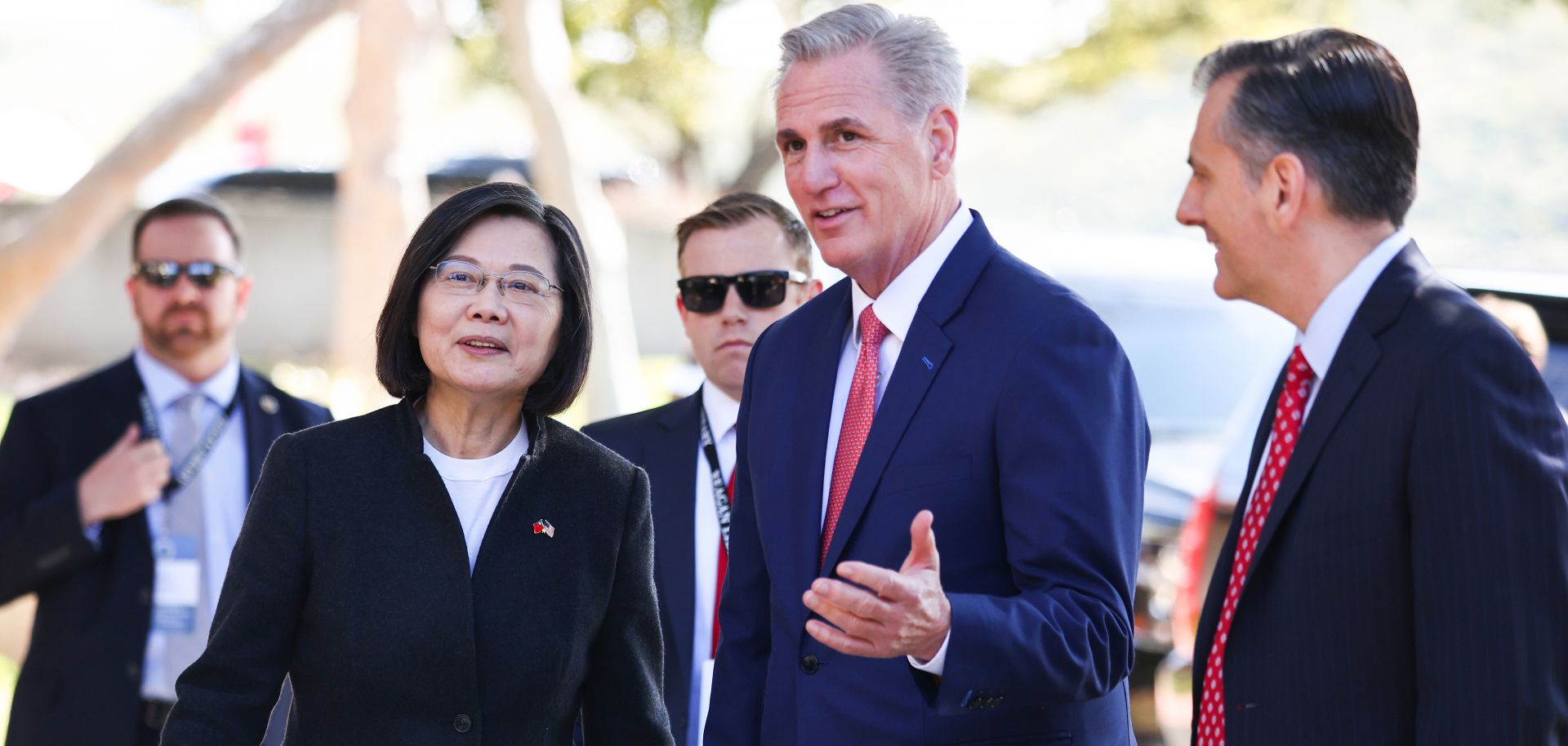
U.S. House Speaker Kevin McCarthy (center right) greets Taiwanese President Tsai Ing-wen (center left) on her arrival at the Ronald Reagan Presidential Library on April 5, 2023, in Simi Valley, California.
While China's response to a meeting between high-ranking U.S. and Taiwanese officials was relatively modest, the trajectory of China-U.S. and China-Taiwan relations remains escalatory. This will perpetuate the risk of cross-strait incidents, pose a pervasive threat of Chinese military coercion against Taiwan, and increase constraints on U.S.-China trade ties. On April 5, Taiwanese President Tsai Ing-wen met with U.S. House Speaker Kevin McCarthy at the Ronald Reagan Library in the Californian city of Simi Valley, marking the first time a sitting Taiwanese president has met with the leader of the U.S. House of Representatives on U.S. soil since 1979. Tsai and McCarthy were joined by 17 other U.S. lawmakers, including 10 members of the House Select Committee on the Chinese Communist Party. In a joint statement released after the meeting, McCarthy reiterated the need for the United States to deliver arms sold to Taiwan on a ''very timely basis'' and strengthen trade and technology cooperation, while Tsai heaped praise on the U.S. partnership. Both sides also emphasized the need to preserve freedom and democracy from outside threats, though neither leader explicitly named China. In response to the McCarthy meeting, China has conducted limited military activities around Taiwan, including a Taiwan Strait patrol and a naval voyage east of Taiwan.
- Tsai's recent trip to California was potentially the most high-profile visit by a Taiwanese president to the United States since the island's then-President Lee Teng-hui gave a commencement speech at Cornell University in 1995, which sparked the Third Taiwan Strait Crisis. It was also only the third time a Taiwanese president has ever sat down with a U.S. House speaker (regardless of location), with the second being Tsai's meeting with McCarthy's predecessor, Nancy Pelosi, in Taipei just eight months ago.
- On April 6, the Maritime Safety Administration (MSA) of China's Fujian province (which lies just across the strait from Taiwan) announced on its WeChat page that it would be conducting ''on-site inspections'' of cargo and construction ships during patrols of the central and northern portions of the Taiwan Strait, with the MSA's largest ship, the Haixun 06, leading the operations. The Taiwanese military is tailing the Haixun 06 and has advised ships in the strait to ignore any requests from China to board their vessels and notify Taiwan's Coast Guard if they receive such requests.
- On April 5, China sailed its Shandong aircraft carrier 200 miles east of the southernmost tip of Taiwan, accompanied by a frigate and a support ship. The USS Nimitz aircraft carrier is in the region as well, sailing 400 miles east of Taiwan according to the island's defense minister, though the U.S. military has not yet associated its presence with that of the Shandong.
- There have been few updates from Taiwanese or Chinese authorities following an April 2 pledge by the People's Liberation Army's Eastern Theater Command (PLA ETC) to host live-fire drills in the East China Sea, which involved two destroyers and a frigate.
China's military response to the Tsai-McCarthy has been modest due to a combination of political, diplomatic and economic calculations. In response to the August 2022 Pelosi-Tsai meeting, Beijing pledged to conduct live-fire military drills as soon as Pelosi arrived in Taipei and then fulfilled that pledge after she left, marking the largest live-fire drills around Taiwan in nearly 30 years. Prior to Pelosi's arrival in Taiwan, Beijing had also communicated through backchannels to Washington that it might impose a no-fly zone around Taiwan to stop the visit, though this did not happen. So far, China's response to the McCarthy meeting has been much tamer, with Beijing making no such explicit pledges of military action, although generic threats about ''severe consequences'' abounded. This more muted response is likely the result of several considerations on China's part, including:
- The reduced symbolic threat posed to Chinese sovereignty. Beijing views a top foreign official visiting Taiwan (as Pelosi did over the summer) as a much greater affront to China's sovereignty — and thus more worthy of a greater response — compared with the Taiwanese president traveling abroad to meet with such an official (as Tsai recently did to sit down with McCarthy). This is also why it's more common for foreign governments to host Taiwanese delegations, which is less likely to trigger Chinese retaliation than the other way around. Tsai, for example, has visited the United States seven times (including the latest trip to California) since taking office in 2016.
- The risk of straining China-EU ties. In addition, the McCarthy-Tsai meeting coincided with visits to China from French President Emmanuel Macron and EU Commission President Ursula von der Leyen. Beijing has been on a campaign to repair its diplomatic relations with Europe for at least the last six months in order to prevent the U.S. containment camp from gaining participants, and an aggressive military retaliation against Taiwan during the French and EU leaders' visits would have risked sullying those efforts. However, this also raises the potential of China waging a stronger response in the coming days now that Macron and von der Leyen have left.
- The potential for political backlash in Taiwan. An aggressive military reaction to the McCarthy-Tsai meeting would also threaten China's political interests in Taiwan by potentially extending the reign of Tsai's more China-skeptic Democratic Progressive Party (DPP). Taiwan will hold presidential and legislative elections in January 2024, where Beijing is hoping for a victory by the opposition (and comparatively more China-friendly) Kuomintang party. But any action that boosts the Taiwanese electorate's threat perception of China before then could sway the vote in favor of the DPP — a phenomenon China has already witnessed firsthand, with its heavy-handed crackdown on Hong Kong protesters in 2019, widely believed to have contributed to Tsai's reelection in January 2020.
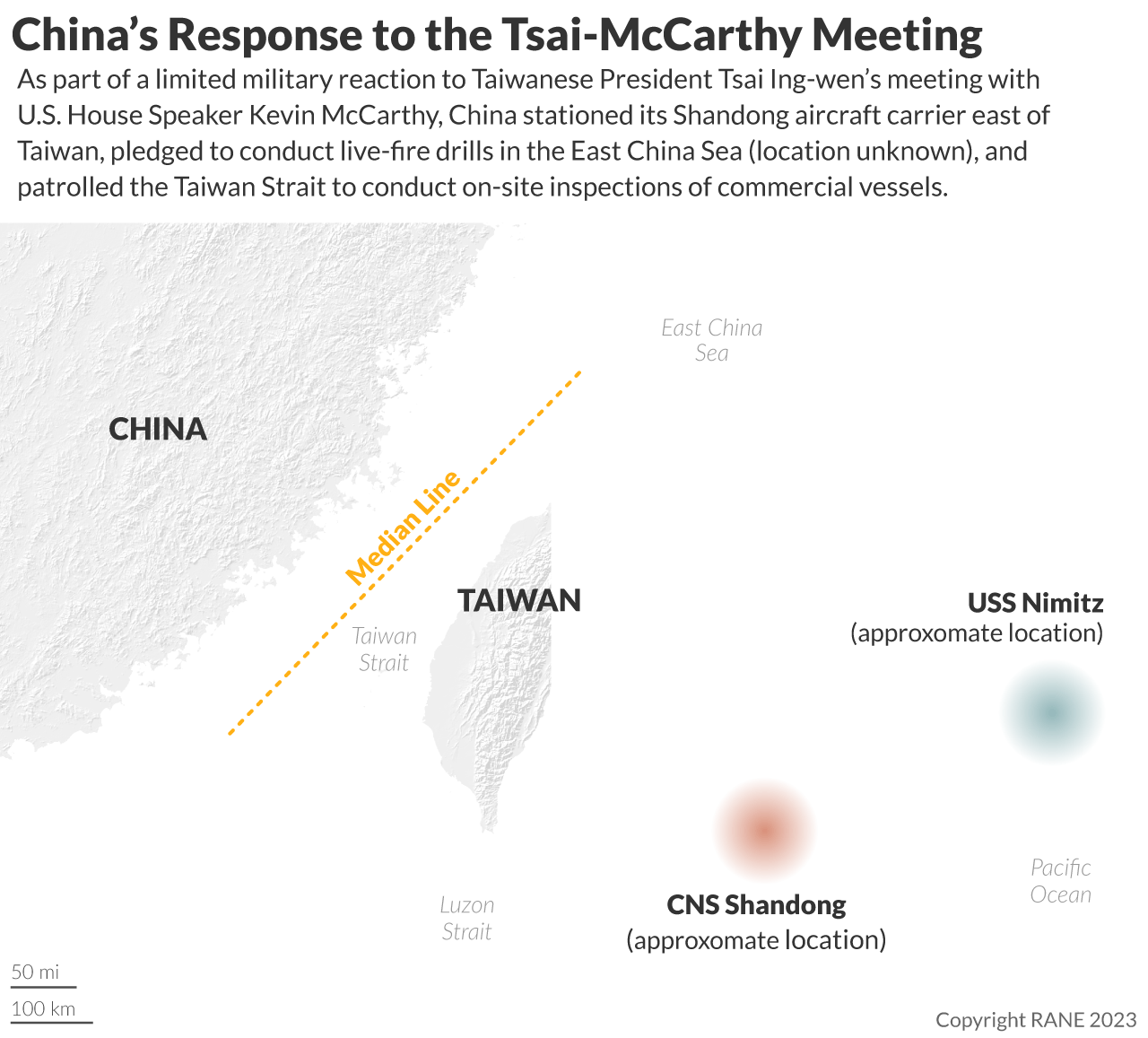
Despite Beijing's prudence regarding the Tsai-McCarthy meeting, the strategies of China and the United States toward Taiwan will remain escalatory in nature, presenting frequent political crises in cross-strait relations, risks of maritime incidents, and roadblocks to improved U.S.-China economic ties for the foreseeable future. Since Tsai came to power in 2016, China's strategy toward Taiwan has gradually evolved from economic coercion to military coercion. The United States, for its part, has also attempted to change the status quo by pursuing greater unofficial diplomatic relations with Taiwan. Together, their actions will drive developments in Indo-Pacific security and China-U.S. economic ties in the coming years. China's latest inspection campaign against commercial vessels transiting the Taiwan Strait — combined with the Chinese military's aerial incursions across the strait's median line (which for decades has served as the de facto maritime border separating Taiwanese and Chinese waters) — raises the chance of a collision and subsequent military standoffs. Such incidents could cause political crises, with each side demanding myriad forms of redress, but are unlikely to escalate into a greater military conflict given both Taiwan and China's hesitance to unnecessarily invoke the high economic and human costs of war. High-level meetings between U.S. and Taiwanese officials will regularly present roadblocks to U.S.-China economic ties, with each visit deepening mutual distrust in the Sino-American relationship in the months leading up to and following the event, while solidifying the long-term perception that non-economic issues cannot be treated separately from the broader U.S.-China relationship. Beijing's military coercion of Taiwan will heighten Europe's threat perception of China as well, particularly regarding peace in the Indo-Pacific and supply chain stability for critical goods like Taiwan's world-class semiconductor chips. This will increase the likelihood of more European trade restrictions on China akin to the Netherlands' recent export ban on advanced semiconductor manufacturing equipment. But new trade deals between China and European countries, like French President Macron's recently signed aerospace and nuclear energy deals in Beijing, will still be possible. And China's relationship with the European Union, in particular, will likely remain deeply nuanced and sometimes contradictory, as the bloc consists of 27 member states and multiple supranational institutions with different strategies and interests regarding Beijing.
- China's strategy toward Taiwan since Tsai was elected in 2016 has been to wield coercion to achieve political concessions in Taipei. From 2016 to 2019, Beijing deployed economic tools, like import restrictions and non-tariff barriers, against politically connected sectors of Taiwan's economy (e.g. agriculture), in an effort to erode the electoral support of Tsai and the DPP. But since Tsai's reelection in January 2020, Beijing has shifted to a strategy of military coercion — which has included growing aerial incursions into Taiwan's aerial defense identification zone, more naval deployments off of Taiwan's southeast and northeast coasts, and the live-fire drills in August 2022. Such actions are aimed at demonstrating China's willingness to militarily uphold its views on sovereignty over Taiwan in the hopes of convincing Taipei and Western capitals that supporting Taiwanese sovereignty is not worth risking war with China.
- The United States, meanwhile, has slowly attempted to change the status quo in its relations with Taiwan over the past two years. Between Oct. 2021 and Sept. 2022, U.S. President Joe Biden claimed at least three times that the United States would defend Taiwan in the event of a Chinese invasion — a stance not supported by documents that codify Washington's unofficial ties with Taipei, like the 1979 Taiwan Relations Act. And McCarthy and his predecessor Pelosi's recent meetings with Tsai show that, amid the current U.S. political environment of bipartisan opposition to China, short-tenured leaders in the House of Representatives are content to use diplomatic visits to gain electoral support, despite the White House's reservations about the escalatory nature of such visits.
While China could temporarily soften its position on Taiwan if the KMT wins the presidency, Beijing will continue to grow impatient with a lack of progress in cross-strait reunification and may still resort to military coercion. China's continued reliance on military coercion will support the DPP's dominance in Taiwanese politics, regardless of the outcome of the 2024 elections. This makes the prospects for improvement in cross-strait ties unlikely, especially as Chinese President Xi Jinping's position on the issue is becoming increasingly intolerant. If the KMT wins the election, U.S. representatives may have to settle for a slower pace of U.S.-Taiwan meetings, and China could temporarily soften its military coercive strategy against Taiwan. But even then, the KMT would have to conduct a balancing act between improving trade ties with Beijing and representing the views of increasingly sovereignty-conscious Taiwanese citizens. Thus, a KMT presidency might look more like the second term of former President Ma Ying-jeou (2012-2016), in which the cross-strait relationship was plagued by political gridlock and Beijing grew increasingly impatient at the lack of progress on peaceful reunification with Taiwan. Given Beijing's heightened willingness to use military coercion since 2020, such gridlock could eventually see Beijing again wield the military against a noncommittal KMT, even if this would happen on a less accelerated timeline than if the DPP stays in power.
