
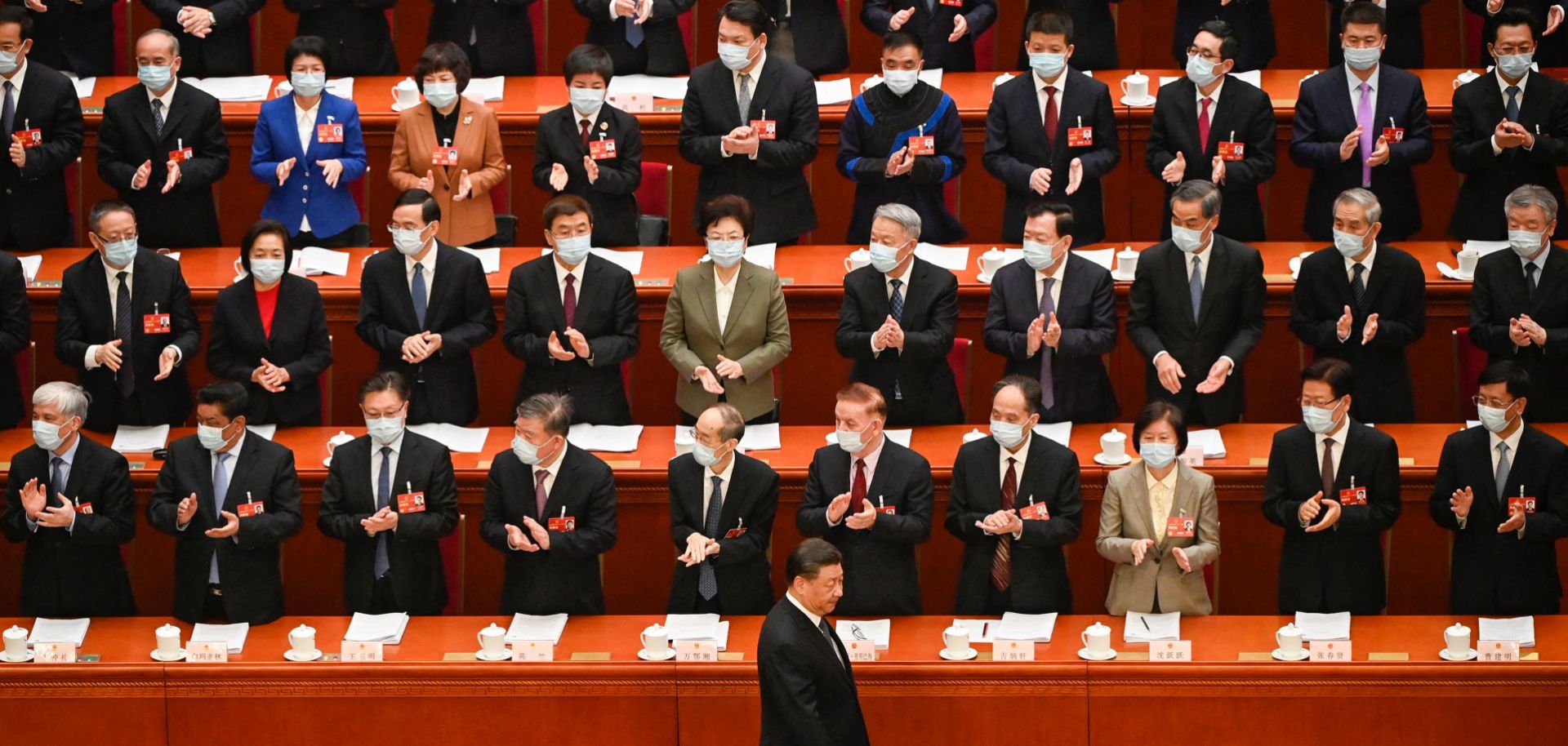
Chinese President Xi Jinping (bottom) arrives for the second plenary session of the National People's Congress with other Chinese leaders at the Great Hall of the People in Beijing, China, on March 7, 2023.
China's legislative meetings focused on stabilizing the economy and extending the influence of President Xi Jinping and the Chinese Communist Party (CCP) over the country's governance, which may improve Beijing's ability to defuse financial risks, but at the expense of economic management expertise and the independence of the private sector. From March 4-13, China held its annual joint sessions of the National People's Congress and Chinese People's Political Consultative Conference (commonly termed ''Two Sessions''). This year's Two Sessions was momentous because it was meant to be complementary to the October 2022 Party Congress, which only occurs once every five years. During these ten days of Two Sessions, the State Council released a work report with a policy agenda for 2023, as well as a reform plan that shuffled duties for top state institutions. New individuals were also appointed to fill senior state leadership roles. Throughout, a number of key speeches (including those made by President Xi himself) set the tone for the annual get-together.
The State Council work report laid out unambitious goals for coping with China's complex economic environment, and focused on stability over rapid recovery. A majority of the text was devoted to extolling China's accomplishments over the last five years despite an increasingly hostile and volatile external environment: namely, foreign trade restrictions (or what Beijing calls ''foreign suppression''), the COVID-19 crisis, the supply chain shocks brought on by Russia's war in Ukraine, and the concomitant downturn in the global economy. It used this past as a prologue for the forward-looking part of the report, which focused on ''seeking progress while maintaining stability,'' as well as self-reliance and self-improvement in science and technology. It also urged cadres to combat ''formalism, bureaucracy'' and corruption, which effectively means any disconnect between party policies and state implementation. In addition, the report listed top work priorities for 2023, including spurring domestic demand and foreign investment, defusing systemic risks (namely, real estate and local government debt), securing stable supplies of key industrial and societal inputs like energy and food, maintaining a ''proactive fiscal policy and prudent monetary policy,'' and improving supervision and development of the platform economy. In addition, the report listed specific economic goals for the year, including ''about 5%'' GDP growth, maintaining unemployment at 5.5%, and keeping consumer price inflation below 3%.
The Two Sessions also saw the release of the State Council Institutional Reform plan, which concentrated China's financial oversight, data management, and science and technology development portfolios into dedicated state organs. Besides detailing some of the minutiae of optimizing China's massive bureaucracy, the plan established new institutions to oversee key industries. First, a new Party Commission was established to oversee China's science and technology development, and many non-essential functions were removed from the Ministry of Science and Technology, which is now ''mainly responsible for guiding and supervising'' research institutions and evaluating the efficacy and progress of scientific research projects. Second, the National Financial Regulation Administration (NFRA) was established to oversee the financial sector, subsuming China's former banking regulator and taking some oversight responsibilities from the People's Bank of China, which will focus relatively more on monetary policy. The new NFRA will also take over investor protection duties from China's securities regulator. And third, Beijing established the National Data Bureau to oversee the country's data activities and develop the data economy, as well as manage the use, sharing and integration of China's national data resources.
- Released on March 16, the CCP's institutional reform plan built upon the State Council's plan, establishing party-run supra ministerial commissions to oversee the development of — and management of risks within — the financial sector, national research priorities, the strengthening of policy guidance organs within private enterprises, and the ''maintenance of national security'' in Hong Kong. These CCP commissions further indicate Beijing's top policy priorities and assumption of greater governing power over the state, and they entail greater government intervention in the economy and regulatory scrutiny against systemic risks. Though they may improve policy coordination, the new commissions will give little clarity on vague laws, like those related to data security.
Key staffing decisions underscore the importance of loyalty to Xi over economic expertise, despite Beijing's retention of some skilled hands to guide China's current institutional transition. Aside from showing Xi's outsized influence over the CCP, these new appointments highlighted the party's need for a transitional cohort to oversee the aforementioned government reforms amid a tough economic environment. Xi was appointed president for a third term, though this role is pro forma and largely insignificant compared with Xi's two other roles as the leader of the CCP and of China's military. As expected, Xi acolyte Li Qiang was appointed as China's premier, a position ostensibly in charge of managing the country's economy, though the premier's duties have been heavily subsumed by the party since Xi came to office in 2012. Li formerly served as the CCP chief of Shanghai, where he implemented the notorious March-May 2022 COVID-19 lockdown that severely damaged China's economy. Unlike China's previous premiers, Li has no experience with central administration. Neither does his new executive vice premier, Ding Xuexiang, one of Xi's trusted aides who previously served as the chief of the National Security Commission. Three roles, however, notably did not change hands, including the positions of central bank chief (Yi Gang), finance minister (Liu Kun), and science and technology minister (Wang Zhigang). Interestingly, all three of these officials are over the normal retirement age (65); they were also removed from the party's Central Committee in October, which is usually a clear sign that they have fallen out of favor with CCP leaders. This continuity may suggest that Beijing intends to temporarily retain these seasoned technocrats to help oversee institutional reforms amid the country's nascent economic recovery. But in the long term, the reduction in the party's economic management expertise looks set to continue.
Speeches from key leaders emphasized China's need to tough it out through difficult geopolitical times and highlighted President Xi's ideological and administrative precedence over the role of premier. China's paramount leader closed the Two Sessions with a recounting of China's process of ''standing up, getting rich and becoming strong,'' adding that ''security is the foundation of development, and stability is the prerequisite for prosperity.'' This follows Xi's speech on the sidelines of the National Committee of the Chinese People's Political Consultative Conference on March 6, during which he claimed the U.S.-led Western containment and suppression of China was at the core of China's challenging external environment and inhibiting its development. That same day, Foreign Minister Qin gave a fiery speech in which he justified China's ''wolf warrior diplomacy'' as a means to fend off U.S. aggression. He also likened the U.S. Indo-Pacific Strategy to ''forming gangs'' in order to contain China, and urged Japan to pursue win-win cooperation with China, only after brow-beating Tokyo for historical grievances and its failure to uphold peaceful relations with China. Premier Li took a softer tone on March 13 during his first press conference, waxing lyrical about China's commitment to open markets and support for private businesses. But Li also reiterated Beijing's narrative of victory in carrying out President Xi's ''zero COVID'' policy, repeated Xi's call to oppose ''formality, bureaucratism'' and corruption in all forms, and urged CCP members to ''subject themselves to supervision'' and truly fulfill the requirement of ''loyalty'' to the party and to Xi.
This year's Two Sessions showed the importance to Beijing of both maintaining steady economic growth, even if that means delaying certain policy goals, and extending the CCP's influence over China's governance. In this party-guided economy, some goals like the energy transition and modest support for free private enterprise will take the back seat to pressing issues like ensuring energy security through coal development and ensuring progress on critical technologies development by expanding industrial oversight. Part and parcel with this guided innovation strategy is bolstering China's self-reliance (e.g. for key industrial inputs) and domestic consumption — to insulate China from Western trade restrictions — as well as providing stable (if not rapid) economic growth, partly to defuse elevated risks of social unrest. China's institutional reforms will likely accelerate Xi's policy goals by enabling the state to more directly intervene to defuse long-term economic and financial risks and coordinate the ''data-fication'' of China's economy. This will likely mean more regulation and oversight of China's private and public data flows, raising privacy and legal compliance concerns with Western multinationals, which are traditionally the engines of China's foreign direct investment.
China's steady replacement of able bureaucrats with Xi loyalists looks set to continue, which may enable an empowered party to pursue painful long-term financial reforms. But this will come at the expense of the state's ability to manage the economy, especially during times of crisis. If China can navigate this storm of external and internal pressures amid its post-COVID economic recovery (an uncertain prospect, given Xi's replacement of pragmatic bureaucrats with loyalists in the central halls of power), even more Xi acolytes will likely replace the technocrat stand-ins in the central bank, finance ministry, and science and technology ministry — furthering party oversight over all aspects of China's development. Conversely, it is possible that a persisting economic slowdown may lead Xi to retain some of these bureaucrats beyond 2023. This would decelerate, but not reverse, the emaciation of China's administrative human capital, which has previously enabled Beijing to deftly manage major economic crises, like the 1997 Asian financial crisis and 2009 global financial crisis, albeit at the cost of mounting debt. Nonetheless, amid increasing Western strategic competition with China, this replacement of pragmatists with Xi loyalists will persist long-term, with Xi believing that China's best chance of enduring ''Western suppression'' lies in strengthening the party's (and his) control over state affairs. Such a strengthening of the CCP could make it harder for Beijing to handle future economic crises, but it also may better enable Beijing to push past institutional resistance to defuse China's debt bombs.
