
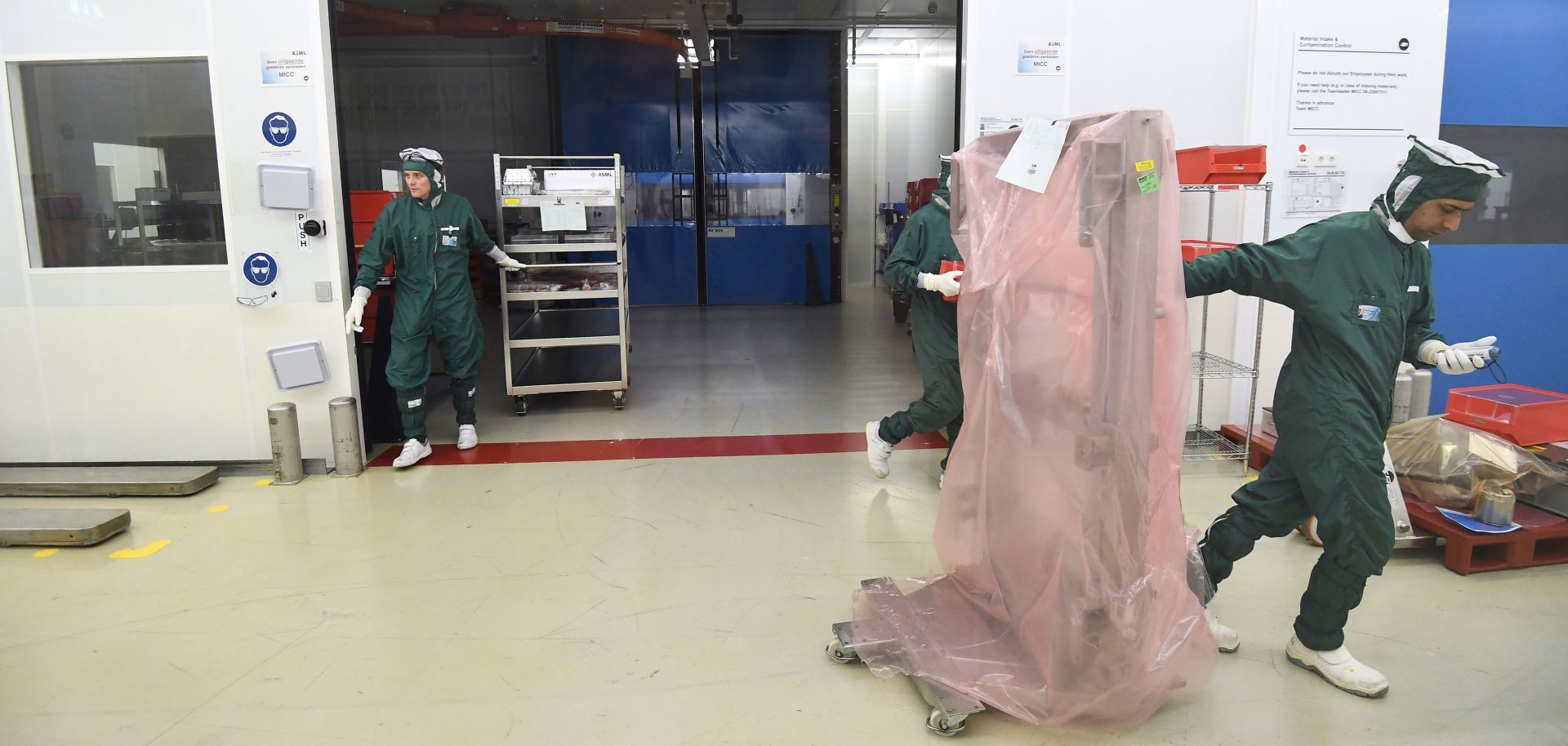
Workers at an ASML factory move parts of a chipmaking machine before shipment in Veldhoven, the Netherlands, in 2018.
While the United States is starting to have limited success in getting other countries to take a tougher line on China's tech sector, Washington will likely still make unilateral moves that go beyond any agreement it signs with other governments to target Chinese companies and further disrupt Beijing's tech ambitions. On Jan. 27, the United States reached a deal with the Netherlands and Japan to broaden the latter two countries' restrictions on exports of advanced semiconductor manufacturing equipment to China, including some of the immersion lithography machines produced by the Dutch firm ASML and Japanese firm Nikon, according to sources cited by Bloomberg. The administration of U.S. President Joe Biden is allegedly also considering cutting off Chinese tech giant Huawei from all U.S. exports and U.S.-made technology, and has stopped approving licenses for companies to export to the company, according to separate reports published on Jan. 30 by Bloomberg and the Financial Times, respectively. The United States' move to curb China's access to advanced chipmaking gear — combined with its continued crackdown on Huawei, one of China's technology ''national champions'' — indicates Washington's intent to wage an increasingly disruptive and multi-pronged assault against China's tech sector with the help of its allies.
- The deal with the Netherlands and Japan builds on wide-ranging U.S. export controls announced on Oct. 7 that, in addition to many other restrictions, largely block China's access to U.S. chipmaking technology and gear that can be used to manufacture 14 nanometer (nm) or more advanced semiconductors.
- In addition to Huawei, the United States has also taken steps to target other leading Chinese technology companies in recent months. On Dec. 15, the U.S. Commerce Department added top Chinese memory chip manufacturer Yangtze Memory Technologies Corp to its so-called Entity list, the department's toughest export control blacklist.
The lack of public information on the U.S.-Netherlands-Japanese deal suggests that the finer details have not been finalized and may need to be negotiated in the coming weeks or months. According to leaks after the Jan. 27 deal, Japan and the Netherlands have agreed to some restrictions on the less advanced machines. But the nature of those export controls remains unclear as the United States, the Netherlands and Japan did not publicly announce the deal (and, according to the Bloomberg report, may never do so). The new U.S. export restrictions unveiled in October, by comparison, were extremely detailed. This could indicate that Japan and the Netherlands are planning to only block exports on an informal, case-by-case basis. China may retaliate against Japan and the Netherlands if they adopt strict export bans akin to those imposed by the United States, which could be another reason why the Dutch and Japanese governments are refraining from publicly announcing their new deal with Washington. Indeed, on Feb. 2, Bloomberg reported that China has already ramped up lobbying efforts to deter Japan and the Netherlands from adopting strict controls on immersion lithography machine exports, which indicates that Beijing believes it can still deter the two countries from enacting more expansive restrictions. But if Tokyo and The Hague are still negotiating the details and/or are planning to impose the restrictions on a more ad hoc basis, Chinese leaders may opt against pursuing any coercive action that could make Japan and the Netherlands adopt a harder position against China — which is the very thing Beijing is trying to avoid.
- On Feb. 4, Japanese media reported that Tokyo would modify export controls for semiconductors this ''spring'' but did not elaborate on exactly how.
- Last year, Washington reportedly pressured the Dutch and Japanese governments to block exports of equipment that could be used to produce chips via a 14nm or smaller process, in addition to the machines used to produce more advanced chips (i.e., 7 nm or less). Japan and the Netherlands initially pushed back against these broader restrictions, partially due to concerns that other countries would more easily be able to quickly produce the less advanced machines. According to media leaks in 2022, the Dutch and Japanese governments were also concerned that the restrictions the United States wanted them to adopt far exceeded what was needed for national security concerns.
If the Netherlands and Japan do agree to more robust restrictions (even if not codified into explicit rules), it would expand the reach and longevity of U.S. tech restrictions on China, while ultimately further fragmenting the global semiconductor supply chain as well. Amid limited cooperation with its allies, the United States has decided not to wait to reach multilateral or bilateral agreements and instead unilaterally impose more significant restrictions on China's tech sector first. But without other countries adopting similar measures, the impact of such U.S. restrictions risks weakening over time as Chinese businesses and their overseas partners find workarounds — whether it's through modifying supply chains to reduce U.S. content levels, legal loopholes or illegal smuggling. If it yields stricter export bans on semiconductor manufacturing equipment, the United States' new deal with Japan and the Netherlands could help address these limits by broadening and prolonging the impact of existing U.S. restrictions on China's tech sector. Japan's Nikon and the Netherlands' ASML effectively operate as a duopoly when it comes to exporting high-end lithography machines for advanced chips, which China does not produce domestically. If the Dutch and Japanese governments imposed export bans akin to the U.S. government's, ASML and Nikon would likely be unable to make enough modifications to skirt the controls because they are Dutch and Japanese firms. Moreover, chipmaking equipment — and especially the immersion lithography machines that ASML and Nikon dominate — are arguably the most technologically advanced aspects of the global semiconductor industry. This means it would be difficult for companies outside of the Netherlands and Japan to quickly fill the void left by the export controls, prolonging the restrictions' impact on China's tech development. In addition to amplifying the United States' broader push to curb China's technological prowess, the fallout from such restrictions would exacerbate the global semiconductor industry's growing split between China and the West by compelling Beijing to further invest in its domestic chipmaking capabilities and, in turn, reduce its reliance on Western suppliers. While China remains years away from having a self-sufficient semiconductor sector, it may come closer to reaching that goal in the 2030s if Beijing continues to subsidize the industry.
- The Dutch company ASML is the world's largest producer of lithography machines and has a near-monopoly over the most advanced machines. In 2021, ASML owned 95% of the global market for immersion lithography machines, with Japan's Nikon owning the other 5%. Without access to ASML or Nikon's equipment, Beijing would be forced to rely on older, less efficient technology, which would significantly delay its efforts to become a leading player in the semiconductor market.
- There are signs that Chinese and non-Chinese companies are already finding ways to get around U.S. export controls. After the Oct. 7 restrictions were introduced, Alibaba and Chinese chip design start-up Biren Technology reportedly tweaked the specifications of some chips manufactured overseas, slowing transfer rates down to avoid tripping the new U.S. export controls on sales to China of chips that have a bidirectional transfer rate above 600 gigabytes per second (GB/s). While those tweaks are focused on skirting export controls on chips, over time manufacturers of chipmaking equipment would likely tweak some of their systems — and reduce the level of U.S. technology and U.S. engineers involved in the machines — in order to resume any paused sales to China.
The United States will likely implement additional export controls on Chinese tech giant Huawei, which could portend broader U.S. restrictions on China's artificial intelligence (AI) and cloud computing industries. In 2019, the United States placed Huawei on its Entity List and subsequently implemented broad export controls on the company's access to foreign and domestically-designed chips. Since then, Huawei has pivoted away from chip-reliant smartphones and 5G gear in favor of cloud computing, AI, laptops, automotive technology and software as it tries to remain a competitive, profitable firm. These industries, however, include those that the United States has deemed relevant to national security, such as cloud computing, AI and driverless cars, which means the United States will likely implement broader restrictions on the company to limit its growth in these sectors. If the Huawei restrictions go through, Washington may try to constrain China's development of these industries even more by implementing export restrictions on other Chinese companies and, in some cases, entire sectors akin to previous restrictions on exports of semiconductors and semiconductor manufacturing equipment. This is especially possible since Western media reported in 2022 that the Biden administration was considering sectoral export restrictions on AI and quantum computing. Such restrictions would lead to a growing split between China and the West in those technological areas.
- In 2022, Huawei Cloud rose to be China's second-largest cloud computing service provider, behind Alibaba Cloud.
- Huawei restrictions would also increase the likelihood of more restrictions on the social media platform TikTok, which is owned by Chinese tech giant ByteDance. Already, a number of state and federal government branches have banned the use of TikTok on government-issued devices and government networks, as have several schools. Sen. Michael Bennet wrote a letter to Apple and Google on Feb. 2 requesting that the companies remove TikTok from their respective app stores over national security concerns.
