
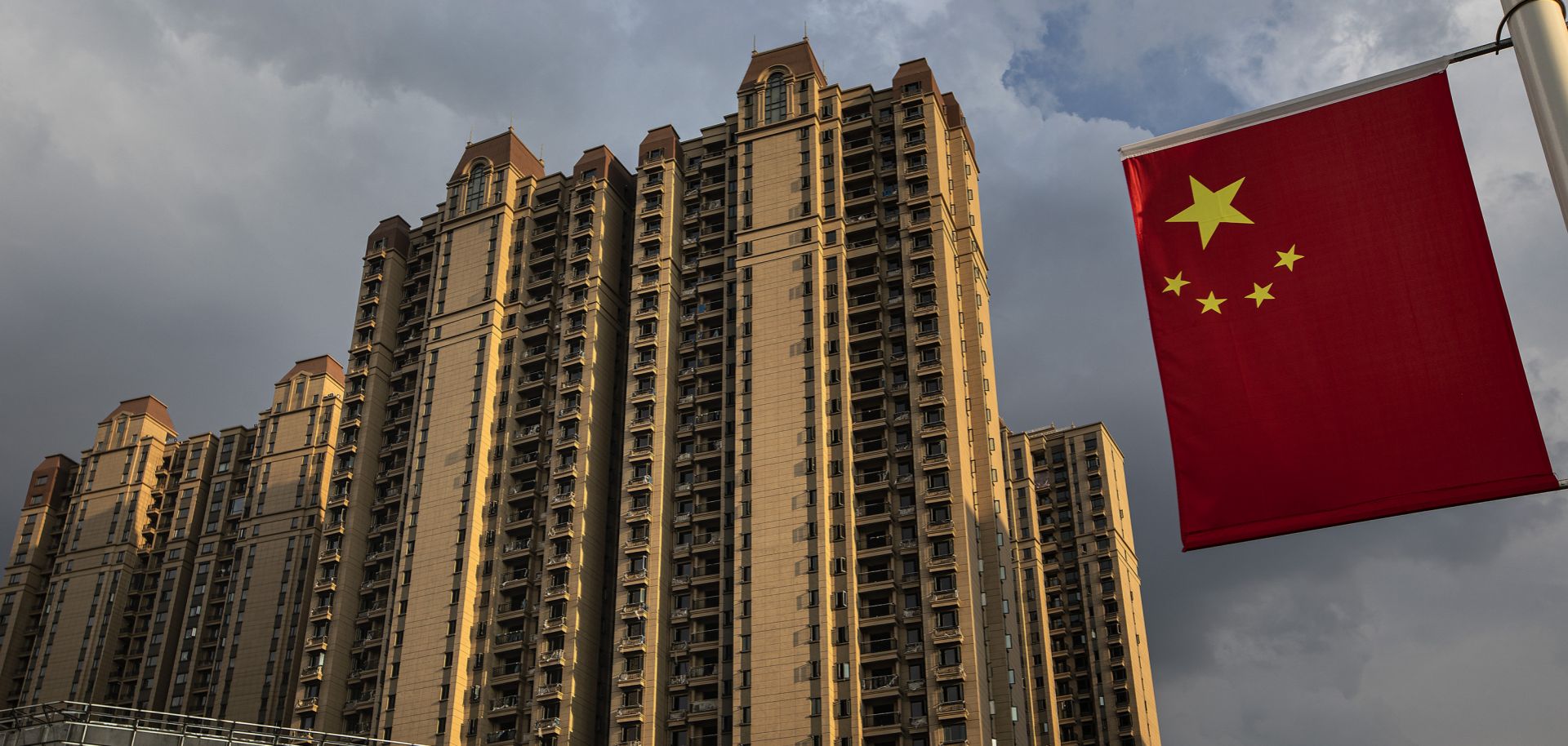
A general view of the Evergrande changqing community in Wuhan, China, is seen on Sept. 24, 2021.
A potential update to Beijing's real estate reform plans could either serve to optimize the government's deleveraging strategy, or overhaul it entirely — the latter of which could weaken China's efforts to develop its economy as well as President Xi Jinping's influence over economic policy. According to sources cited in a Jan. 6 Bloomberg report, Beijing may be planning to relax a policy that has wreaked havoc on China's real estate sector by severely limiting the amount of debt property developers can take on. The relaxation of China's so-called ''three lines policy,'' which was introduced in 2020, could reportedly involve raising lending caps on developers and extending the deadline for companies to meet debt limits by six months from the originally planned date of June 2023. This comes ahead of Beijing's new rules for Chinese companies raising debt overseas, which are due to take effect on Feb. 10. It also comes as China continues to grapple with a real estate crisis brought on by the government's deleveraging efforts, which saw sales among the country's largest 100 developers drop 43% in the first 11 months of 2022 and 48 developers default on a total of $65 billion in debt over 2022.
- The original ''three red lines'' policy was released in August 2020 and heralded by President Xi as crucial to reforming China's economy away from a long-term over-reliance on real estate speculation and broader fixed asset investment, and toward better investment in high-end manufacturing, services and a robust domestic stock market. The policy increases restrictions on borrowing for real estate developers, with the heaviest restrictions placed on those that violate the three red lines (limits on debt to equity, debt to assets, and cash to short-term borrowing ratios). Under the rules, developers are permitted to increase their debt annually by 15%, 10%, 5% or 0%, depending on if they violated zero, one, two or three of these lines, respectively. This policy triggered China's largest real estate price dip since 2015 and forced real estate giant Evergrande to default on its debt in late 2021; other major Chinese property developers (including Kaisa Group and Shimao Group) followed suit.
A slight tweak to the policy seems most likely, which would enable Beijing to provide a small boost to the economy without backtracking on real estate reforms. Concessions for only the healthiest developers would track with Beijing's behavior over the last year, which has suggested authorities want to enforce austerity on the sector while keeping the economy afloat with targeted real estate support. A deadline extension for the debt limits seems likely given that it doesn't compromise Beijing's overall goal of imposing fiscal austerity on the sector, but simply gives developers more time to get their affairs in order for the ''three red lines'' policy. Aside from the extension, an easing of restrictions on only the healthiest real estate companies (i.e. those not violating any of the three red lines) seems the most likely outcome, as it would give industry leaders more capital to conduct mergers and acquisitions of underwater assets held by unhealthy developers, thereby strengthening the sector as a whole by clearing out driftwood and providing a kind of stimulus to get the sector rolling and support the broader economy — all without abandoning Beijing's sectoral deleveraging efforts. This campaign has always been a balancing act between debt reduction and providing ample liquidity to get business done. Such a boon for healthier developers would also align with Beijing's fiscal easing measures on the sector over the past year, which have focused on providing healthy developers with better access to credit, providing all developers with liquidity to complete unfinished housing projects (and thus defuse wildfire mortgage boycotts), and providing first-time home buyers better mortgage terms without incentivizing speculators.
But if Beijing instead pursues a more comprehensive overhaul of the policy, it could indicate that Chinese leaders are particularly concerned about the health of the economy and encourage a slower approach to economic reforms, while increasing the risk of future real estate crises. Raising lending caps on firms that are violating one or more of these three red lines would be a major concession on deleveraging efforts. Such a course correction would serve as an alarm bell for the health of the Chinese economy amid declining export demand, dragging consumption and low local government revenues (which depend heavily on real estate sales) by indicating Beijing is so concerned about economic growth in 2023 that it is willing to jeopardize the long-term reforms needed for China to develop into an advanced economy. Though such concessions may help buoy the real estate sector and the broader economy in 2023, they would also raise the risk of subsequent real estate crises by incentivizing real estate developers to take on unsustainable debt in the future, knowing that Beijing would eventually relent on austerity efforts. Should Beijing abandon its ''three red lines'' policy entirely in 2023, it would come at a great financial cost to China by effectively making the recent dip in real estate sales (and subsequent dip in investment and retirement portfolios) all for naught. But for now, such an extreme move seems unlikely, as Beijing's trend over the last year has been to make minor tweaks on deleveraging. Still, easing up on lending limits for firms that violate the three red lines could also mark a major loss of face for President Xi Jinping, who has made real estate reform and other austerity efforts (e.g. tackling local government debt) a key policy platform for leading China to once again become a world-leading power. Xi has already had to reverse his much-vaunted ''zero COVID'' policy under pressure from nationwide protests in November. Though his hold on the reigns of power in China is still strong, a second major policy loss in as many months could compromise Xi's status as a power player in China's economic reforms and embolden lower-level policymakers that advocate for a more slow-moving agenda to economic reform (and one that doesn't coincide with heavy U.S. trade restrictions on China and a global economic downturn).
