
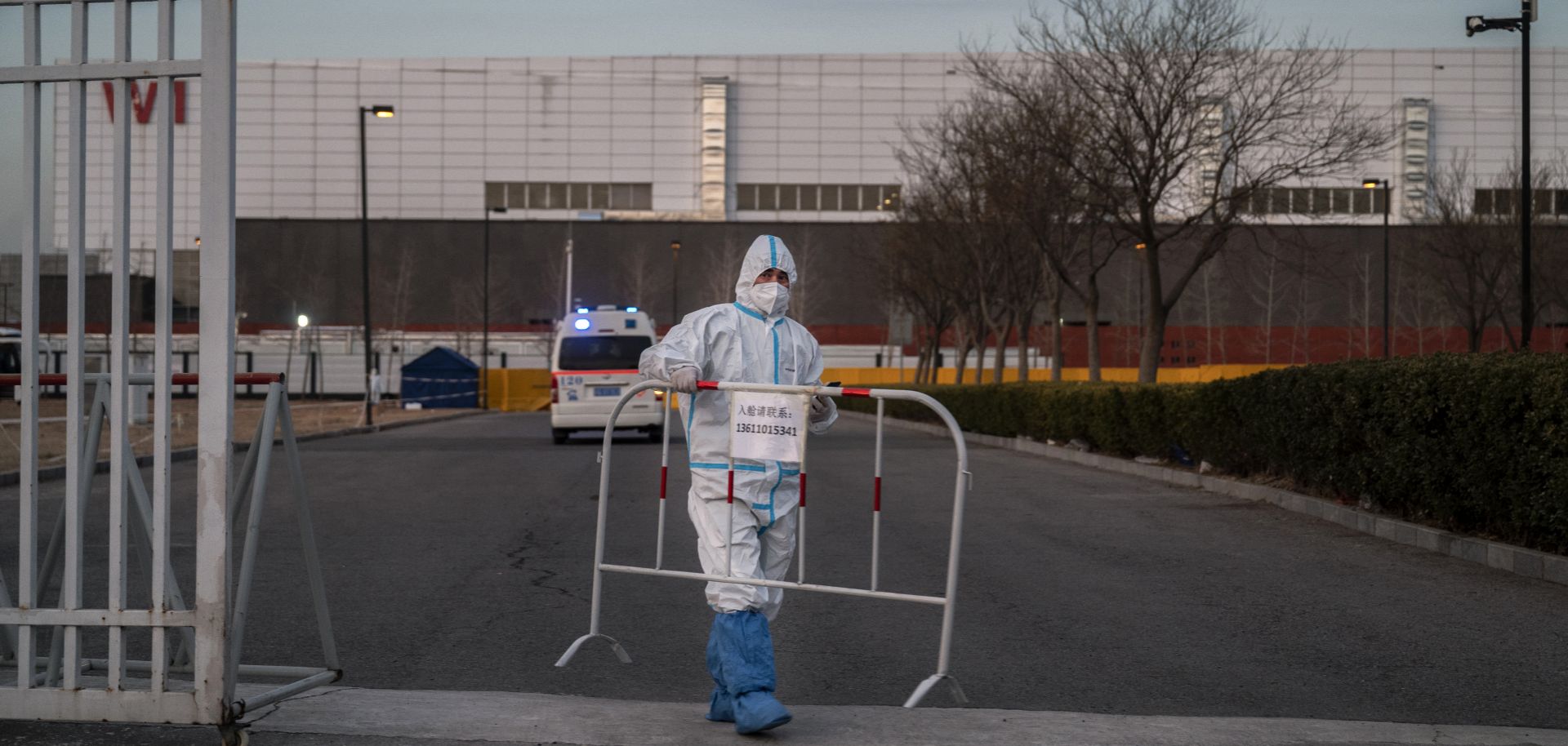
A worker places a barricade on a road after allowing an ambulance to enter a COVID-19 quarantine facility in Beijing, China, on Dec. 7, 2022.
China's new COVID-19 management measures significantly ease burdens on individuals and businesses, boosting economic prospects and stemming the immediate risk of renewed lockdowns and protests, though they could reemerge over the next year. On Dec. 7, China's National Health Commission (NHC) released 10 new COVID-19 management measures, which include allowing asymptomatic and mild cases to isolate at home for seven days and close contacts to isolate at home for five days; not requiring regular testing for most people or health codes for most public venues; not blocking domestic travel except for to high-risk areas; not requiring testing for domestic and inbound travel; and isolating lockdowns to high-risk areas by building and apartment, not by community or street. It also forbade business and manufacturing disruptions in non-high-risk areas and the sealing shut of doors or other exits of buildings. In a Dec. 7 press conference regarding the changes, NHC spokesperson Mi Feng noted that any easing on inbound travel would be gradual.
- These new measures follow nationwide protests from Nov. 25-27 following the death of 10 citizens in a fire in the western city of Urumqi, which many blamed on excessive COVID restrictions. The demonstrations were the largest and most widespread protests that China has seen in over 30 years.
- On Nov. 11, Chinese authorities released a round of 20 so-called ''optimization'' measures for epidemic management, which were intended to minimize economic disruptions from China's strict ''zero-COVID'' policy by regularizing lockdowns and quarantine procedures. But the measures have since been poorly implemented, which Beijing has blamed on local officials.
These new measures, if thoroughly implemented at the local level, will massively reduce the economic burden of movement restrictions and isolation requirements, providing a positive sign for China's slowing economy, but the risk of renewed lockdowns will remain over the next year. China's strict ''zero COVID'' policy has significantly depressed domestic consumption and business activity over the past year. It's also led to sudden and severe disruptions in China's industrial production, as seen in the major downgrading of Apple iPhone production forecasts in October and November at the Foxconn plant in Zhengzhou. The easing of this policy won't address the other factors constraining China's economy, including the country's ailing real estate sector, high youth unemployment and dipping Western demand for Chinese exports as the rest of the world teeters toward a recession. But it will still broadly improve China's economic growth prospects for early 2023. Indeed, under the updated measures, people in China will now be able to travel to other parts of the country, both for business and pleasure, without having to go through nearly as many COVID-19 checkpoints and testing procedures. The changes may also improve people's ability to work from home and reduce the overall risk of individual quarantine, as citizens will be hesitant to self-report contraction of COVID-19 unless absolutely necessary (e.g. for access to a school or medical facility). That said, central authorities will be watching closely for any spike in COVID-related deaths, shortages of medical supplies at hospitals or medicine at pharmacies, or other indicators that suggest the medical system may become overwhelmed. And such signs could prompt renewed restrictions, as officials remain concerned that a COVID-19 surge could overwhelm China's medical system, given the lower rate of vaccinations among China's elderly population and the low number of intensive care unit (ICU) beds available in Chinese hospitals. Meanwhile, localities remain ill-equipped to implement the new COVID-19 restrictions as they lack sufficient labor, finances and medical resources. Thus, these new measures will likely prompt a significant rise in nationwide cases that could trigger renewed restrictions, potentially including lockdowns, in the future.
- Under the updated measures, authorities can still impose lockdowns for COVID-19 management. But the guidance suggests such lockdowns should be contained to smaller areas (e.g. buildings) instead of entire neighborhoods or cities, and should only occur in places deemed ''high risk'' based on infection numbers and close contact tracing. If local officials generally follow these procedures, the risk of significant supply chain disruptions from arbitrarily expanded lockdowns should abate, assuming a large nationwide outbreak doesn't trigger a complete rethink of easing measures.
- National authorities seem genuinely committed to easing the economic burdens of COVID-19, as shown by the Dec. 6 meeting of the Politburo, chaired by President Xi Jinping. The readout from the meeting made no mention of ''dynamic clearing'' (China's preferred term for its ''zero COVID'' policy), and instead emphasized optimizing epidemic control measures while stabilizing economic growth.
- Chinese officials have recently emphasized in state newspapers the need to raise the ratio of ICU beds to normal hospital beds from 1:170 to 1:10. In announcing the eased COVID-19 restrictions, the NHC also said authorities will focus on boosting vaccination rates among the elderly, who are the most at risk of severe infection from the virus.
- Only 66% of Chinese citizens over the age of 80 have been fully vaccinated (compared with 90% of the general population).
These measures will ease the risk of nationwide protests in the short term, but isolated protests over local epidemic management may persist. It is also possible that Chinese citizens' frustration with COVID-19 implementation and other economic issues could reignite nationwide demonstrations in the future. Most immediately, Beijing's eased measures (as well as the security crackdown on protest participants) will likely defuse the risk of renewed nationwide protests, as people will be happy to get back to their (mostly) normal lives. The threat of isolated protests due to local implementation of persisting epidemic restrictions, however, will remain, as local officials may still opt for tighter restrictions if they feel they don't have the resources to implement the new measures sufficiently. Moreover, Beijing's policy concessions to protesters may over time challenge the very political stability and public order that the Chinese Communist Party hoped to preserve via the new measures. While large public protests have historically been taboo due to a heavy-handed security state and nearly ubiquitous surveillance, the recent bout of mass unrest may open the door to more protest activity in the future if people believe that enough public demonstrations can lead Beijing to give in to their demands. But people have plenty of other grievances, including the downturn in real estate (the primary destination for household savings), youth unemployment and dropping industrial performance — which could compel them to again take to the streets en masse, even in the face of repression. Thus, China could see new protest activity in the coming year, and not just among the youth, if a big enough event (like the Urumqi fire) catalyzes sufficient public discontent. Such a triggering event could take the form of people losing their life savings in a true real estate collapse (which for now appears unlikely) or new rounds of layoffs of young employees at tech giants like Alibaba and Meituan (which is somewhat more likely amid the Chinese government's ongoing regulatory scrutiny on the tech sector). Finally, given that China's COVID-19 restrictions remain the strictest in the world, even after the new adjustments, the potential for new lockdowns or other measures could again reanimate protest activity — especially if demonstrators believe the government has deceived them or is moving too slowly on easing COVID-19 restrictions.
