
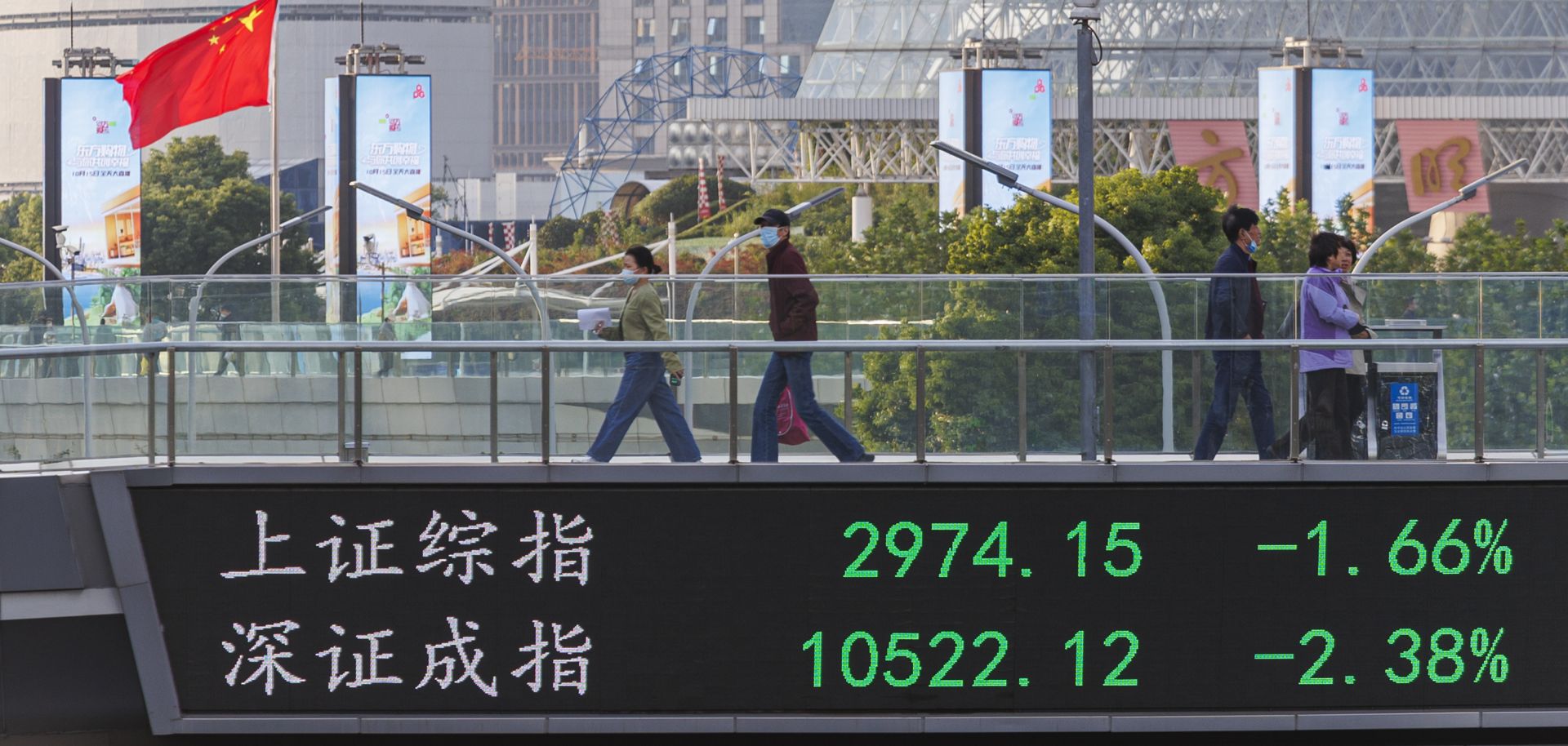
People walk on a pedestrian bridge that displays the numbers for the Shanghai Shenzhen stock indexes on Oct. 10, 2022, in Shanghai, China.
Editor's Note: This column is the third part of an ongoing series that explores China's demographic challenges. Part one can be found here; part two can be found here.
As discussed previously, China's shrinking population and rapidly aging workforce are pushing its government to adjust its social security, pensions and retirement policies. Yet Beijing's success with respect to these issues is intertwined with and will depend on the evolution of the country's broadly inflexible savings, finance and investment mechanisms.
As an economy advances and becomes more complex, the financial system plays an increasingly important role in properly allocating capital and labor to accommodate later stages of economic development. China's financial system, however, has failed to keep pace with its economic growth and increasing degrees of systemic complexity, as evidenced by the country's inefficient stock markets, overreliance on real estate investments, and overfunding of bloated state-owned enterprises.
Without changes that increase high-productivity capital growth, China's inflexible financial structure will continue to impede its economic development, as well as its leaders' ability to offset the impending fallout from the country's population decline. There is no existing model for China's predicament, but certain economic fundamentals will have outsized impacts on whether Asia’s largest economy can escape the middle-income trap in the face of mounting systematic and demographic challenges.
Unwieldy State-Owned Enterprises
China places great emphasis on strengthening specific industries, such as its so-called ''new-energy vehicle'' sector (which includes battery-powered electric cars and plug-in hybrids). But compared with developed economies, the country still lags behind in total productivity growth and innovation — both of which are critical to achieving a high-income economy. Capital allocation has proven a major inhibitor to innovation, which will likely prompt China to diversify its financial system from overly cumbersome state-owned enterprises (SOEs) to more streamlined, high-value-added SOEs and private enterprises while maintaining a high level of government involvement in the economy. China also possesses a plethora of advantages suggesting that a higher degree of innovation is attainable, including an enormous domestic market; generous investments in research and development; millions of scientists, engineers and software developers; and a developing legal framework to protect intellectual property.
Utilizing these advantages, however, has proven difficult. The Chinese government conducted a regulatory crackdown beginning in 2021 on the country's technology sector, which has curbed the angel investor practices of Chinese tech giants like Alibaba and Tencent. Dynamic tech startups built on intellectual property (as opposed to more traditional assets) have thus faced institutional constraints due to inflexible financial channels, political favoritism and weak rule of law, further suppressing innovation. To address these challenges, the Chinese government has said it will prioritize allowing market forces to allocate labor and capital away from bloated SOEs, which generate few patents, and into the far more innovative private sector. But state intervention in industrial planning and non-fiduciary priorities for SOEs confound this reallocation.
China typically has poor overall productivity growth due largely to the injection of capital into inefficient SOEs, which are often tasked with policy goals that limit their productivity. The government uses SOEs to fulfill social responsibilities like stabilizing employment. This, however, not only leads to employee redundancy that reduces worker efficiency and profits, but perpetuates Chinese workers' so-called ''iron rice bowl'' expectations of having a reliable job and long-term benefits. State support for SOEs — like preferential access to loans and financing, state bailouts and state contracts that significantly reduce the need to be competitive — also perpetuates China's inefficient allocation of capital and thus labor.
China has frequently stated it will enforce equal treatment and competition neutrality principles to reduce SOE inefficiencies. But it has rarely acted on these statements, which has created increasingly capital-needy state entities by letting stronger SOEs continue to merge with and acquire weaker ones. When the mostly state-owned companies in strategic sectors find themselves on the brink of bankruptcy, Beijing has also shown an unwillingness to let them fail — opting instead to continuously bail them out. China's hesitance to let SOEs go under is partially driven by the desire to prevent major layoffs that could lead to unrest. Yet reducing labor inefficiencies is key to boosting income, which is necessary to help ameliorate the challenges of a diminishing workforce.
Risky Banking and Underdeveloped Credit Systems
Credit allocation is a major factor in financial health, but decisions to that effect in China are typically made with heavy reference to window guidance (or regulatory directives vis-a-vis the credit supply as a means to realize policy goals) provided by the central bank or other government bodies, as opposed to market forces, which can distort valuations. China's decades of rapid economic growth saw liquidity expand and real estate and asset prices skyrocket. Households, businesses and financial institutions were then incentivized to ride the wave and take on risks that allowed them to systemically outperform those that did not, creating widespread individual and systemic financial risk brought on by financial distortions. Inverted balance sheets continue to drive insolvency risk, particularly as previously underlying economic assumptions — such as perpetually rising asset values, expanding liquidity and monetary stability — fluctuate unpredictably. This has been acutely demonstrated by China's ongoing real estate crisis, where the debt value of assets in a formerly reliable sector outpaced real value throughout the market and led to widespread default.
This highlights China's need to transfer GDP share to the household sector and provide investment avenues that more readily respond to market dynamics, which further implies a need to expand access to household credit. China, for a middle-income economy, has relatively high levels of bank and savings account ownership but low levels of formal credit use, with informal networks (such as friends and family) and informal credit from subprime financial markets being far more common. Informal credit carries a higher cost and financial risk in largely unregulated financial activity and is not effectively reinvested into the economy. Beijing wants to increase access to formal credit for individuals, as it did in 2022 by cutting lending rates in response to economic struggles and the depreciation of the yuan. But this has been complicated by the lack of credit rating agencies in China, making it difficult to gauge risk. Such an increase would give Chinese households greater access to purchases that are likely to appreciate in value over the long term, such as education and stocks. China's social credit score system is meant to partially address this issue, along with giving the state another lever of control over markets. Ultimately, the goal is to boost household spending power and, in turn, help offset the economic impact of China's demographic decline by strengthening consumption, ensuring each person spends more as the country's population shrinks. If China has fewer people but each spends more, this will help offset some of the economic headwinds inherent to a smaller population.
Overreliance on Real Estate
The volatility of China's stock markets has made them unreliable investment avenues. As a result, Chinese household investment remains heavily concentrated in real estate and other physical assets. Chinese investors also largely do not own many stocks or other forms of capital. But real estate holdings cannot be quickly turned into cash for consumers and investors — making them a highly underutilized source of capital with limited economic value.
The inability to effectively utilize capital — as well as China's recent real estate slowdown — is a driver for persistent capital flight, even after tightened regulations in 2016. China is broadly attempting to redirect investment into the country's stock markets and end its overreliance on real estate, which comprises about 70% of household wealth and generates about 30% of China's GDP. But as the primary store of household wealth, real estate cannot be unwound before Beijing establishes a viable investment alternative, which it is attempting to do by developing the country's private wealth management sector.
At the same time, China may need to undertake measures to help its ailing real estate sector due to the industry's economic importance. This could see Beijing relax the so-called ''three lines policy'' it introduced in 2020, which has since wreaked havoc on China's real estate sector by severely limiting the amount of debt property developers can take on. Without the ability to increase debt to fuel their growth, Chinese developers have scaled back their construction plans, pushing several into default. As Beijing tries to balance continued austerity and speculation busting with the overall health of the sector, it may loosen borrowing restrictions for the healthiest property developers, thereby providing these companies with enough liquidity to complete some of the unfinished projects that have recently triggered mortgage boycotts and unrest. Combined with Beijing's recent moves to improve mortgage terms for first-time homebuyers, this could help reinvigorate modest consumer demand for housing, which has fallen since the implementation of the ''three red lines'' policy. But the key would be to do so without re-incentivizing consumers to use real estate as an investment vehicle.
In addition to being a source of investment, China also sees real estate as a tool to support birth rates. Many local governments now provide loans and housing subsidies to families with two or three children, particularly in lower-tier cities where people are relocating for lower living costs — a practice that will only expand in the coming years.
China may seek to increase real estate taxes as well. Currently, the government only collects taxes on owned real estate assets (like properties) when the ownership is transferred — effectively making China the only major economy without a real estate tax. In addition to redirecting investment to the stock markets, China may make slow regulatory adjustments that enable the government to collect a low level of tax income on owned assets. Instituting a tax would put real estate into circulation as taxable rental housing as opposed to the current situation wherein every time a property is occupied it loses value. China has toyed with introducing real estate tax programs, but Beijing may be ambivalent to pursue such ideas in the near term amid the ongoing real estate crisis for fear of further disincentivizing homebuying.
Decreasing housing demand has translated to lower property values and higher vacancy rates in recent years — a trend that risks solidifying as China's population shrinks and further dampens demand, putting even greater pressure on the country's leaders to develop more efficient investment mechanisms.
Inefficient Stock Markets
In the coming years, China will likely look to improve the stability and productivity of its stock markets by, for example, supporting the growth of the private wealth management industry (especially for foreign firms in China) and diversifying into higher growth sectors like technology. China introduced two domestic stock markets in Shanghai and Shenzhen in 1990, and its stock markets' total market capitalization is now second only to that of the United States. Nonetheless, the system remains less efficient than its Western counterparts — largely because the original purpose of China's stock markets was to raise funds for SOEs, not to build a sound market economy. The stock markets' early days were characterized by rampant public speculation and day trading, which sank many investors and contributed to the perception that they were unreliable investment destinations, exacerbating the overexposure of citizens and institutions to real estate. Today, China's stock markets only account for around 3% of financing that the real economy can access, as measured by the country's Aggregate Financing to the Real Economy (AFRE).
IPOs, for their part, are often used for political means (like inflating a local government's economic portfolio), blurring the value of what is typically considered a reliable economic growth data point. IPOs are also constrained by lengthy approval processes and tight regulations that lead to frequent trading suspensions imposed by the China Securities Regulatory Commission (CSRC). These delays and interruptions often damage corporate credit and incentivize reverse mergers, leading to underperforming public firms and a near-zero delisting rate. Though this is slowly changing under tighter delisting regulations that seek to clear out shell and zombie companies by raising standards based on financial performance, share performance, compliance and law violation. Further, the CSRC on Feb. 1 began allowing companies to register IPOs directly with the Shanghai and Shenzhen stock exchanges, reducing regulatory hurdles. Such IPO reforms indicate that the actual health of an enterprise will play an increasingly prominent role in the country's stock markets, thereby increasing competition and making the stock markets a more reliable investment destination for small, medium and household investors. This will be crucial to boosting innovation through private enterprise, increasing household wealth and increasing consumption — all of which will be key in helping China navigate its middle-income transition and offset the adverse effects of its population decline.
Looking Forward
China's efforts to redirect investments away from real estate and into the stock markets imply the need to absorb a substantial amount of economic costs brought on by bad debt from mismatched balance sheets. China's accumulated public and private debt in all sectors of the economy totals upwards of $51.9 trillion, or nearly three times its GDP — amounting to a debt burden larger than that of the United States (which, as a developing economy, China is less prepared to manage). China's debt levels will only grow as retired dependents make up a larger share of the population due to pensions, insurance, healthcare and other social spending costs, highlighting the need to bring the country's financial systems up to speed with its increasingly complex economy.
Absorbing the costs of this redirection will probably fall squarely to the government (and, subsequently, local governments) as Beijing is unlikely to put the burden on businesses or households. The success of this redirection will be critical to China's success in weathering its impending demographic decline, since raising the GDP share of the household sector is necessary to drive a consumption-based economy.
Chinese policymakers understand that ensuring continued economic growth with a shrinking and rapidly aging population will require systematic changes that reorient China's economic fundamentals. They are already making substantive policy decisions to this effect. But deeply rooted institutional norms and co-dependent goals (like the fact that China cannot redirect household investment out of real estate without first boosting the efficiency of its stock markets) will ultimately constrain the impact of such decisions. Beijing will also need to reduce its favoritism for SOEs in order to realize its capital allocation goals, but non-fiduciary social responsibilities and the need to maintain employment for the sake of social stability will make this difficult. Potential solutions need to further account for additional strains emanating from China's labor mismatch, geographic divide and broader geopolitical challenges, which will be explored in the subsequent parts of this series.
