
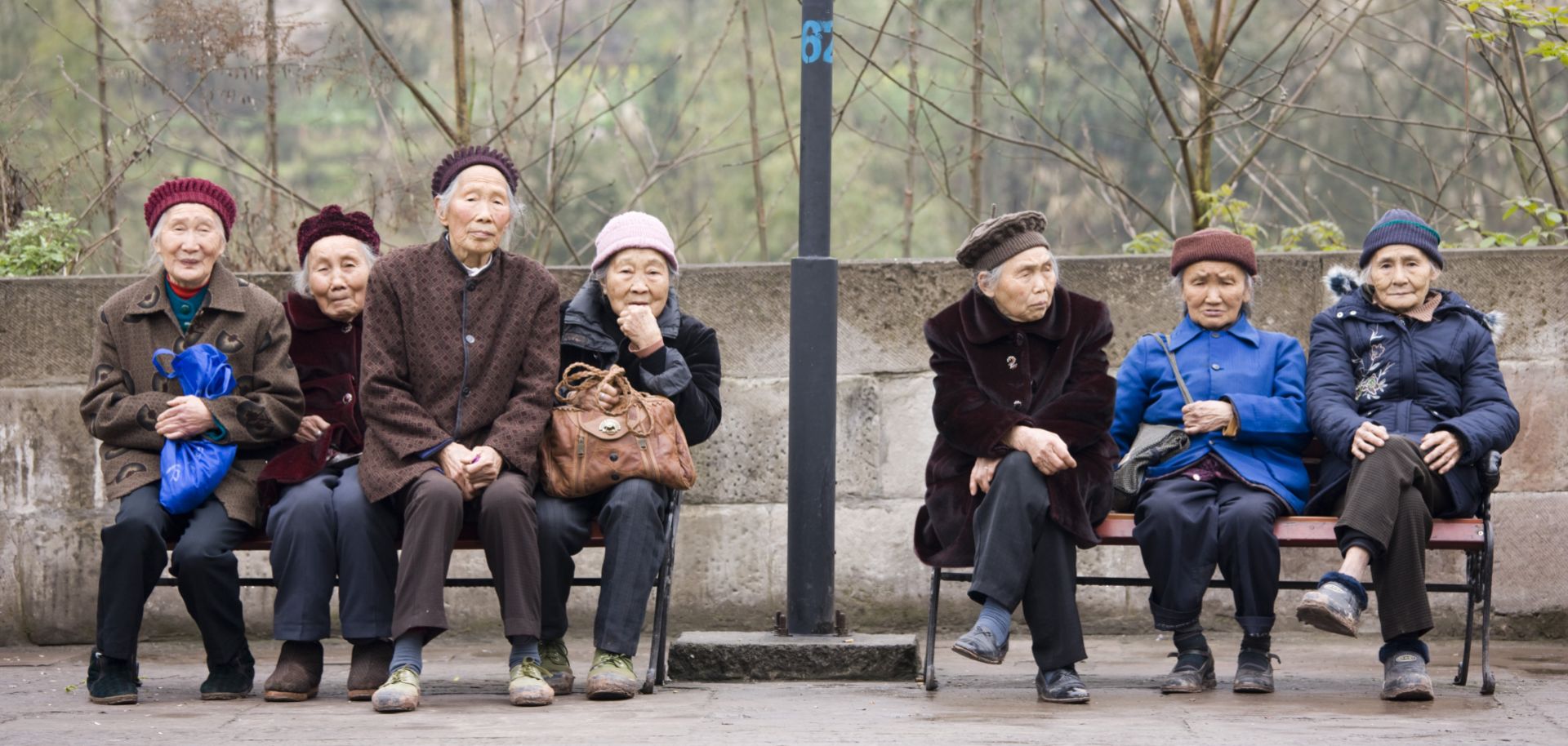
Elderly women sit together on benches in Chongqing, China.
Editor's note: This column is the second part of an ongoing series that explores China's demographic challenges.
As discussed in the first part of this series, dropping birth rates are driving China's demographic decline. But its population's rapid aging (and Beijing's failure to timely adjust the country's pension and retirement systems accordingly) presents an additional acute compounding challenge.
China's life expectancy is now 78 according to the World Bank, the oldest in the country's recorded history. This is still low compared with developed countries, where the life expectancies range between 82 and 85 years old. But it is nonetheless a dramatic, society-altering improvement from the early 1960s, when people in China on average died before they were 45 years old.
As China's population ages — and the birth rate drops ever further below replacement level — the combined cost of healthcare and public pensions will place a massive (and potentially insurmountable) burden on public expenditures. In the immediate term, the government will look to confront this challenge by reforming the country's pension system and decades-old retirement system, the latter of which was instituted at a time when most people did not live past middle age. The question, however, is whether those reforms will be large enough to sufficiently mitigate the greater demographic decline that risks impeding China's economic development and keeping it trapped as a middle-income country.
Rapid Aging
China's birth rate has fallen to roughly 1.16 children per woman, according to the latest official data released in 2021 — far short of the replacement level of 2.1 (the number of births needed to keep population levels stable). The country's population is also aging at a record pace, with the number of Chinese citizens aged 65 and older growing by nearly 100 million people from 2000 to 2021, according to the World Bank.
Having a higher proportion of elderly to working-age citizens has proven a natural trajectory in developed economies as people live longer due to healthcare advances, improved nutrition and safer working conditions, and as couples opt to have fewer children due to the heavy cost burden as well as increased education and career opportunities for women (among other factors). China's challenge, however, is unique in that it remains in aggregate a developing country that has not yet emerged from its middle-income transition — a complication compounded by the drastic discrepancies in economic development across regions.
The greater concern is not that China is aging but that it is doing so at an unprecedented speed. The United Nations considers a country's population ''aged'' when at least 7% of people are 65 or older. In most developed nations, the transition to an aged population has occurred over the course of three or four generations. But China has done it in one.
In 2000, China was near the 7% threshold to be deemed an aged population. Two decades on, it has not only surpassed that threshold but nearly doubled it, with people aged 65 or older making up 13.5% of China's population in 2021. That percentage is only set to exponentially grow in the coming years.
This has sharp implications in the near term as China's ratio of retired dependents to workers will quickly become so lopsided that it could collapse the country's entire pension system. At 1.4 billion people (according to the government), the sheer size of China's population, in addition to accounting for its massive geographic area and sprawling bureaucratic needs, renders the attendant administrative challenges highly dubious. China had a ratio of 9.9 workers to one pensioner in 2000 and 5.8 in 2020. That ratio is set to fall to a minuscule 2.3 by 2050, altogether far too low to simultaneously support the ballooning retired cohort and pursue sustainable economic growth. China will thus look to implement reforms throughout President Xi Jinping's third five-year term to account for the wide-reaching vulnerabilities of its retirement and pension systems.
An Outdated Retirement System
China's outmoded statutory retirement age — 60 for men, 55 for women and 50 for female blue-collar workers — is exacerbating the economic impact of its population's rapid aging. The retirement age law was instituted in 1951 when life expectancy was much lower and, considering the vast economic and societal changes China has gone through over the past 70 years, is in need of urgent reform. China's average retirement age ranks near the youngest in the world. Without any changes to this trend, the working-age cohort of China's population is expected to shrink by 35 million people between 2021 and 2025, while the cohort of retirees is expected to increase by 40 million. Looking further out, the ratio of retirees to workers in China is projected to explode from 17% in 2020 to 33% in 2035.
The more years an individual spends in retirement (and out of the workforce), the fewer taxes China's government is able to collect from their wages and fewer years of contributions to the country's public pension fund. Under China's Social Security Law, statutory pensions received after retirement are also classified as tax-exempt income, further reducing sources of revenue.
To account for this, the government included gradually raising retirement ages nationwide by 2025 as part of its 14th five-year plan. According to the Chinese business publication China Economic Weekly, authorities in all of the country's 31 provinces had rolled out pilot programs for retirement deferrals in February 2022. If widely replicated and expanded, these gradual steps could lead to a change in national retirement age requirements.
However, the revelation of the government's intention sparked backlash, as did previous calls to raise the retirement age in 2008 and 2012. Older workers were not keen to delay access to their pensions. Younger workers coming from an increasingly over-educated generation were worried about losing job opportunities in what is already a tight labor market for degree holders, which has left many younger Chinese citizens underemployed in recent years.
Moreover, the prospect of raising the retirement age touches on a cultural taboo in China, where caring for the elderly is a deeply ingrained cultural norm. Traditional social and family structures also often involve retired grandparents providing childcare for working parents. Within this context, both young and old have balked at the prospect of having older people stay in or return to the workforce, viewing it as a sign the government is not sufficiently attuned to its well-established social responsibilities. To mitigate the risk of public backlash, Beijing will thus likely gradually reform the country's retirement system in a more piecemeal fashion by adjusting rules for specific regions and occupations, as opposed to enacting a blanket national policy change.
The Pensions Predicament
China has one well-established pension scheme, which is the government-led public pension fund that covers around 1.03 billion people. The fund is already showing indications of unsustainability as it reported a drop in income as well as a deficit for the first time at the end of 2021. According to the Chinese non-profit Insurance Association of China, the public pension fund is facing up to a 10 trillion yuan or $1.5 trillion shortfall in the next five to ten years. A 2019 report from the state-sponsored think tank called the Chinese Academy of Social Sciences predicted that the fund will be depleted by 2035. There is little reason to expect a turnaround without substantive policy reforms as China's diminishing working age cohort results in ever-fewer contributions to the fund, along with ever-larger payouts.
The Chinese government is also developing another pension scheme, which is a supplemental occupational annuity for public sector employees and a voluntary enterprise annuity scheme that was introduced in 2004. However, participation is mostly limited to state-owned enterprises comprising a workforce of less than 5% of the total working population, and despite the government's issuance of guidelines in 2018 encouraging private enterprises to participate in annuity systems, such enterprises rarely offer coverage, sitting at a 0.5% coverage rate in 2020. Enterprises that do participate tend to rely on risk-averse investments that generate fewer returns. The government is also hesitant to impose more costs on private businesses that already struggle with overhead, particularly for small and medium enterprises and even more so amid the COVID-19 pandemic. Additionally, high employer contributions to social security are legally mandated, which often leads employers to seek cost-saving measures by underreporting wage payments or seeking part-time or temporary workers. A 2018 study by social insurance research think tank 51Shebao found that only 27% of companies paid out the full total of mandated social security payments, making the potential for further payments in the form of enterprise annuities unlikely. In general, owing to its many constraints, this second pillar is not a sufficient alternative or supplement to the public pension fund.
Even with strong backing, China's public pension and annuity accounts are often insufficiently funded to disperse payments to recipients. As the government is forced to increase financial subsidies and receives less revenue yearly, the country intends to develop the nascent third commercial pillar in the coming years.
The Three-Pillared Potential Solution
As it is with a slew of other challenges related to China's demographic decline, the government is acting far later than ideal. Private wealth management and commercial pensions are severely underdeveloped. China made clear its intention to address the shortcomings of its unwieldy social security and pension systems in 2018 by introducing regulatory guidance for various supply-side products and private pension insurance schemes aimed at establishing a starting point for the industry as a viable third pillar. China then began inviting foreign asset management players into the market in earnest in 2020, marked by France-based Amudi's establishment of the first wealth management joint venture with the Bank of China in September of that year. Outfits like Schroders, Goldman Sachs, JP Morgan, Fidelity and Blackrock soon followed. In January, U.S.-based Principal Financial Group became the first foreign company to invest in a bank-sponsored Chinese pension company.
China is now actively experimenting with the private wealth management sector. In October 2022, five government bureaus jointly promulgated private pension implementation measures. In November, these bureaus oversaw the initiation of a full pilot program in over 30 cities, including some of China's largest in Beijing, Shanghai, Shenzhen and Chongqing. The pilot program allows residents in participating locales to invest in around 130 approved wealth management, commercial pension insurance and mutual fund products. Both courting foreign companies and unveiling new private sector schemes are likely signs of things to come as China hopes to develop and integrate its private pension industry with its other two pillars, with the former offering enormous investment and innovation potential to industry players anxious to break into the lucrative China market.
Over the next five years under its top-heavy political model, the Chinese government will look to develop a private pension scheme and a retail asset management industry to serve as a viable and flexible third pillar, as well as reform the country's retirement age laws. Successfully doing so would serve to mitigate some of the severe risks inherent to a growing dependent population in a country with rapidly rising incomes and living costs. By the same token, failure to properly reform the pension system will leave China's growing retirement cohort not only without disposable income, but also without the wherewithal to acquire specialized goods and services needed in old age.
This issue is thus one of the high-stakes challenges coloring China's demographic decline, but it does not sit in policy isolation and is intimately linked with China's stock market and real estate dynamics. The nascent private pension industry may take off, but prospects are constrained by the country's underdeveloped stock markets. Similarly, real estate remains the primary mechanism for investment and savings in China, even as the government acts to deleverage it. This means China's retirement schemes are not only burdened by a rapidly aging society that lacks a replacement generation, but are also in trouble due to the unwinding of its de facto primary savings mechanism. In effect, China cannot reel in its runaway real estate industry without first developing a reliable alternative mode of savings.
In the next part of this series, we'll more thoroughly explore the challenges China faces relating to its real estate and capital flows in the context of the country's demographic decline.
