
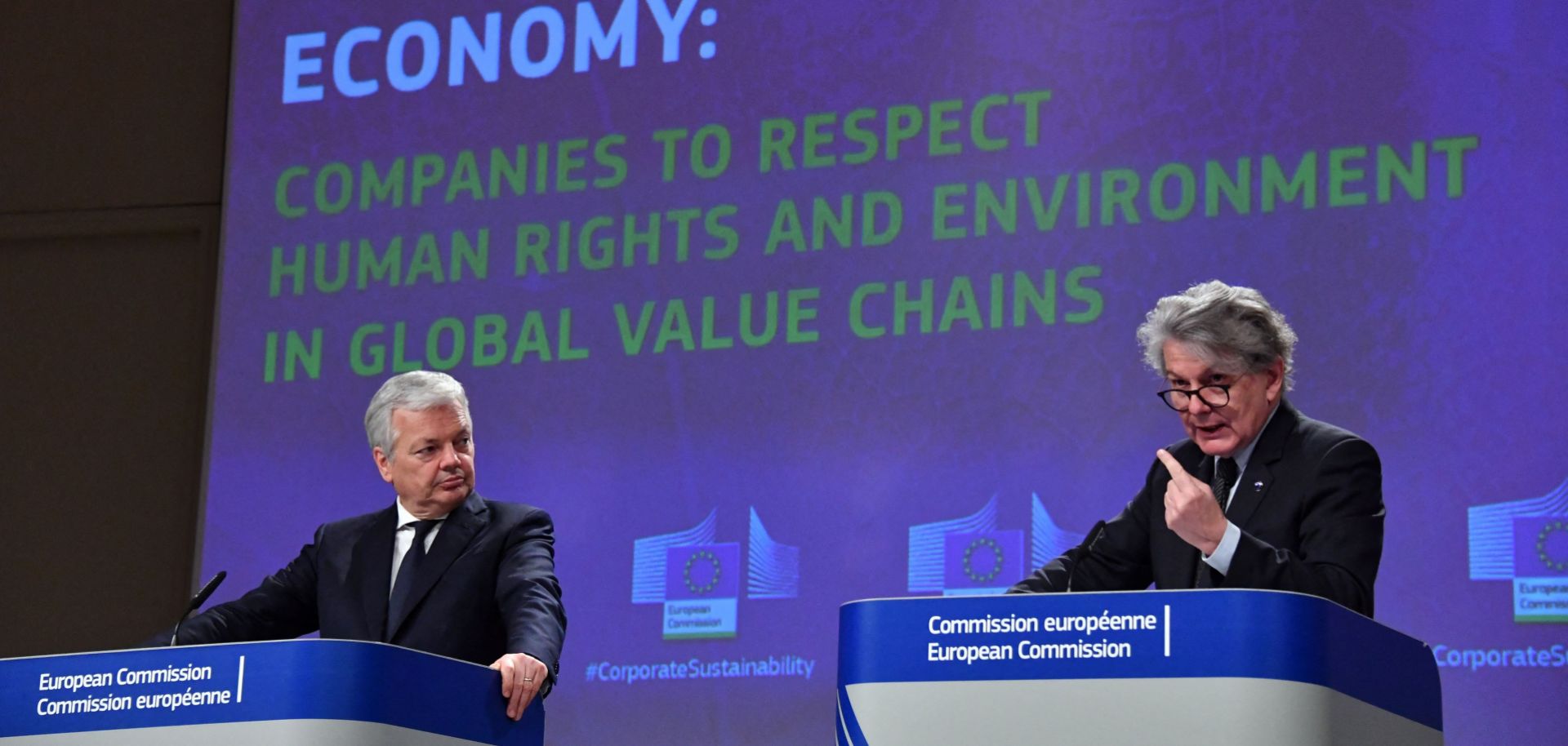
The window of opportunity for the European Union to approve a due diligence directive that would increase costs, paperwork and liability risks for large companies operating in the bloc is quickly closing, which means the plan could be severely watered down or abandoned completely. A plan to implement a Corporate Sustainability Due Diligence Directive (CSDDD, or CS3D) in the European Union is generating significant controversy, as it would require large companies in the bloc to screen their supply chains for environmental and human rights violations. EU member states were supposed to vote on the directive on Feb. 9, but the meeting was postponed after the German government announced it would abstain. Negotiators from EU member states and the European Parliament had reached a preliminary agreement on the CS3D on Dec. 14, but Berlin withdrew its support after the pro-business Free Democrats (FDP), part of Germany's coalition government, criticized the plan for placing an excessive burden on businesses. While it won't alone be enough to block the CS3D's approval, Germany's abstention has encouraged other member states unhappy with the proposed legislation to voice their doubts. Italy also stated it would abstain following Germany's decision, while Sweden, Finland, Austria, Lithuania and Estonia are reportedly among the countries that could also decide to pull out of the agreement without Germany's backing, which is largely seen as key to holding the deal together.
- The Feb. 9 vote at the European Council was largely seen as a formality following the interinstitutional agreement in December. The vote was initially postponed to Feb. 13, then indefinitely once the prospects for a successful approval faded. Following the setback in the Council, the European Parliament also removed a vote on the proposal from the agenda of the Legal Affairs Committee on Feb. 13.
- Germany's FDP has recently been hardening its position on various economic policy issues, including EU regulatory initiatives like the CS3D, in an attempt to boost its popularity at home. Support for the FDP in Germany has dropped dramatically since the last federal election in 2021, as voters perceive the party as having made too many concessions to the other two members of the country's government coalition, the left-leaning Greens and the Social Democrats.
- The controversy over the CS3D also comes amid a broader backlash against Environmental, Social and Governance (ESG) regulations in Europe, which has seen a growing number of conservative and pro-business political leaders across the bloc criticize the European Union for excessively burdening businesses by over-regulating in the area. In recent months, Europe has seen a growing political and societal backlash against sustainability and environmental policies as well, including the ongoing farmer protests across several countries demanding less environmental regulations and more support from governments to abate emissions. Such sentiments are also gaining steam at the EU level, where center-right parties within the European Parliament have pushed back against elements of the Green Deal, including nature restoration plans and the phase-out of internal combustion engine vehicles.
The proposed due diligence directive would require companies to screen their supply chains to make sure their products are not linked with environmental damage, forced labor or inhumane working conditions, and to take action to identify, assess, prevent and mitigate eventual adverse impacts. Under the CS3D, companies operating in the European Union would have to embed sustainability and human rights due diligence within their procurement strategies to identify and assess actual or potential negative human rights and environmental impacts within their supply chains. The proposed due diligence framework would require companies to actively prevent or mitigate anticipated negative impacts according to the criteria presented by the directive (yet to be presented in further guidance) and develop a complaints procedure for the rights of supply chain workers. Companies would be required to adopt a risk-based approach to identify where risks are most severe or most probable, and then prioritize their mitigation efforts according to impact and likelihood. Additionally, large EU and non-EU companies would have to formulate and implement climate transition plans for their supply chains in line with the Paris Agreement's goal of limiting global warming to 1.5 degrees Celsius. Companies would need to monitor the effectiveness of their due diligence actions as well, and openly report on those activities concerning suppliers. Inaction could lead to legal accountability enforced by EU member states, and also expose the companies to civil lawsuits from affected parties.
- The scope of the directive includes companies' upstream and downstream partners in activities relating to production, supply, transport, storage, design and distribution of goods. Covered impacts include, but are not limited to, child labor, slavery, labor exploitation, pollution, deforestation, excessive water consumption and damage to ecosystems. Required due diligence elements include policies, risk-management systems, contractual assurances, complaints mechanisms, publicly communicating on due diligence policies, and regularly monitoring the effectiveness of due diligence policies and measures — all accompanied by continued dialogue and consultation with affected stakeholders.
- The rules would apply to EU-based companies employing more than 500 people and with a net worldwide turnover of 150 million euros ($161 million), as well as to non-EU companies with a net turnover of more than 150 million euros generated within the European Union. The new requirements would come into effect three years after their eventual approval for large companies and up to two years later for other affected companies. Breaching the rules could lead to regulatory penalties, as well as fines of as much as 5% of a company's global net turnover.
If approved in its current form, the directive will require large companies operating within the European Union to bear the costs of establishing and operating the related due diligence procedures, and of taking actions to solve eventual issues that emerge from the process, potentially influencing how they operate on a global scale. The proposed CS3D applies to not only the direct actions of large companies operating within the European Union, but also the actions of their subsidiaries, suppliers and third-party partners. If the current draft of the directive is approved, EU-based companies — as well as non-EU companies that conduct a set level of business in the European Union — could thus become liable for the actions of their suppliers. Affected companies would, in turn, be forced to bear the costs of establishing and operating the related due diligence procedures across their entire value chain, along with the costs of taking the appropriate actions to solve eventual issues that emerge from the process, lest risk being exposed to regulatory liability from member states and civil litigation from affected parties. The greatest burden would be placed on companies operating in sectors that have long and complex value chains and/or that rely on raw materials often imported from Asian, African or Latin American countries with lower environmental and labor standards. This includes manufacturing companies (especially those in the textiles and food industries), as well as mining, oil and gas, agricultural, electronics, pharmaceutical and automotive companies. Small- and medium-sized companies that do not directly fall within the scope of the directive could also be indirectly impacted if they provide services or supplies to larger firms subject to the new due diligence requirements.
- The directive is expected to affect approximately 13,000 companies based in the European Union, as well as about 4,000 companies that are headquartered elsewhere but still maintain substantial commercial operations in the bloc.
- While critics argue the directive would saddle companies with excessive costs and paperwork, investors — who are already subject to disclosure rules under the European Union's Sustainable Finance Disclosure Regulation — have been generally supportive of the new rules, which would enable them to more accurately track eventual issues in their portfolios and help them reach their ESG targets.
- The automotive industry's growing reliance on batteries for electric vehicles has increased the demand for raw materials like lithium, nickel and cobalt, which are linked to environmental harm, as well as labor and human rights issues in countries like the Philippines, Indonesia and the Democratic Republic of Congo.
- If the CS3D is approved, the pharmaceutical supply chain would also face various challenges, particularly in sourcing raw materials and active pharmaceutical ingredients (APIs) from regions with high slavery risks, like Afghanistan, or APIs and other ingredients from countries where operations often lack transparency, potentially concealing forced labor, like China and India. While more thorough audits are feasible, complex geopolitical situations in these regions and the outsourcing of audit processes may complicate them, allowing labor abuses to remain hidden or ignored.
If the directive isn't approved in the coming weeks, it risks being frozen until after the upcoming European Parliament elections, which could ultimately result in the CS3D being either abandoned or substantially watered down. At such a late stage of the legislative process, the final draft of the CS3D can no longer be amended by member states or European Parliament negotiators, which can now only approve or reject it in its current form. This means there is no way to tweak controversial elements of the existing proposal to get skeptical member states on board to secure a majority backing. Against this backdrop, unless member states manage to find a compromise over the coming weeks, the proposal will be sent back for further negotiations and likely delayed until after the elections for the European Parliament are held in June. With right-wing climate-skeptic parties on the rise across Europe and more centrist mainstream parties also increasingly critical of ESG legislation amid a building green fatigue among European voters, the upcoming vote is expected to yield a more conservative, business-oriented European Parliament that's far less ambitious on climate and sustainability issues than its predecessor. If the CS3D's final approval is delayed until after the EU elections, the parts of the directive with the greatest business and economic implications will thus likely be substantially weakened amid increased pushback from the European Parliament and/or European Council. Members of the bloc's two voting bodies could, for example, call for the inclusion of rules that make it easier for companies to reduce their liability. They could also push for an overall smaller scope of the regulation or carve-outs for entire industries considered of strategic importance. If a majority in either the European Parliament or the European Council collapses, there's a chance the entire proposal may be abandoned as well, which means more member states may develop their own national due diligence regimes, leading to a patchwork of different regulations that will complicate compliance for companies operating across different EU markets.
- The last possible chance for the current European Parliament to give final approval to the directive is at the last plenary section on April 22.
- Certain EU countries, including France and Germany, already have their own supply chain due diligence laws in place, while others, like the Netherlands, are currently working on one. The uncertainty over the CSD3's future could see more countries follow suit in the coming years.
- The CS3D would expand the scope of supply chain due diligence obligations for German companies compared with the country's current domestic legislation (from about 3000 companies now to about 7000 if the CS3D is adopted). However, an EU-wide regulation would arguably contribute to leveling the playing field for German companies, which are already subject to Germany's own supply chain act, vis-a-vis their competitors.
