
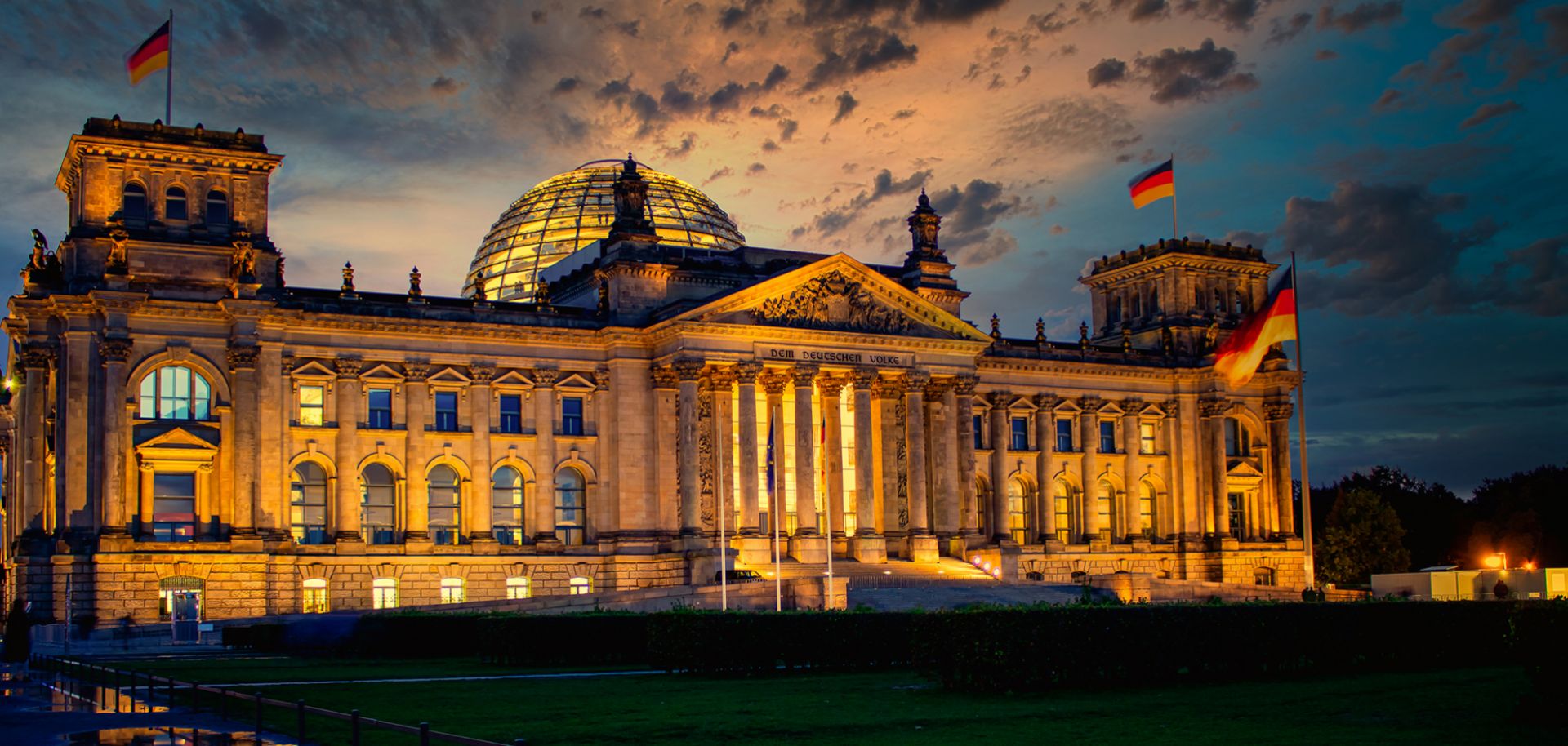
The Bundestag, Germany's federal parliament, is seen at night in Berlin.
Germany's shrinking federal budget will increase tensions within its coalition government and exacerbate political gridlock in Berlin, leading to policy uncertainty at the national and EU level. On May 23, Germany's government postponed parliamentary discussions on a contested piece of climate legislation over fundamental disagreements between the three coalition partners. This episode underscored the ongoing tensions and difficult coexistence between Chancellor Olaf Scholz's center-left Social Democratic Party (SPD), Finance Minister Christian Lindner's pro-business Free Democratic Party (FDP), and Economy Minister Robert Habeck and Foreign Minister Annalena Baerbock's pro-environment Greens party. The three ruling parties had already agreed to the law, which would effectively ban new oil- and gas-powered heating systems in German houses in favor of electric heat pumps, at the Cabinet level at the end of March. However, the FDP decided to block the proposal before it could go to parliament for a first reading, calling for a major overhaul.
- The Greens' proposal would allow only heating systems that run on at least 65% renewable energy to be installed from 2024 (both new installments and repairs of old ones). Eco-friendly boilers tend to cost twice as much as conventional ones. Due to this added cost for German households, the draft law was met with resistance from opposition parties — including former Chancellor Angela Merkel's Christian Democratic Union (CDU) party — as well as several media outlets and some members of the ruling coalition itself. Still, the government had earmarked subsidies worth billions of dollars to cushion the financial impact of the new requirements by covering up to 80% of the costs.
- The FDP's last-minute opposition to the proposal reportedly triggered a furious reaction from Habeck, who accused the FDP of ''breaking their word.'' However, given the opposition to the measure among both FDP and CDU lawmakers, the draft law would still very likely be amended in parliament. While the government originally planned to adopt the legislation before the parliamentary summer recess, it now appears more likely to reach an agreement after September.
While extra spending has helped the German government overcome competing policy priorities over 2022, upcoming budget cuts and the reinstatement of the constitutional debt limit will make compromising harder. Germany's current coalition government, comprised of three ideologically diverse parties, has been struggling to find common ground since taking office in December 2021. This has been particularly evident in areas such as climate, fiscal and foreign policy, where competing priorities have made decision-making slow and erratic. Despite these differences, the coalition has managed to navigate them thus far by increasing public spending and taking on extra debt, as well as by resorting to ''special funds'' to avoid violating a constitutionally enshrined debt brake, which the coalition members have agreed to reinstate in 2024 after a three-year suspension. Moreover, a 20 billion euro shortfall in tax income will reduce the German government's financial room to subsidize expensive measures (like the controversial switch to climate-friendly heating systems), further complicating Berlin's ability to throw money at its ideological differences. In fact, Scholz and Lindner are reportedly drawing plans to plug this shortfall in the 2024 budget through spending cuts across all departments except for defense. The three coalition parties' poor performance in recent regional elections has exacerbated intra-coalition tensions as well. The SPD, the Greens, and the FDP are all concerned that the compromises they have made since entering the government have damaged their popularity with voters, which has pushed party leaders to become more hawkish in defending their traditional party lines.
- Germany's constitutionally mandated debt brake limits annual government borrowing to 0.35% of GDP. The measure has been suspended since 2020 to allow for increased spending on COVID-19 relief efforts and to enable the government to deal with the ongoing fallout from Russia's war in Ukraine.
- Over the past year, the German government has created off-budget funds worth a total of 300 billion euros to finance a radical revamp of the country's armed forces and provide financial support against high energy prices.
- Germany's Finance Ministry expects a total decline of 70.2 billion euros in tax revenues for the 2023-7 period compared with previous forecasts. This anticipated decline is primarily due to tax reliefs and other support measures that the government introduced in 2022 to cushion the economic impact of the energy crisis on households, businesses and industry.
- Rising borrowing costs are also further complicating the budget outlook for the German government, which will have to allocate a much larger share of its budget to interest payments on existing debt (which have jumped to 40 billion euros compared with 4 billion in 2021).
- Lindner has made restoring the constitutional limit on net new debt one of his top priorities and is opposing any significant tax increase to bolster the federal budget.
While a government collapse is unlikely, infighting within the coalition over the allocation of funds will delay key decisions and increase policy uncertainty. The intra-coalition disputes over diverging spending priorities will increase over the coming months amid upcoming cuts in the 2024 budget. While the three members of the coalition will seek to avoid the collapse of the government at a time of slow economic growth in Germany and high global geopolitical tensions, their constant disputes will make it even harder for them to reach compromises. This will increase policy uncertainty in the country by further complicating an already slow and often contradictory policymaking process in Berlin. The coalition's internal disputes will also continue to undermine Germany's leadership role in the European Union by impeding Berlin's ability to speak with a single voice and take a definitive stance on many decisions in Brussels, which will consequently increase policy uncertainty at the EU level as well. Moreover, given how budgets will be tighter than previously estimated due to lower tax revenue for the next few years, fiscal conservatism (as well as the deteriorating economic environment) is set to constrain government spending for the medium term, possibly causing Germany to reevaluate some of its policy priorities and cut back on ambitious digital and energy transition plans and defense spending targets announced in the wake of Russia's invasion of Ukraine.
- Germany's GDP contracted by 0.3% in the first quarter of 2023, according to revised estimates from the Federal Statistics Office on May 25. This data indicates that the country's economy entered a technical recession during the 2022-3 winter, as it shrank by 0.5% in the fourth quarter of 2022. Lindner reacted to the news by reiterating that Germany's ''expansionary fiscal policy'' must end amid falling fiscal revenue.
- In March, last-minute opposition from the FDP saw Germany veto a planned EU ban on sales of new petrol and diesel cars from 2035 after Berlin had already agreed to support the measure. The move increased and prolonged policy uncertainty for Europe's automotive industry. It also increased tensions between Germany and other EU member states, as well as between members of Germany's ruling coalition.
