
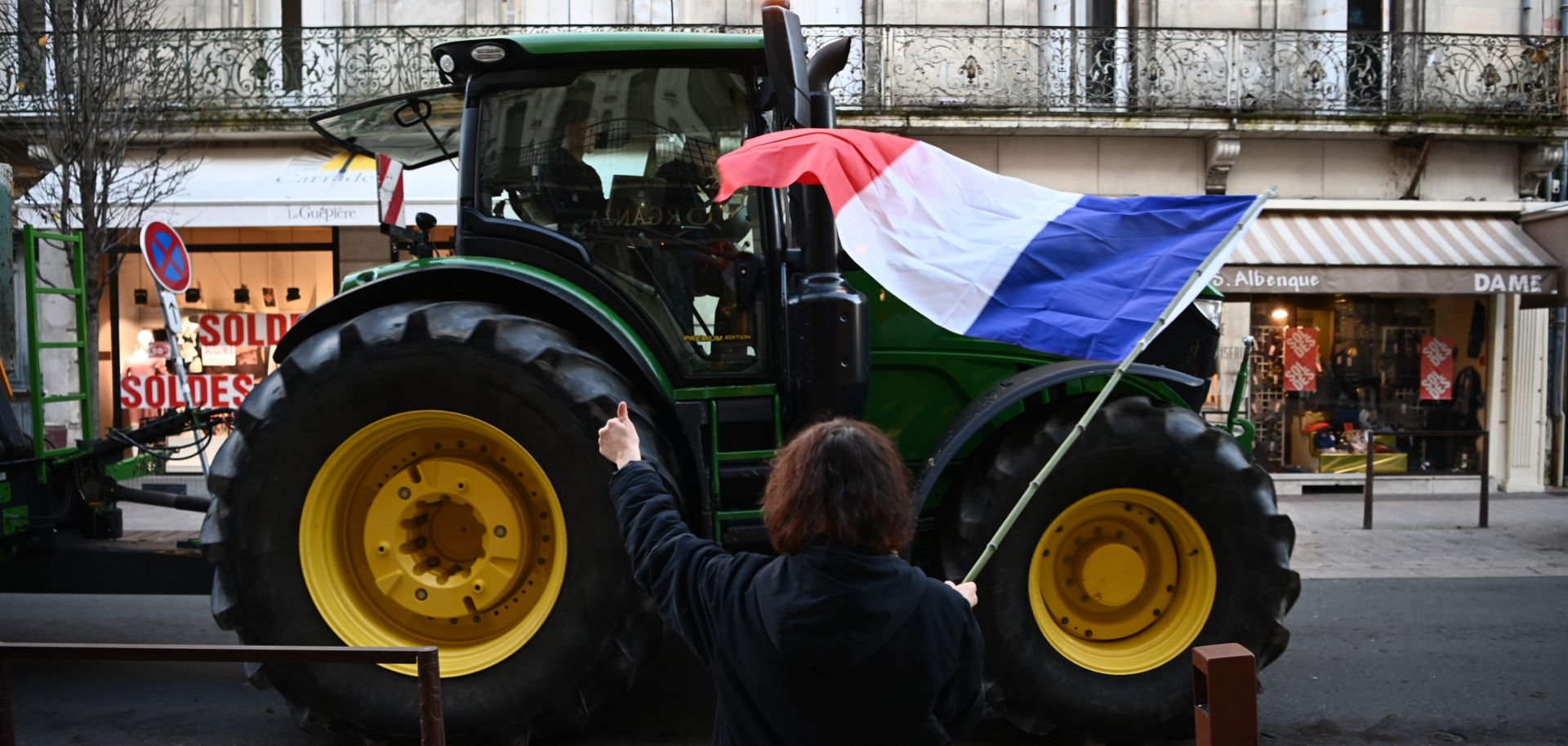
In Europe, growing farmer protests in a key electoral year will likely slow the implementation of environmental reforms in the European Union and make it harder for Brussels to negotiate free trade agreements. Farmers across Europe have taken to the streets in recent weeks to voice their discontent over their governments' economic, environmental and trade policies. Germany has seen the largest demonstrations, with thousands of farmers blocking the country's major cities to protest government plans to cut agricultural subsidies amid an ongoing budget crisis that has forced Berlin to reduce spending across the board. Because of the protests, the German government abandoned its original plan to abolish vehicle tax benefits for agricultural businesses and phase out subsidies for agricultural diesel only gradually until 2026, but farming groups are demanding the latter measure be removed entirely. In France, unionized farmers have been blocking motorways and targeting government buildings in the country's southwest to protest rising costs and excessive red tape associated with new taxes and green policies, and are now moving to the capital Paris. Meanwhile, Bulgarian, Polish and Romanian farmers have been protesting across their respective countries' major cities and borders with Ukraine to demand compensation for the financial losses they've incurred as a result of cheap grains being imported from Ukraine since the fall of 2023.
- In recent years, Western European farmers have opposed environmental regulations aimed at making the sector greener — by, for example, reducing nitrogen emissions, cutting diesel subsidies, limiting water usage and banning toxic pesticides — which they argue impose excessive financial burdens.
- The Netherlands has periodically seen farmer protests since 2019, when a government proposal to close down farms and reduce livestock numbers to cut nitrogen emissions triggered nationwide demonstrations. Belgium also experienced similar protests, with farmers from the northern region of Flanders marching into the capital Brussels and blocking access to the city's EU district to protest nitrogen emissions reduction plans.
- In Spain and France, farmers staged a number of demonstrations during the spring and summer of 2023 to protest government plans to limit water usage amid a severe drought. Earlier that year, France also saw another round of farmer protests in February against pesticide restrictions and other environmental regulations.
- More recently, farmers in central and eastern Europe have been protesting the European Union's temporary liberalization of trade with Ukraine since Russia's 2022 invasion, which has led to an influx of cheap Ukrainian agricultural products into the region. Rising imports from Ukraine pushed down prices in domestic markets, hurting local producers and prompting governments in Poland, Hungary, Slovakia and Bulgaria to unilaterally ban Ukrainian grain imports.
Farmers are protesting environmental regulations, foreign competition and falling government support, all elements that are hurting their margins and affecting an industry that is gradually losing its traditional influence in Europe. The agricultural sector has historically wielded significant influence over European politics and policies, despite its relatively limited contribution to the Continent's overall economic activity and labor market. Today, farmers remain key stakeholders in EU and national policy decisions, and agricultural lobbies remain powerful political players in the bloc. But this influence has started to wane in tandem with the sector's shrinking contribution to the Continent's economy, with fewer Europeans now working and living in rural agricultural areas. Testifying to this waning influence, in recent decades, the European Union has steadily cut funding for agricultural subsidies and other programs under its Common Agricultural Policy, and has also increasingly included agri-food products in its recent free trade agreements and negotiations. More recently, environmental and sustainability considerations have put the agricultural sector under further scrutiny, given how agriculture is a major user of land and a significant contributor to environmental challenges, including biodiversity loss, water scarcity and carbon emissions. The current wave of protests is thus part of a broader trend that has seen farmers and agricultural lobbies protesting measures from both the European Union and national governments that are perceived as going against the interests of a historically influential industry that now feels it is being neglected by decision makers.
- The agricultural sector's traditional influence in the European Union is evident in the substantial public funds allocated to the industry, with the bloc's Common Agricultural Policy (CAP) accounting for a third of the EU budget (roughly 55.7 billion euros). But while still substantial, the CAP's share of the EU budget has shrunk in recent decades; the CAP comprises 33% of the bloc's current 2021-27 budget, compared with 38% in the 2014-20 budget and 66% during the 1980s.
- The agricultural sector's contribution to the European Union's overall economic activity and employment has approximately halved over the past 30 years. Today, the industry only represents around 1.4% of the bloc's total GDP and 4.2% of its total workforce — down from 3% and 8%, respectively, during the early 1990s.
- Despite only modestly contributing to the bloc's economy, agriculture has a significant impact on its environment. Almost 40% of the European Union's territory is used by agriculture, while the sector is responsible for more than 50% of the bloc's water usage and over 10% of its total greenhouse gas emissions, mostly through methane and nitrous oxide emissions.
The demonstrations are taking place at a turbulent time in European politics, with far-right groups co-opting farmers' grievances to garner more support ahead of upcoming EU elections. While their influence over policymaking is in decline, agricultural lobbies still have a significant capacity to sway political outcomes. The electoral districts in many European countries are designed to overrepresent rural areas compared with cities, while demonstrations (which tend to include roadblocks) and industrial action from farmer groups can severely disrupt the movement of people and goods, as well as the delivery of food products. This means national governments often cater to the needs of farmers to secure their votes and avoid unrest. The recent wave of protest is also particularly important in light of Europe's current political context, as moderate mainstream political forces struggle to contain the rise of anti-establishment right-wing parties. Rural Europeans' anger over EU and national government policies offers a fertile ground for the resurgence of so-called agrarian populism, which pitches rural communities against urban elites. In many European countries, these views are increasingly merging with far-right ideologies that present rural farmers as the protectors of national identity, whose jobs and livelihoods are increasingly being threatened by internationalist forces (often associated with EU policies) and immigration. Against this backdrop, European governments have been wary of cracking down on the ongoing farmer protests for fear of further fueling the rise of far-right parties — especially ahead of the EU elections in June. For that same reason, Brussels and European capitals will similarly be apt to listen to the protesters' demands, as evidenced by European Commission President Ursula von der Leyen's Jan. 25 announcement that the bloc was launching a ''strategic dialogue'' with farming groups in an effort to placate the demonstrations.
- Despite being a relatively small constituency, farmer groups are increasingly attracting sympathy from voters outside rural areas. This became evident in the Netherlands' March 2023 provincial elections, where the populist Farmer-Citizen Movement (BBB) party unexpectedly secured the most votes by capitalizing on opposition to emissions reduction and nature restoration measures. The BBB's victory prompted the Dutch government to pause nitrogen emissions reduction plans. The party, which was formed in 2020, only secured less than 5% of the vote in the country's November 2023 national elections, but it is among the potential coalition partners for a government led by the far-right Party for Freedom (PVV).
- In Germany, the far-right Alternative for Germany (AfD) party has voiced its support for the recent farmer protest movement, while right-wing extremist groups have joined the demonstrations across multiple cities, including Munich and Dresden.
- In France, the far-right Rassemblement National (RN) party has also positioned itself as a vocal supporter of the recent farmer demonstrations. The party's president, Jordan Bardella, recently traveled to the epicenter of the protests in France's western Gironde region, where he met with the protest movement's leaders, voiced his party's support and praised France's agricultural heritage.
- In Spain, the right-wing Vox party (which obtained 12.4% of the vote in the country's July 2023 general election) has argued that protecting the livelihoods of agricultural communities is a higher priority than applying EU environmental regulations.
- In Romania, by contrast, far-right parties' attempts to co-opt farmer protests in the country have not proven as successful, with only around 20 farmers reportedly attending a recent rally organized by the far-right party SOS Romania.
As protests continue to gain momentum, political considerations are prompting mainstream parties in national governments and the European Parliament to re-evaluate some of their policy stances on climate, trade and EU enlargement. The ongoing alignment between right-wing parties and farmers is already impacting EU policy, and will likely increasingly do so as the June elections for the European Parliament draw nearer. Indeed, many center-right lawmakers in the supranational legislature have recently taken tougher stances against the parts of the EU Green Deal that impact rural communities for fear of losing votes to the far-right in those constituencies. Approving environmental legislation in the run-up to this summer's EU election is thus becoming more difficult, with packages being rejected, delayed or significantly watered down. Following the election, which will likely yield a more conservative and less environmentally ambitious European Parliament, the EU climate agenda will likely be implemented at a slower pace, with potentially looser emission reduction and nature restoration targets, and/or higher subsidies to farmers to reduce the costs associated with the net-zero transition. Overall, this will impede progress toward the European Union's aim of becoming climate-neutral by 2050. Widespread farmer protest movements across the bloc may also affect EU trade diversification efforts, with protectionist policies designed to shield the agricultural sector from outside competition likely to disrupt Brussels' ongoing free trade negotiations with individual countries like India and Australia or the South American trade bloc Mercosur. Finally, the backlash against the lifting of import duties and quotas offered to Ukraine in the wake of Russia's invasion illustrates the challenges the European Union will face in its effort to incorporate Ukraine as a new member state in the future, since the war-torn country's large agricultural sector could significantly undercut those of existing EU countries.
- In 2023, the European Parliament watered down two flagship Green Deal proposals: the Nature Restoration Act, which calls for the bloc to restore at least 20% of its degraded areas by the end of the decade, and a proposed revision of the Industrial Emissions Directive, which aims to reduce livestock methane and ammonia emissions. In July, the Nature Restoration Act narrowly survived an attempt by the European People's Party (EPP) to kill the proposal, but restoration targets for wetlands were still scrapped. Similarly, European lawmakers removed new rules for livestock farm emissions from the Industrial Emissions Directive.
- In November, EU lawmakers rejected the Sustainable Use of Pesticides Regulation, a proposal to halve the use and potential toxicity of chemical pesticides in EU agriculture by 2030 and promote more environmentally sustainable farming practices.
