
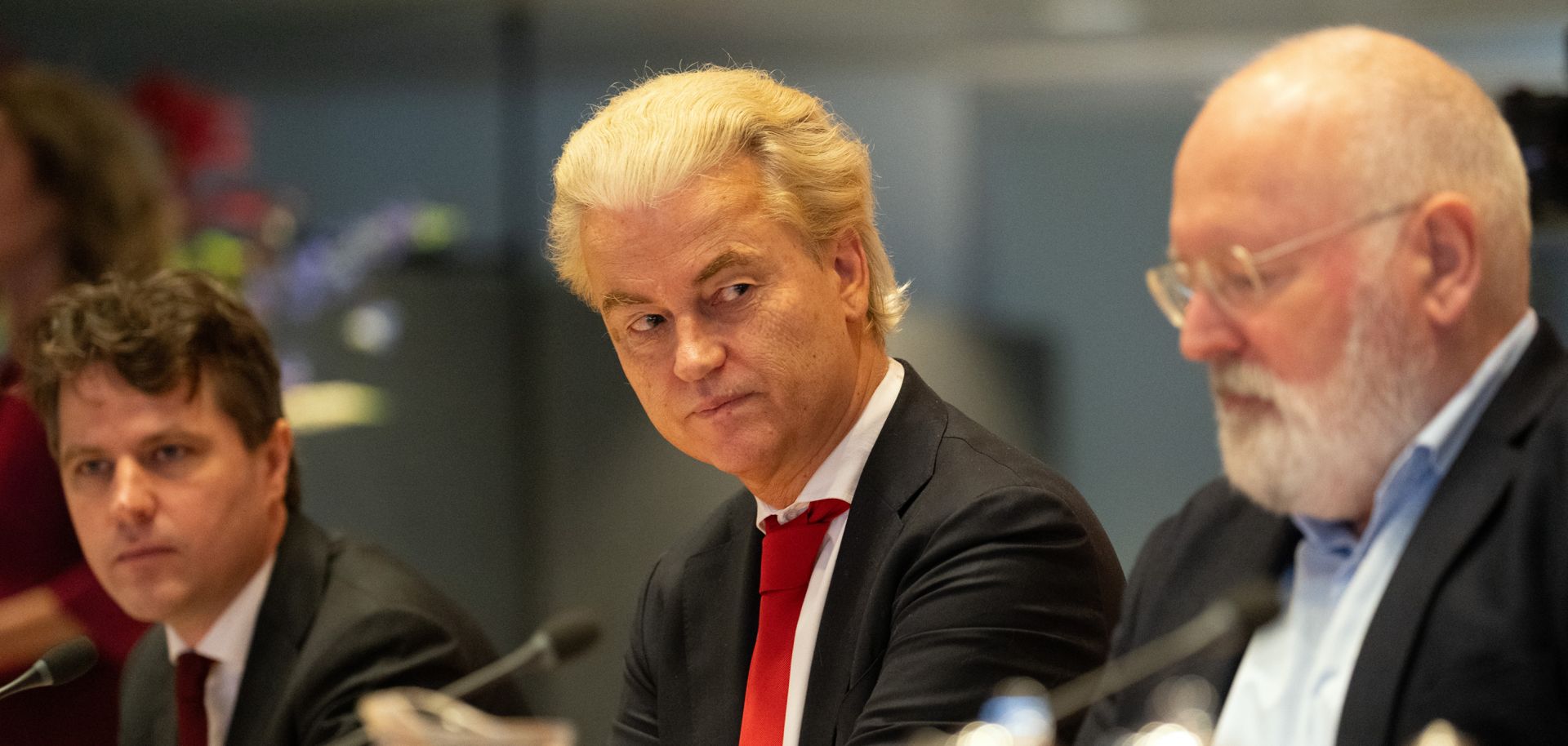
While the Dutch general election has increased the possibility of a far-right-led government, a fragmented parliament reduces the chances of radical changes in the country's domestic and foreign policies. Coalition talks continue in the Netherlands following the Nov. 22 general election, in which Geert Wilders' far-right Party for Freedom, or PVV, led with 23.6% of the votes, followed by former EU Commissioner for Climate Frans Timmermans' Green Left-Labor Party alliance with 15.7%. The outgoing liberal right-wing People's Party for Freedom and Democracy, or VVD, of former Prime Minister Mark Rutte (now led by outgoing Justice Minister Dilan Yesilgoz-Zegerius) won 15.2% of the vote, and Pieter Omtzigt's recently formed center-right New Social Contract, or NSC, won 12.9%. The PVV is projected to secure 37 seats in the country's 150-seat parliament, which means it needs coalition partners to form a government.
While Wilders will seek to form a minority center-right government, his coalition partners will push to moderate some of his most radical positions. To form a parliamentary majority, Wilders needs the backing (as part of a coalition or externally in parliament) of either the Green-Labor alliance, which is projected to secure 25 seats; the VVD, with 24; or Omtzigt's NSC, with 20. So far only the small far-right Forum for Democracy party and the anti-establishment Farmer Citizen Movement, which won a combined projected 10 seats, have said they are open to joining a coalition led by PVV. These seats are not enough to appoint a government, which will force the PVV to look for additional partners. However, the Green-Labor coalition is not a viable partner for the PVV because of their deep ideological differences. And while the NSC shares some of the PVV's anti-establishment rhetoric, Omtzigt previously refused to collaborate with the far-right during the electoral campaign, and some of the two parties' views differ significantly, including in fundamental areas such as EU integration. In the meantime, Yesilgoz-Zegerius has already ruled out her VVD party joining an eventual PVV-led coalition, but she said she could support a "center-right" government from the outside. Against this backdrop, both an eventual alliance with NSC and the external backing from VVD will force Wilders to moderate some of his most radical positions in order to form a minority government, including by smoothing its anti-Islam stances and abandoning plans to hold a referendum on leaving the European Union.
- Wilders' campaign advocated for stringent measures against constitutionally protected religious freedoms for Islam, proposing a ban on the Koran and Islamic educational and religious symbols in state buildings. He has also called for stricter migration and asylum policies, blaming a recent influx of migrants and asylum seekers for the Netherlands' housing crisis and elevated healthcare costs. He is also highly critical of the country's current climate mitigation efforts, particularly of nitrogen reduction targets, promoting instead a greater focus on climate adaptation measures. A vocal critic of the European Union, Wilders has also called for a Dutch referendum to exit the bloc.
Any new Dutch government would likely remain fiscally conservative, stricter on migration and less environmentally ambitious, with no major policy shift from the previous administration. Even if Wilders manages to persuade other parties to back him as the Netherlands' new prime minister, he would become the head of a minority government supported by partners that will seek to moderate his government's policies. Alternatively, a grand coalition led by Timmermans' Green-Labor alliance would need the backing of center-right parties, which would likely temper its typically left-wing socio-economic agenda and ambitious climate policy proposals. This means that, overall, any new Dutch government would likely remain fiscally conservative, stricter on migration and less environmentally ambitious, but with no major policy shift from the previous administration. Moreover, the new government's priorities will largely remain those of its predecessor, with the country's housing shortage, immigration policy and the green transition at the top of the agenda. Key differences between a PVV-led and Green-Labor-led government would be in their approach to these issues, with a PVV-led government likely to be more aggressive in restricting immigration (both regular and irregular), watering down nitrogen emissions reduction targets, and eventually increasing pressure on Brussels to reduce military and financial support for Kyiv. Such a government would also likely be less collaborative with the European Union in areas such as migration, common EU spending and enlargement. Finally, regardless of who will lead the ruling coalition, it will likely take months before a new government takes office. Until then, a caretaker administration with limited executive powers will remain in place, leading to prolonged political uncertainty and preventing the country from making important policy decisions.
- VVD, NSC and the Farmer Citizen Movement have called for a reduction in fiscal deficits in the eurozone and are committed to maintaining a budget deficit below 3% of gross domestic product according to EU fiscal rules. While PVV has advocated for a significant reduction in climate mitigation spending, both NSC and VVD continue to support the Netherlands' adherence to its climate targets despite calling for more cost-efficient policies. This means a PVV-led minority government would water down but not completely overhaul the country's climate agenda.
- A PVV-led government would likely continue to block Romania and Bulgaria from joining the Schengen area, as well as Ukraine, Moldova and Western Balkan countries from joining the European Union.
- It took a record nine months for the Netherlands to form a coalition government after the 2021 election, and a similarly long and complex negotiation process is also likely this time around given the highly fragmented parliament that emerged from the vote.
One of the few areas where Dutch policy could significantly change under a Wilders government is relations with Ukraine, as under his government The Hague could become more skeptical of providing financial and military support to Kyiv. During his electoral campaign, Wilders said he would seek to reduce the Netherlands' financial and military assistance for Ukraine, which already totals more than 7 billion euros ($7.67 billion). While Wilders' coalition partners will likely push for continued assistance to Kyiv if he becomes prime minister, a Wilders-led government could start calling for a gradual reduction in the scope of the aid due to the economic impacts on Dutch taxpayers. Should the Netherlands increasingly align itself with countries such as Hungary and Slovakia, which are skeptical of continued support for Ukraine, the European Union could struggle to reach a consensus on additional funding for Ukraine.
- The Netherlands has already pledged to supply Kyiv with F-16 fighter jets in 2024 and a further 2 billion euros in aid.
