
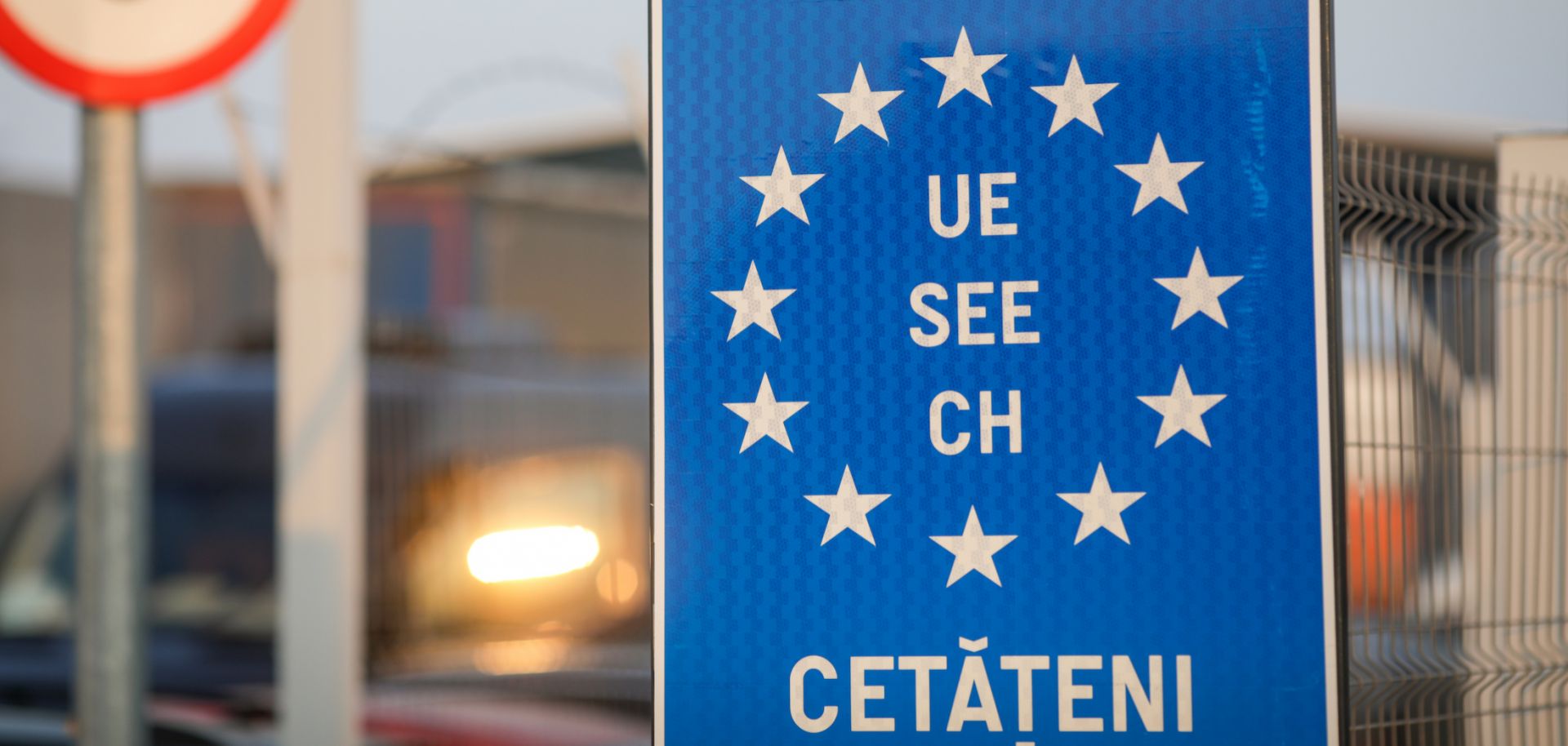
Bulgaria and Romania are increasing their diplomatic push to join the European Union's passport-free Schengen Area by the end of the year, but skepticism in Austria and the Netherlands will likely continue to delay their membership and the economic benefits associated with it. On Oct. 24, Bulgarian Prime Minister Nikolai Denkov arrived in Vienna for a series of meetings with Austrian Chancellor Karl Nehammer and members of the Austrian Parliament. The Bulgarian delegation includes the Minister of Internal Affairs Kalin Stoyanov and the Deputy Minister of Foreign Affairs Elena Shekerletova. Denkov's trip is part of a diplomatic effort to convince Austria to lift its veto on Bulgaria's accession to the passport-free Schengen area. Austria and the Netherlands are currently vetoing Bulgaria's accession to Schengen, arguing that the Balkan country is not doing enough to prevent the arrival of irregular migrants in its territory. Austria is also against Romania's accession to Schengen for the same reasons. Nonetheless, on Oct. 19, the Spanish government, which holds the rotating presidency of the European Union, said Madrid will put the issue of Bulgaria and Romania's Schengen accession on the agenda of the next summit of EU interior ministers on Dec. 5-6. This has triggered hopes in Sofia and Bucharest that they will be finally accepted into Schengen, though so far both Vienna and The Hague are keeping their respective vetoes.
- Decisions to join Schengen require unanimity. In December 2022, the members of the European Union voted to accept Croatia in the Schengen area, but Austria and the Netherlands vetoed Bulgaria's accession and Austria also vetoed Romania's accession. Since then, the European Commission, the European Parliament and several EU member states such as Germany and Spain have spoken in favor of accepting Bulgaria and Romania into Schengen as soon as possible, arguing that they both meet the criteria for accession.
The ideological composition of the Austrian and Dutch governments and electoral calculations suggest that they will continue to delay Bulgaria and Romania's Schengen accession. The main party in the Austrian coalition government is the Austrian People's Party (OVP), a right-wing party that uses anti-immigration rhetoric and is also critical of the Schengen Agreement. Moreover, polls show that vetoing Bulgaria and Romania's Schengen accession is popular among Austrian voters. Austria will hold general elections and elections for the European Parliament in 2024, which suggests that the OVP is unlikely to make the unpopular move of lifting its veto ahead of both elections. The Netherlands, for its part, will hold a general election on Nov. 23. This means that the outgoing government coalition is unlikely to make a decision as controversial as accepting Bulgaria into Schengen so soon before the election, or even during the subsequent negotiations to form a new coalition (which are likely to take weeks). Depending on the ideological composition of the next Dutch government, The Hague could eventually lift its veto, but this will probably not happen in time for the Dec. 5-6 summit of EU interior ministers.
- On Sept. 13, Austrian Interior Minister Gerhard Karner said it currently made ''no sense'' for him ''to talk about an extension of the Schengen area'' at a time when ''migration figures are rising across Europe'' and ''additional border controls are being discussed'' in other EU countries, noting that Austria needed ''more controls, not less.''
- On Oct. 20, the Dutch Minister of Migration Eric van der Burg said that the Netherlands would not lift its veto on Bulgaria's Schengen accession for the foreseeable future, noting that ''the situation at the moment has not changed and I don't see it changing in the short term.''
- According to an opinion poll published in Dec. 2022, 52% of Austrians support their government's decision to block the inclusion of Romania and Bulgaria into the Schengen area.
Protracted Schengen negotiations will further delay the economic benefits for Bulgaria and Romania of joining the passport-free zone, and potentially increase anti-EU sentiments in both countries. Schengen membership has clear economic benefits. For one, the removal of border checks facilitates the free flow of goods and people between Schengen countries, which reduces transit times and costs and encourages cross-border economic activities. Schengen membership also encourages cross-border travel for tourism and business, and streamlines visa application processes for travelers wishing to visit Schengen member states. Given these benefits, Schengen membership is a strategic goal of the Bulgarian and Romanian governments. The delayed negotiations over the issue (and, in turn, the delayed economic gains from entering the passport-free area) will thus serve as a political defeat for both governments, which opposition forces will use to criticize them. More importantly, delayed Schengen membership could fuel anti-EU sentiments in two countries where the political establishment is generally pro-EU, which could manifest in greater support for Eurosceptic parties in the EU parliament elections in June 2024. With like-minded parties expected to perform strongly in other parts of the continent in next year's ballot, Bulgaria and Romania could contribute to the election of a more nationalist supranational legislature.
- On Sept. 15, Romanian Prime Minister Marcel Ciolacu said that if Austrian Chancellor Karl Nehammer ''unjustifiably uses his right of veto again, as prime minister I will have to challenge Austria's decision at the European Court of Justice in order to claim compensation for the losses caused by non-accession.'' According to Ciolacu, the financial losses caused by Romania's delayed Schengen accession amount to ''at least 2%'' of the country's GDP.
- Romania's next general election must take place before March 2025. The nationalist Alliance for the Union of Romanians (AUR) is currently polling between 14-20%, up from 9% in the last general election in December 2020. Bulgaria does not need to hold a general election until 2027, but the Eurosceptic, far-right Revival party is currently polling between 15-17%, up from 13% in the April 2 general election. Both Romania and Bulgaria will elect members of the European Parliament in June 2024, which means that these parties have a strong chance of gaining seats in the supranational legislature.
- The diplomatic spat between Austria and Romania is also threatening a major natural gas project in the Black Sea that could add up to 10 billion cubic meters per year to Europe's gas market by 2027. In June, Austrian oil and gas company OMV (which owns a part of the Neptun Deep gas field off Romania's coast) sued the Romanian government over a controversial law that allows Bucharest to temporarily direct part of the gas output, at regulated prices, to households or any other priority customers during emergency situations. The Romanian government said in September that it would not modify the law as long as Austria keeps vetoing Romania's Schengen membership, meaning the spat may end up delaying a project key to Europe's energy security.
