
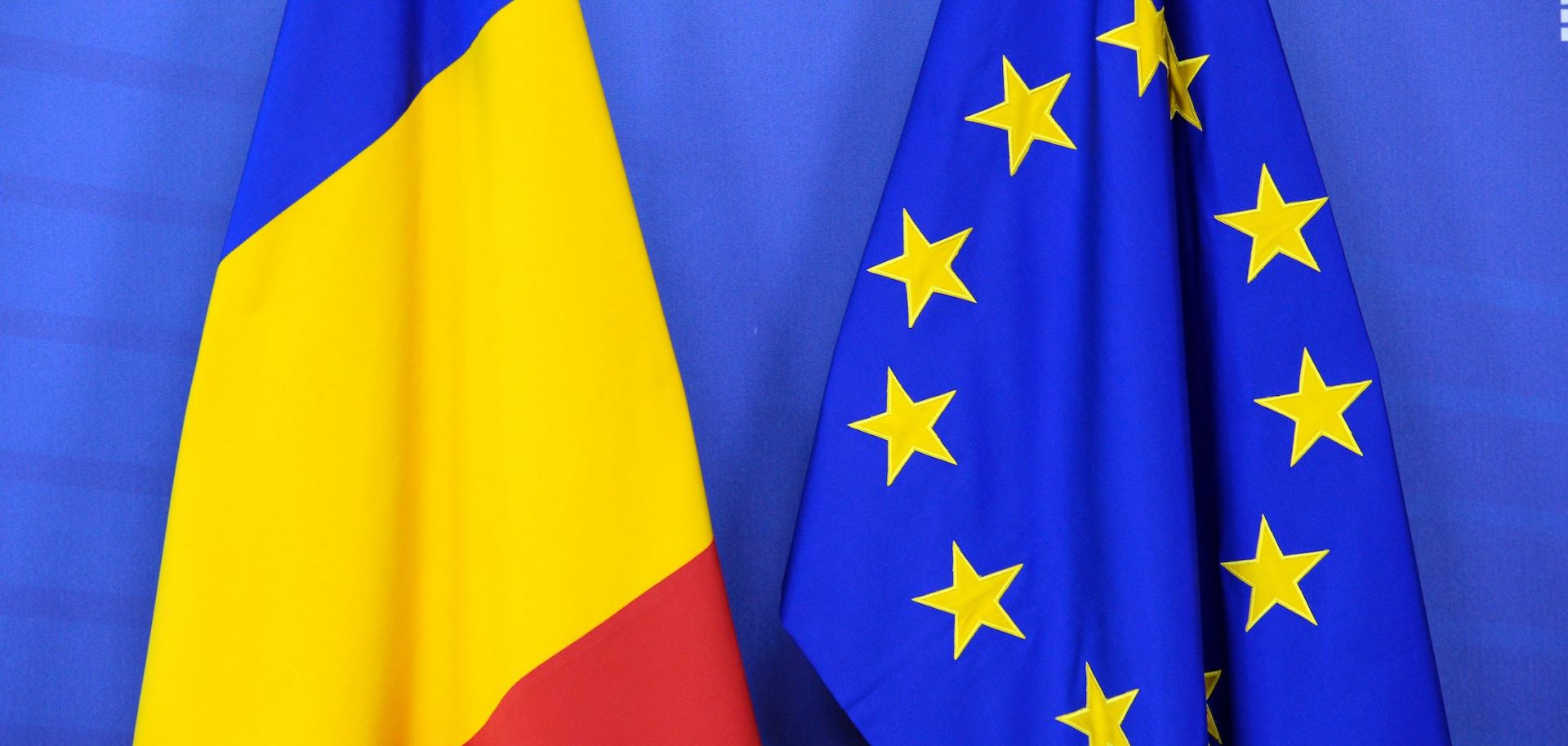
The Romanian and EU flags are seen at the European Commission's headquarters in Brussels, Belgium in February 2017.
Romania's protracted accession to the passport-free Schengen area risks delaying economic benefits and fueling nationalist sentiments in the country. The Romanian government is in the middle of a diplomatic push to convince the European Union to accept it into the Schengen agreement, which removes border controls among its 27 members. On March 9, Romanian Interior Minister Lucian Bode reportedly told his counterparts from other EU member states that Bucharest plans to enter Schengen in 2023 and that his government will continue making efforts to address areas like curbing irregular migration and protecting the country's external borders to qualify for membership.
- As a member of the European Union, Romania is expected to eventually join Schengen. While in recent years Bucharest has complied with many of the requirements to join the agreement, some EU governments are skeptical about Romania's preparedness to enter the passport-free area. This is a problem for Bucharest because membership in Schengen requires unanimous support from all the member states of the agreement.
- In December, the European Union rejected Romania and Bulgaria's access to Schengen, primarily because of resistance from Austria and the Netherlands. Austria was particularly vocal in its opposition to Romania's membership, arguing that Bucharest needs to do more to fight against irregular migration.
- In February, a delegation from the Romanian parliament visited Vienna to discuss Austria's veto of Romania's Schengen accession with Austrian lawmakers. After the meeting, the head of the Romanian delegation, former Foreign Minister Titus Corlatean, admitted that it would be difficult to address Vienna's ''hesitation'' over the issue.
- In March, Romanian Interior Minister Bode proposed to include the issue of Romania's Schengen membership in the agenda of the meeting of the European Union's Justice and Home Affairs Council that took place on March 9-10. While this attempt was unsuccessful, Bode reportedly discussed the issue with his EU counterparts.
Romania will eventually join Schengen because most EU member states are in favor, but the process may not be completed in 2023 due to political calculations in some key member states. The main party in the Austrian coalition government is Chancellor Karl Nehammer's conservative Austrian People's Party (OVP), which has a hawkish stance on immigration. Austria is requesting the European Union reform its migration rules to enhance controls of the bloc's external borders before Romania can join Schengen. But such a broad migration reform is unlikely to materialize in 2023 because of conflicting priorities among member states. In addition, Austria will hold a general election in mid-2024 in which the far-right, anti-immigration Freedom Party of Austria (FPO) is expected to perform strongly. This means that the OVP is unlikely to make concessions on a politically charged topic such as Romania's Schengen accession for fear of losing votes to the FPO. Finally, Sweden is currently in charge of the European Union's rotating presidency, which gives it the power to set the agenda for the bloc's summits. Because Sweden is also governed by a coalition of parties with strong anti-immigration positions, Stockholm is unlikely to include the issue of Romania's Schengen membership in the European Union's agenda. Spain, which takes over the European Union presidency in July, will be more accommodating to Romania's requests but may still struggle to break the impasse on the issue due to opposition from member states.
- Both the European Commission and the European Parliament have repeatedly said that Romania currently qualifies for Schengen membership. Countries including Germany, Italy and Spain have openly expressed their support for Romania's membership.
While for Romania a delayed Schengen membership would primarily mean missed economic opportunities, a prolonged stalemate could also fuel already rising anti-EU sentiments in the country. Membership in the Schengen area would have almost immediate economic benefits for Romania because the elimination of border controls would significantly reduce the time it takes for goods and people to move to and from the rest of the European Union. It would also allow for goods and people to enter and leave Romania from a larger number of crossing points because no border infrastructure would be needed. These changes would reduce transportation costs for companies moving goods across Romania's borders and would probably increase tourism flows to and from the country. In addition to delaying Romania's access to these economic benefits, a protracted accession process may also have political consequences by potentially fueling euroskeptic sentiments in the country. Romania has traditionally been a pro-EU country, as both its mainstream political parties and the general public are supportive of membership in the bloc. However, in recent years the popularity of right-wing, nationalist and euroskeptic ideas has increased. Further delays in Romania's Schengen accession could deepen these sentiments to the point where they become mainstream and make it harder for Romania to cooperate with European institutions. Romania will hold elections for the European Parliament in mid-2024, followed by a general election in late 2024. Both will give an opportunity for nationalist parties to strengthen their representation in the national and supranational legislatures.
- Romania's largest nationalist party is the populist Alliance for the Union of Romanians (AUR), which defends Romania's traditional values and national sovereignty. While the party does not explicitly call for Romania's exit from the European Union, it rejects the bloc's federalization and wants to enhance member states' national sovereignty. The AUR received 9% of the vote in Romania's 2020 legislative elections and is currently polling at roughly 19%, making it the third most popular party in the country.
