
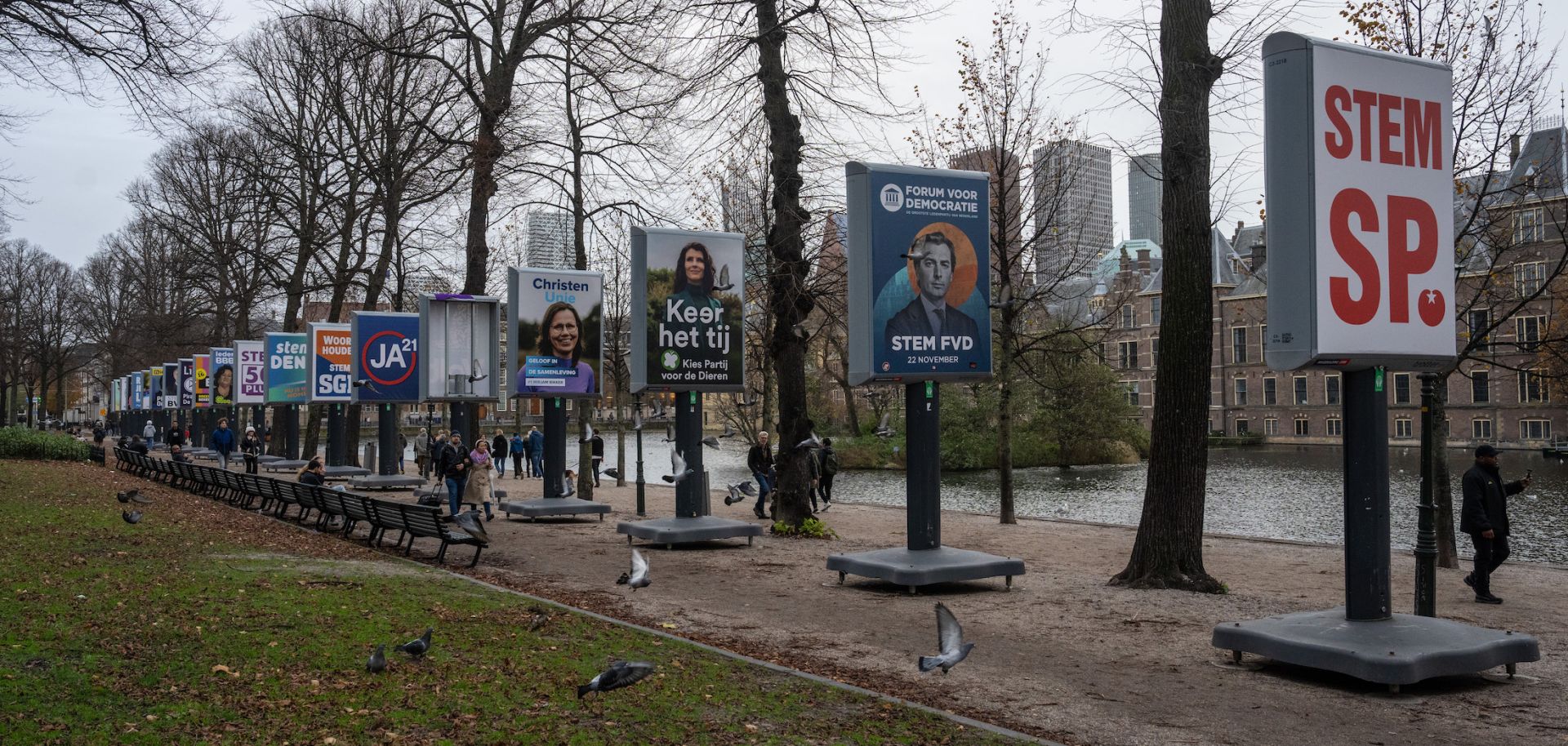
The Netherlands' upcoming general election will result in a fragmented parliament and long coalition talks, though significant policy changes are unlikely under what will probably be another moderate government. The Netherlands will hold an early parliamentary election on Nov. 22 following the collapse in July of the coalition government led by Prime Minister Mark Rutte over internal disagreements on migration policy. Alongside his resignation, Rutte also announced he was retiring from national politics after nearly 13 years in power at the head of four different coalition governments. According to polls, Rutte's right-wing liberal People's Party for Freedom and Democracy (VVD), now led by outgoing justice minister Dilan Yesilgoz-Zegerius, will receive around 18% of the vote. The center-right New Social Contract (NSC) party is also expected to receive around 18% of the vote, followed by the left-wing, environmentalist Green-Labor alliance (GL/PvdA) at 16% and the far-right, anti-immigration Party for Freedom (PVV) at 13%. The remaining projected votes are split between a plethora of smaller and special-interest parties, including the populist Farmer-Citizen Movement (BBB).
- The VVD party, which has led four different coalitions since 2010, has pledged to impose stricter immigration policies, control rent prices and boost private housebuilding. The party has also emphasized that combating climate change should not come at the cost of economic growth. Unlike other major parties in the Netherlands, the VVD has not dismissed the possibility of forming a coalition with the far-right parties PVV and Forum for Democracy (FvD).
- Founded in August 2023, the NSC party is strictly tied to the central figure of its founder, Pieter Omtzigt, a former Christian Democrat. The NSC's platform combines left-wing views on economics (e.g. increased taxes on the rich, stronger workers' rights and higher minimum wage) with right-wing migration policies and social values. Omtzigt has expressed he'd be willing to collaborate with both the VVD and the Labour-Green alliance, but not the far-right PVV and FvD.
- Led by former EU climate commissioner Frans Timmermans, the leftist GL/PvdA alliance is a partnership between the Labor Party and the Greens. The alliance has campaigned on stronger environmental commitments and further European integration, as well as traditional left-wing policies like increasing the minimum wage and expanding social benefits, raising corporate and high-income taxes, increasing public investments in the net-zero transition, imposing rent controls and boosting public housing.
- The far-right PVV party has traditionally captured 10-15% of the vote, but has so far remained outside government coalitions, supporting twice center-right minority governments in parliament.
- Formed in 2020, the populist agrarian BBB party capitalized on rural anger against the former Dutch government's green policies to win provincial elections in March 2023 with 20% of the vote. But support for the party has since plummeted, with the BBB currently polling at just 6% — making it a potential wildcard in the upcoming parliamentary election. Other smaller parties expected to enter parliament that could become part of a ruling coalition include the Christian Democrats (polling at 3%), the liberal-progressive D66 (polling at 5%), and the socially conservative Christian Union (polling at 2%), as well as single-issue parties, such as the Party for the Animals.
The election will produce a fragmented parliament and long negotiations to form a multi-party coalition. A raft of populist parties and various other smaller parties have cropped up in the Netherlands in recent years, fragmenting the country's political landscape. But while this proliferation of parties makes the final outcome of the Nov. 22 election highly uncertain, the new Dutch government will probably be centrist or center-right, as the Dutch electorate continues to gravitate toward the middle of the political spectrum, with the right-wing VVD, center-right NSC and left-wing Green-Labor alliance all leading the latest polls. In one scenario, should the VVD party secure the most votes, it could pursue a coalition with NSC and the BBB agrarian populist party, possibly in a minority government supported by the far-right PVV. By contrast, in a second scenario in which the NSC wins the most votes, a coalition government including PVV would be less likely since Omtzigt has explicitly refused to collaborate with the far-right, but an NSC victory could pave the way for a multi-party right-leaning alliance with the VVD, the BBB, the Christian Democrats and a few smaller parties. A third option could see Timmermans' Green-Labor alliance forming a government with NSC, excluding both VVD and PVV and with the support of smaller left-leaning parties such as the social-liberal D66, the Euro-federalist Volt party, and the Party for the Animals. The most likely scenario, however, is a partnership between NSC and VVD, as they both have similar views on migration, climate, energy and social policies; which of the two parties would lead such an alliance — and whether it would include the far-right PVV — would largely depend on who wins the most votes in the upcoming election.
- The Netherlands uses a system of proportional representation to elect its legislature, in which parties are allotted seats based on how many votes they secure. According to current polls, 18 parties are expected to win at least one seat in the country's 150-seat parliament in the upcoming election. The broader right-wing political camp — together with Omtzigt's NSC — is expected to win around 90 seats.
- While NSC leader Omtzigt has said he'd be open to collaborating with both the VVD and the Green-Labor alliance, he's expressed more hesitance about cooperating with the latter due to significant disagreements on key policy areas such as migration, climate and energy.
Regardless of its eventual composition, the next Dutch government will likely remain focused on addressing housing, immigration and climate issues, with no major policy shifts from the previous administration. It could take months for coalition talks to yield a deal, and in the interim, a caretaker administration will remain in place, leading to prolonged political uncertainty and preventing important policy decisions from being taken. But whatever government eventually emerges from negotiations will likely maintain the Netherlands' tradition of fiscal prudence, constructive engagement with the European Union, and relatively conservative stance on migration. Moreover, while the overall policy direction will depend on the ultimate composition of the ruling coalition, the new government's priorities will largely remain similar to those of its predecessor, with the country's housing shortage, immigration policy and the green transition at the top of the agenda.
- The Netherlands has a long history of coalition governments, as no single party in the country has ever secured the 76 seats needed to form a majority in the 150-seat Dutch parliament. New coalitions also traditionally include at least one or two parties from the previous administration, which guarantees a degree of policy continuity.
- It took a record nine months for a coalition government to be formed after the Netherlands' 2021 election, which saw 17 parties obtain at least one seat in parliament.
- A recent Ipsos poll shows that 35% of Dutch voters consider inflation and rising living costs as the most important issues in the upcoming election, followed by healthcare (31%), immigration (29%), the housing shortage crisis (28%) and climate (24%).
But in tackling these key issues, the new government may take a markedly different approach than its predecessor, particularly when it comes to reducing the country's nitrogen emissions. Government failures to address the issue of high nitrogen concentrations in the Netherlands' soil due to extensive farming activities (a situation known as ''the nitrogen crisis'') have shaken the country's political landscape in recent years. Since 2019, Prime Minister Rutte's government has proposed a series of measures to slash nitrogen emissions, including by drastically reducing the number of livestock in the country, which triggered mass protests from farmers and rural communities, and led to the BBB party's unexpected victory in provincial elections in March 2023. Against this backdrop, the new administration will face growing pressure to walk back its predecessor's costly climate policies, particularly those designed to slash nitrogen emissions, with decisions in this sense significantly affecting the future of sectors like farming, construction and aviation. A government led by the NSC or the incumbent VVD would stress the need to balance climate policies with economic growth and affordability for citizens, while one led by the Green-Labor alliance will be more ambitious on climate. Both, however, would likely scale back the government's targets for reducing nitrogen emissions. Indeed, even Timmermans, the leader of the Green-Labor alliance, said on Nov. 5 that he no longer supports the outgoing government's goal to halve the Netherlands' nitrogen emissions by 2030.
- Immigration also remains a key issue in the Netherlands, with the previous government collapsing due to infighting over proposed legislation to reduce the number of migrants allowed to seek asylum in the country. The country's housing shortage is a significant issue as well, with research commissioned by the government indicating a nationwide deficit of 390,000 houses. The Netherlands' nitrogen crisis has only exacerbated the housing crisis, with 18,000 construction projects halted due to nitrogen emissions restrictions.
