
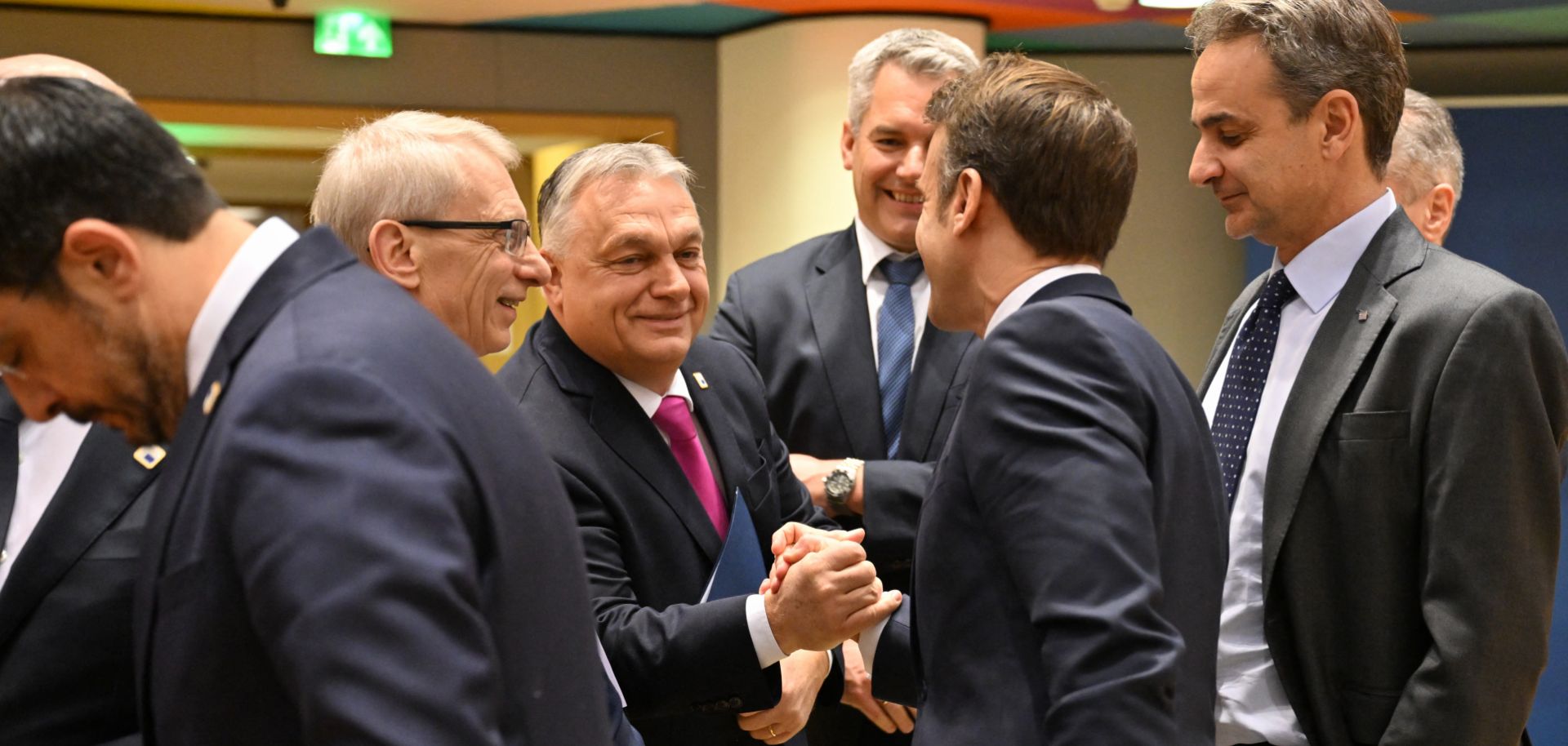
EU member states' decision to start accession talks with Ukraine has kicked off a long process that may still be obstructed at multiple later stages, while the bloc's failure to approve a 50 billion euro aid package will delay, but likely not block, the disbursement of crucial EU financial support for Kyiv. During a summit on Dec. 14-15, EU leaders agreed to open accession negotiations with Ukraine and Moldova, grant candidate status to Georgia, and postpone talks with Bosnia and Herzegovina until it completes reforms toward meeting accession criteria. At the same time, they failed to strike a deal to increase EU funding to Ukraine by 50 billion euros ($53.4 billion) as part of the bloc's long-term budget. In the weeks leading to the summit, Hungarian Prime Minister Viktor Orban threatened to veto both the financial aid for Ukraine and the country's EU membership bid (both of which require unanimity among the bloc's member states), citing Ukraine's corruption and lack of minority protections for ethnic Hungarians living in the country. But besides these formal justifications, Orban used his veto as leverage to secure more funding for Hungary from Brussels, which has frozen billions of EU funds earmarked for Budapest over corruption and rule-of-law concerns. The unblocking of 10 billion euros in frozen EU cohesion funds earmarked for Hungary on Dec. 13 was likely why Hungary ultimately decided not to oppose starting accession talks, but it was not enough to convince Orban to back the financial aid package for Ukraine, which he vetoed.
- To reach the required unanimity over the decision to formally start EU accession talks with Ukraine, Orban walked away from the room while the vote took place, in a move allegedly pre-agreed with other EU leaders. According to EU rules, unanimity is fulfilled even if one of the 27 member states' leaders is absent. This allowed Orban to save face without derailing Ukraine's EU accession bid.
- EU member states also reached a preliminary agreement for a 12th package of sanctions against Russia, which reportedly includes a ban on imports of Russian diamonds and measures to strengthen the enforcement of a price cap on Russian oil.
The start of negotiations does not guarantee future EU membership for Ukraine, which faces a lengthy accession process fraught with required unanimous approvals at multiple stages. EU member states' decision to launch accession negotiations with Ukraine sends a message of unity (though only formally so given Hungary's de-facto abstention) behind the bloc's commitment toward the country's EU integration. But the move is largely symbolic and does not guarantee future membership, which will likely take years to materialize and may still be opposed at later stages. Moreover, Ukraine will have to implement multiple economic, political and institutional reforms before it can become an EU member, which will likely take years. In fact, the formal launch of the negotiating framework for Ukraine to join the European Union will only start after the next European Council summit in March 2024, before which the country will still have to meet several additional criteria for its membership. After that, the process will still take years and the path to membership will be constantly threatened by the veto power of disgruntled member states like Hungary, which may have interests in stalling or delaying the process in exchange for concessions from Brussels on other issues.
- Despite all the constraints, the start of accession negotiations marks a significant step for the European Union in its strategic enlargement goal, and for Ukraine in its decades-long geopolitical shift toward the West, now propelled by Russia's invasion.
- Croatia, the last country to join the European Union, took 10 years since its application to become a member of the bloc before being formally accepted in 2013, and the obstacles in its way were much lower than those faced by Ukraine.
- The formal start of accession negotiations in March hinges on Ukraine's progress toward meeting membership criteria. The European Commission acknowledged that Ukraine had implemented four out of seven key reforms it had previously identified as necessary to meet accession standards, with measures primarily aimed at strengthening the rule of law in the country. The Ukrainian government is now making progress on the remaining recommendations, with legislation aimed at limiting oligarchs' influence in the country's politics and establishing a legal framework for protecting minority rights already presented to lawmakers in Ukraine's parliament.
Hungary's move to veto the 50 billion euro aid package will delay the disbursement of critical EU financial support for Ukraine, but the bloc still has other options to continue financing Kyiv. EU leaders will hold another summit to discuss financial aid for Ukraine in January. Should Brussels fail to convince Hungary to lift its veto, the European Union would still be able to work around it by having all other member states approve bilateral aid packages for Ukraine that, together, would amount to roughly the same amount previously earmarked for Kyiv in the EU budget. However, circumventing Budapest's veto would risk creating a precedent for other EU member states to follow, which could further undermine EU unity on Ukraine moving forward. Moreover, if Hungary is excluded from financing Ukraine, other EU countries could seek to be excluded in the future, eventually reducing the amount of money that the bloc can provide to Kyiv. So while the option to provide the 50 billion euros to Ukraine outside of the EU budget process is on the table, Brussels will still prefer to reach an agreement with Hungary on the matter, which could see it promise to unblock more EU funds earmarked for the country that remain frozen amid the ongoing rule of law dispute, in exchange for Budapest's support on the aid package.
- On Dec. 15, Irish Prime Minister Leo Varadkar said it was ''possible for the 26 member states to provide the money [for Ukraine] on a bilateral basis'' and noted the bloc was looking into ''workarounds.'' Separately, Estonian Prime Minister Kaja Kallas said that the European Union would continue to support Ukraine financially and that there were ''different ways'' the bloc could do this.
