
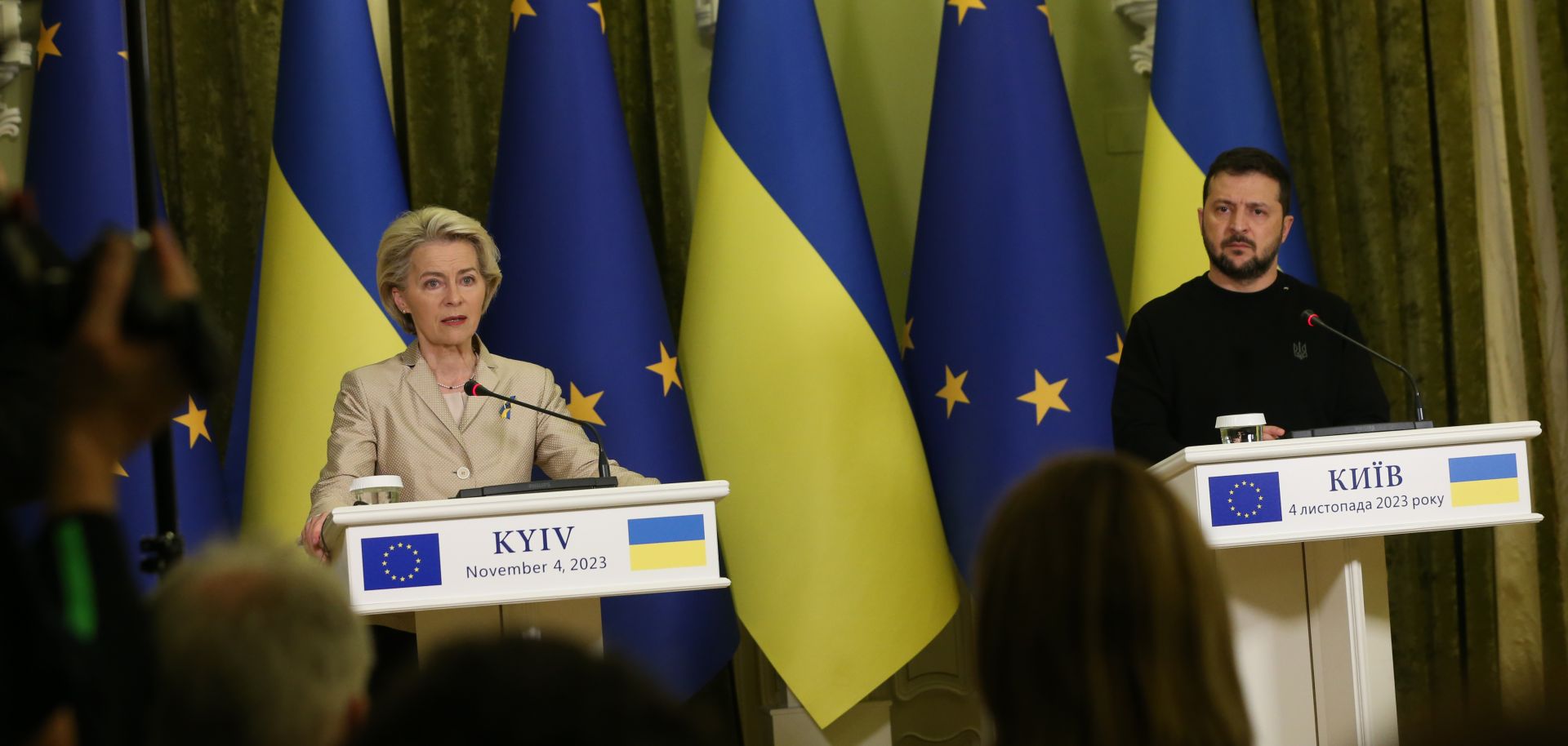
The West will probably continue supporting Ukraine financially, militarily and politically in the coming months, but upcoming elections in the European Union and the United States will increasingly threaten that support, which means that pressure on Kyiv to reach a deal with Moscow will increase in 2024. During a joint press conference with European Commission President Ursula von der Leyen on Nov. 4, Ukrainian President Volodymyr Zelenskyy admitted that there was growing fatigue in the West over his country's war against Russia and that it was ''clear the war in the Middle East'' had ''tak[en] over the focus of international attention,'' alluding to the ongoing Israel-Hamas conflict in Gaza. However, he denied media reports that U.S. and EU officials were asking Ukraine to consider peace negotiations with Russia. Von der Leyen, meanwhile, promised that the European Union would continue supporting Ukraine.
- The day before Zelenskyy and Von Der Leyen's press conference, NBC News published a report that the United States and European Union were increasing pressure on Ukraine to reach a settlement with Russia, citing ''one current senior U.S. official and one former senior U.S. official familiar with the discussions.'' Zelenskyy's Nov. 4 remarks also come after a duo of Russian comedians released on Nov. 1 the recording of a conversation with Italian Prime Minister Giorgia Meloni, in which she said that EU leaders were ''tired'' of the war in Ukraine and that ''we [are] near the moment in which everybody understands that we need a way out.'' In the recorded phone call, which took place in September, one of the comedians pretended to be the head of the African Union to deceive Meloni. The Italian government said in a statement it ''regretted'' Meloni was ''deceived by an impostor.''
- In an interview with Time magazine published on Nov. 1, Zelenskyy said that ''exhaustion with the war rolls along like a wave. You see it in the United States and in Europe.''
The prospect of a stalemate in Ukraine, U.S. and EU lawmakers' pre-election political calculations, and the war in Gaza are among the main drivers behind the West's growing fatigue with support for Kyiv. The growing exhaustion with the Ukraine war in the United States and Europe is the result of multiple factors. For one, the war has been going on for almost two years and neither side appears close to a clear victory. In fact, many EU and U.S. public officials have started to use the term ''stalemate'' off the record to describe the situation on the ground in Ukraine. Against this backdrop, a growing number of Western politicians have started voicing concerns over the billions of dollars being spent on a conflict with no near end in sight. In the United States, for example, many Republicans in Congress are now openly questioning whether Washington should continue financing Kyiv's war efforts; while in the European Union, Hungary and Slovakia recently blocked a decision to provide additional funding for Ukraine (the bloc is scheduled to discuss the issue again in December). This skepticism will likely only grow as Western policymakers enter into campaign mode next year, with the United States scheduled to hold presidential and Congressional elections in November 2024, and the European Union scheduled to hold elections for the European Parliament in June 2024. In addition, the outbreak of war in the Gaza Strip last month has only further complicated matters by diverting the attention of both Western citizens and their governments away from the war in Ukraine. This diversion of attention to the ongoing Israel-Hamas conflict could grow to include military materiel as well, as both Ukraine and Israel may need some of the same U.S.-provided weapons and ammunition. Moreover, the approaching winter months will probably result in a reduction in active fighting in Ukraine, which will only add to the West's perception of a stalemate and, in turn, make EU and U.S. policymakers all the more wary of accepting Ukraine's continued requests for additional weapons and funds.
- In an interview with The Economist published on Nov. 1, Ukraine's army chief, Valery Zaluzhny, admitted that the war had reached a stalemate and said that this was creating fatigue among some of Ukraine's main supporters in the West. President Zelenskyy immediately criticized Zaluzhny's remarks and said that while ''time has passed'' and that ''people are tired…this is not a stalemate, I emphasize this once again.''
- On Oct. 31, U.S. Defense Secretary Lloyd Austin and Secretary of State Antony Blinken defended the administration of President Joe Biden's $105 billion emergency aid request for Israel and Ukraine before the Senate Appropriations Committee, arguing that the two conflicts are interconnected. While there is bipartisan support in the Democratic-controlled U.S. Senate for the package, the plan faces roadblocks in the Republican-led House of Representatives, where some Republican lawmakers are trying to dismantle Biden's aid package and prioritize support for Israel.
- During an EU summit on Oct. 27, Slovakian Prime Minister Robert Fico criticized a plan to provide an extra 50 billion euros in support for Ukraine, arguing that ''the Ukrainians will not win on the battlefield.'' He added that ''Ukraine is among the most corrupt countries in the world and we are conditioning what is excessive financial support on guarantees that European money (including Slovak) not be embezzled.'' Hungary is also questioning the plan, though Budapest's position is likely linked to ongoing negotiations with the European Commission to unblock billions of euros in EU funds for Hungary that Brussels froze over concerns about the status of the rule of law in the country.
With the West's financial, military and political support increasingly in doubt, Ukraine will likely adopt a more conservative military strategy on the battlefield to save its resources and, in a less likely scenario, may even open the door to informal talks with Russia. While war fatigue in the West is real, it has not reached the point where the United States and the European Union are actively and publicly pressuring Ukraine to negotiate with Russia. In fact, in December, the European Union will probably unblock the extra funding for Ukraine that Hungary and Slovakia recently questioned, while the European Commission will likely say in a Nov. 8 report that Ukraine is making progress toward membership in the bloc. In the United States, the Biden administration's strategy of linking assistance for Israel to assistance for Ukraine could also convince Congress to pass a new package of financial support for Kyiv, especially as many Republicans are in favor of it. However, the situation in both territories will become more politically complicated in 2024 as EU and U.S. lawmakers gear up for their respective elections in June and November, which will force Ukraine to make difficult decisions as it faces realistic prospects of running out of men, money and weapons to continue its fight against Russia. In response to this looming threat, Ukraine will most likely adopt a more conservative and defensive approach on the battleground in 2024 that prioritizes protecting its current territory over recovering the land Russia has seized in order to save resources. Such a shift in Kyiv's military strategy would result in a prolonged stalemate in which the intensity of fighting may decrease but the conflict would not end, leaving Ukraine partially occupied and in constant need of foreign economic assistance. Over time, this scenario would enable Russia to not only solidify control of its captured territories in eastern Ukraine, but build out its military capacity to attack Ukrainian targets elsewhere in the country for a prolonged period. If insufficient Western support significantly worsens Ukraine's financial and military situation, there's also a chance Kyiv may be forced to enter at least informal conversations with Russia over a cease-fire. But even in this alternative (and less likely) scenario, Kyiv would remain highly unlikely to ink a formal peace treaty with Moscow in the short to medium term, because it would involve territorial concessions that Ukraine is not willing to make.
- Should former U.S. President Donald Trump or another Republican candidate with similarly skeptical views about U.S. support for Ukraine win next year's presidential election, Washington's support for Kyiv would probably drop significantly in 2025. While European countries would likely still continue to provide some financial and military backing for Ukraine, their levels of support would presumably also decline with such a change in U.S. leadership.
