
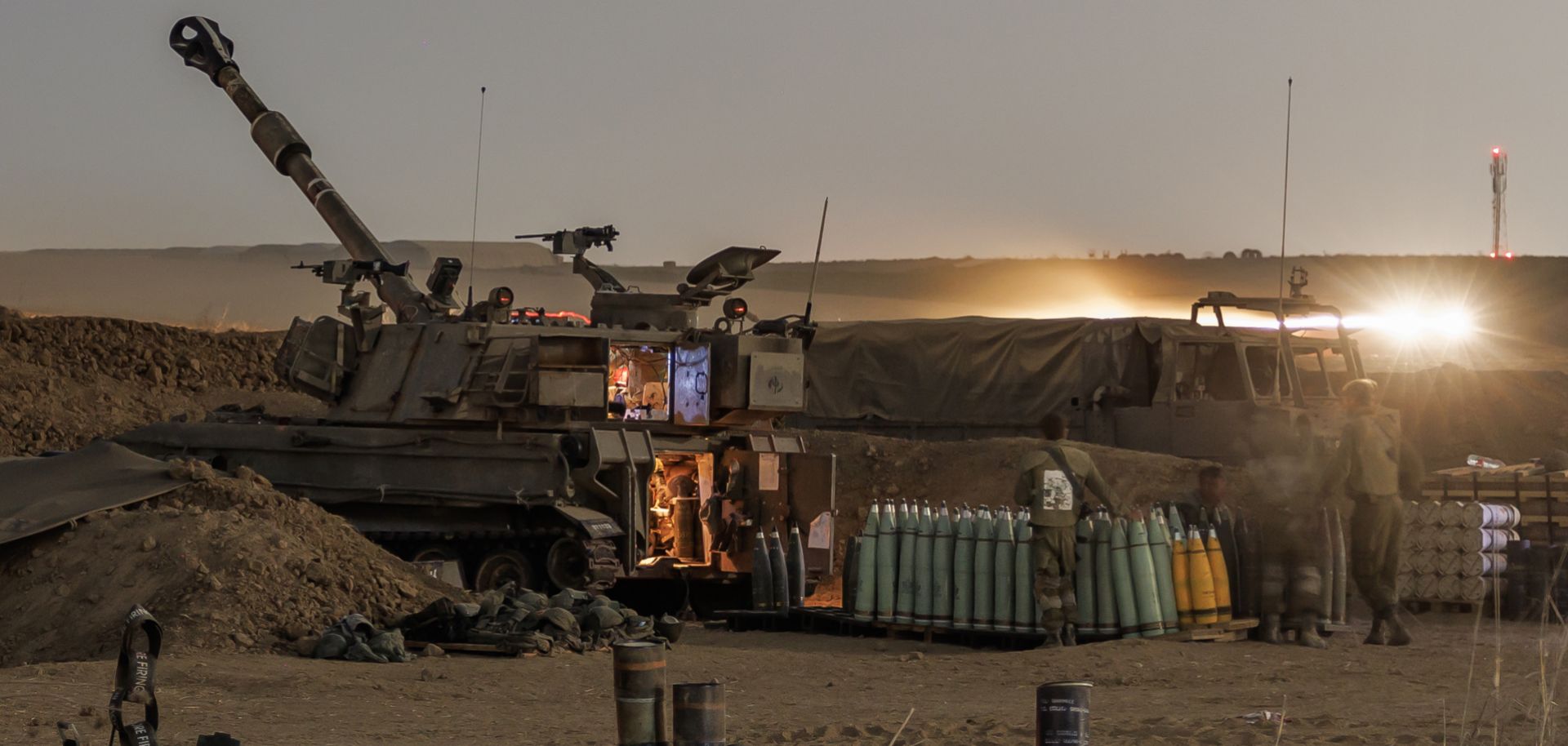
The expansion of Israel's ground operation in the Gaza Strip raises the risk of regional escalation from Iran and its proxy forces, while amplifying the threat of violence in the West Bank and sporadic attacks in Israel. On the evening of Oct. 28, Israeli Prime Minister Benjamin Netanyahu announced that his government's war against Hamas in the Gaza Strip had entered a ''second phase,'' simultaneously calling it Israel's ''second war of independence'' and telling Israelis that the ground war would be ''long and difficult.'' Since then, ground troops from the Israel Defense Forces (IDF) — backed by tanks, artillery and airstrikes — have entered the northern part of the strip. Although the IDF has not commented on the number of troops or their precise locations, photos and videos circulating on social media on Oct. 30 show them on the outskirts of Gaza City, the largest city in the territory, where they appear to have engaged in heavy combat. Shortly after Netanyahu's statement, the account of Iranian President Ebrahim Raisi shared a post on X (formerly Twitter) stating that Israel's actions had ''crossed red lines, which may force everyone to take action.''
- Over the weekend, fighting also intensified in the West Bank, where clashes overnight on Oct. 29-30 around the city of Jenin killed the founder of a local militant group and three other fighters. The head of Israel's internal security service, Shin Bet, also reportedly warned the government that an increase in both Israeli settler violence and IDF clashes with Palestinians were bringing already simmering tensions to a dangerous boiling point.
- On Oct. 30, Israeli officials announced that fighter jets had again struck military infrastructure in Syria and Lebanon in response to rocket launches from both countries. The IDF has traded artillery and tank fire across both the Lebanese and Syrian borders since the start of the war.
The expanded ground incursion comes after weeks of speculation and amid ongoing U.S. pressure on Israel to tighten the scope of its military campaign in order to increase its chances of defeating Hamas, enable more humanitarian aid to enter Gaza, and allow more time for hostage release negotiations. Israeli officials have not divulged their plans, but so far, the ongoing operation in the Gaza Strip appears to be narrower in scope compared with a full-scale ground invasion. According to reporting by The New York Times, Israeli military chiefs adjusted their plan after significant pressure from U.S. military leaders who urged their Israeli counterparts to at least initially conduct more focused assaults to scope out the environment on the ground before committing a larger force for what will be a difficult campaign of urban warfare, especially given the vast network of underground tunnels that Hamas and other militant groups like Palestinian Islamic Jihad (PIJ) operate. Concurrently, U.S. officials continue to press Israel to limit its ground invasion to allow more humanitarian aid to flow into the war-torn territory, as global media attention highlights the plight of those in Gaza, and as U.S. President Joe Biden faces growing pressure from within his Democratic Party to call for a cease-fire. The United States had also been urging Israel to slow its invasion timeline to allow more time for negotiations to release the 239 hostages now believed to be held by Hamas. But those backchannel talks appear to have stalled, which probably helps to account at least in part for the timing of Israel's expanded ground campaign.
- On Oct. 29, NBC News, citing three sources familiar with the hostage negotiations, said that talks had stalled on Oct. 27 after Hamas and Israel could not agree on the sequencing between Hamas first releasing more hostages or Israel first allowing fuel deliveries into the strip. Talks apparently remain ongoing but at a much slower pace.
- Under reportedly significant U.S. pressure, Israel restored partial internet access in Gaza on Oct. 29. The approximately two-day communications blackout had significantly curtailed humanitarian efforts.
- In multiple television interviews on Oct. 29, U.S. National Security Adviser Jake Sullivan repeatedly stated that Washington fully backs Israel's right to defend itself but that Israel needs to distinguish between civilian and military targets, as well as allow humanitarian aid to continue to come into Gaza.
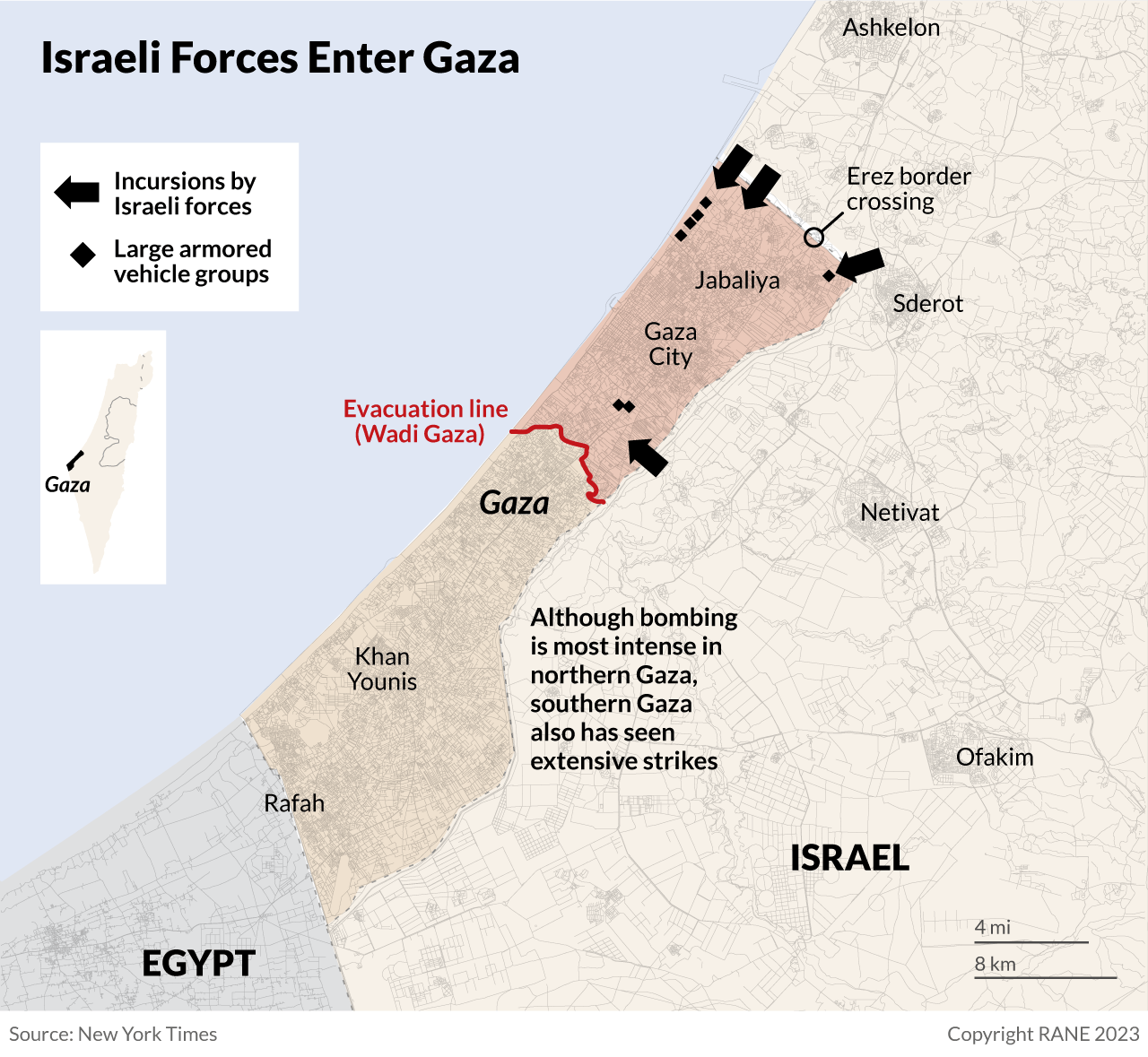
Israel's expanded ground operation in Gaza will threaten to increase the frequency and intensity of attacks by Iran and its aligned militias. Even though Israel's ground incursion so far does not amount to a full-scale invasion, the IDF's offensive in Gaza represents the largest number of Israeli soldiers in Gazan territory since the start of the conflict — a development that Iran and its militias have been warning for weeks would lead them to retaliate. Further IDF advances into Gaza, especially if they lead to alleged atrocities involving Palestinian civilians, would only increase the risk of Iranian-backed escalation. The latest warning on Raisi's X account confirms this threat and hints at further attacks against regional U.S. military targets, which pro-Iranian militias in Iraq, Syria and Yemen have been targeting for weeks. Even if neither Tehran nor Washington desires a regional war, the scope for miscalculation is large, as already two dozen U.S. soldiers have been injured in Iranian-backed rocket and drone attacks; the deaths of any soldiers in future Iranian-supported attacks would put significant pressure on Washington to respond more aggressively. For Israel, the most immediate threat of regional escalation would be if Iranian-backed Hezbollah in Lebanon joins the war more forcefully. Hezbollah and the IDF have traded tit-for-tat strikes since the start of the conflict, though neither has so far escalated to a larger extent. That could change, however, either by design should Hezbollah and its Iranian backers want to force Israel to fight a two-front war, or by accident if an Israeli or Hezbollah attack leads to mass casualties that politically forces the other side to respond in kind.
- The threat posted on Raisi's X account is consistent with other Iranian threats. Iran's Supreme Leader Ayatollah Ali Khamenei and the Supreme National Security Council ultimately have the final say on Tehran's national security strategy, though both Khamenei and the council are typically hawkish.
But regardless of how Hezbollah or other Iranian-backed groups react, IDF forces will be at least partially preoccupied with an uptick in violence in the West Bank and the growing risk of attacks in Israel. On Oct. 30, Israeli Finance Minister Bezalel Smotrich announced that he had instructed his ministry to halt the transfer of funds to the Palestinian Authority (PA), which nominally governs the West Bank, in light of what he said was the PA's ''support'' for Hamas. This will only add to the PA's challenges in curbing militancy and likely amplify already high grassroots grievances in the West Bank. A further uptick in the already elevated level of violence could force the IDF to divert more attention to the territory, not only to protect its own soldiers from growing attacks but also to curb violence by Israeli settlers against Palestinians. Growing violent unrest in the territory will also increase the risk of militants from the West Bank conducting attacks elsewhere in Israel, especially in the neighboring city of Jerusalem. In Israel, there will be a growing risk of intercommunal violence between Israeli-Arabs and Jewish Israelis as well. In addition, an escalation from Palestinian militants in Gaza or the West Bank, or from Hezbollah or Palestinian cells based in southern Lebanon, could result in more aggressive rocket or drone attacks targeting central Israeli cities like Tel Aviv, which are typically safer than other areas of the country due to their geographic distance from Israel's northern and southern borders.
- On Oct. 30, a Palestinian from East Jerusalem stabbed an Israeli police officer and attempted to flee through nearby streets before he was shot dead.
- On Oct. 29, alert sirens went off in towns across central Israel, including Tel Aviv, after a large rocket barrage from the Gaza Strip. No major injuries were reported but shrapnel from intercepted rockets fell across the region.
- On Oct. 28, Defense Minister Yoav Gallant reportedly warned Israel's war cabinet that the situation in the West Bank was precarious and expressed the need to ''make sure that the area is not enflamed.''
- On Oct. 27, the IDF, providing what it said was visual and intercepted audio evidence, publicly accused Hamas of keeping its main base of operations under the al-Shifa hospital in the Gaza Strip — a charge Hamas denied. A future IDF operation around the hospital could lead to a mass casualty incident akin to the Oct. 17 explosion at the al-Ahli hospital that killed hundreds of people in Gaza. The tragedy provoked widespread condemnation of Israel throughout the Islamic world, despite the United States and other Western governments blaming the hospital blast on a failed PIJ rocket launch.
