
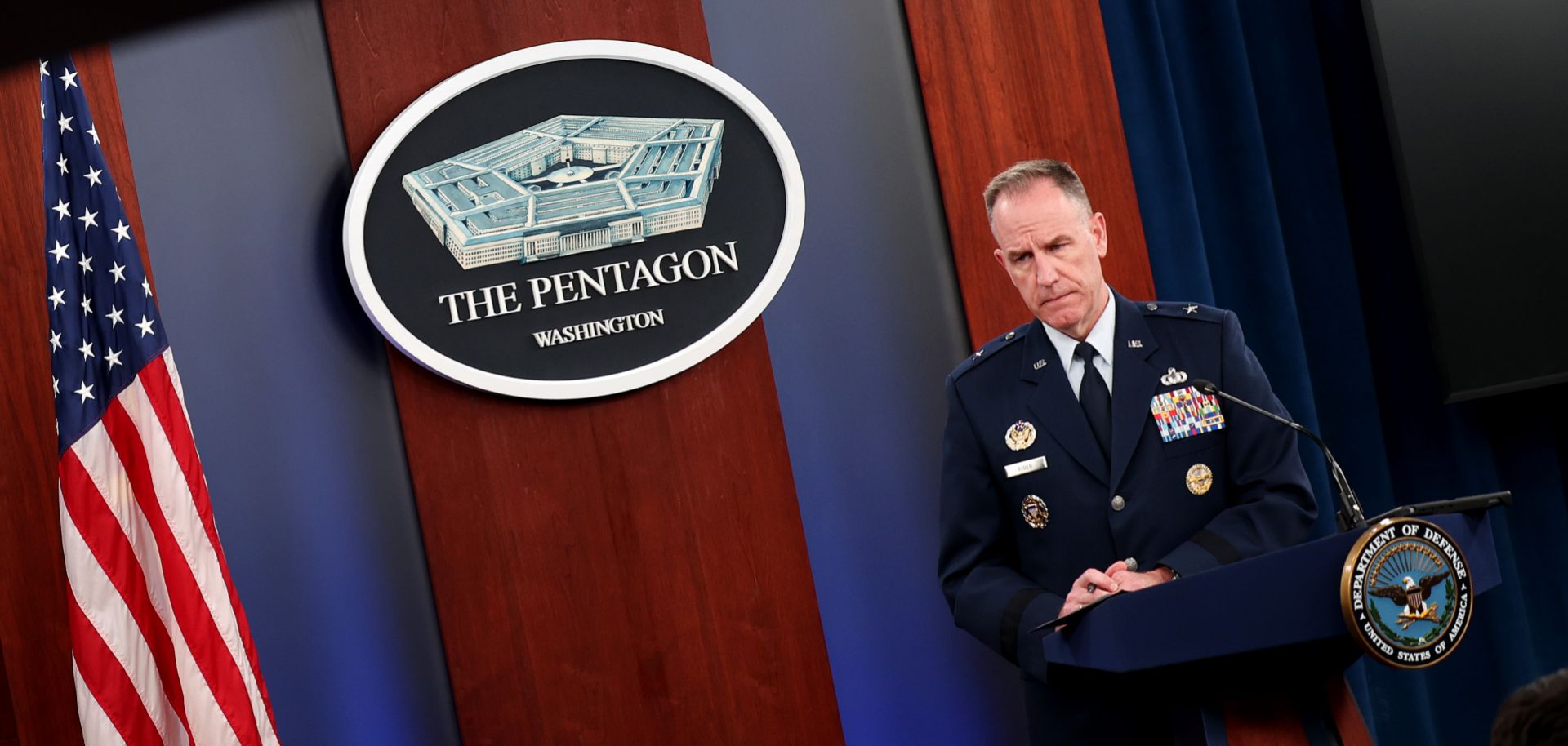
In the Middle East, the United States is positioning itself defensively in response to the risk of wider regional escalation due to the ongoing Israel-Hamas war, but major Iranian or proxy attacks against Israel or U.S. forces may still pull Washington into a large-scale conflict. On Oct. 26, U.S. warplanes struck two Iran-linked sites near the Syrian city of Bukamal on the Iraqi border, where the Pentagon said it had struck ammunition and storage areas associated with the Islamic Revolutionary Guard Corps (IRGC) — marking the first U.S. military operation against Iranian-linked targets since the Hamas-Israel war broke out on Oct. 7. U.S. Defense Secretary Lloyd Austin said that the strikes were in response to numerous attacks on U.S. forces in Syria and Iraq in recent weeks amid the ongoing conflict in Gaza. The attacks came after the Pentagon said it was deploying around 900 new troops to the region, mostly to operate air defense systems like the Patriot, Avenger and Terminal High Altitude Area Defense (THAAD) systems that are designed to intercept drone, rocket, and missile strikes from Iran and its proxies.
- U.S. airstrikes against Iran-linked sites in Syria are relatively routine; in March 2023, the United States carried out another set of strikes on such targets. Iran has long harassed U.S. troops in Syria and Iraq to attempt to undermine the United States' position in both countries and try to convince Washington to withdraw troops from them.
- On Oct. 19, the United States and Saudi Arabia downed several Yemen-originated missiles that were reportedly launched by Iran-aligned Houthi rebels in Yemen and aimed at Israel.
- Since the outbreak of the Hamas-Israel war, at least 24 U.S. soldiers have been injured in Iraq and Syria in attacks by pro-Iranian militias, according to the Pentagon.
The airstrikes and deployment of new air defenses, combined with carrier-based air assets, suggest that the United States will remain focused on a defensive response to Iran and its proxies' intervention in Gaza to avoid getting drawn into a military conflict. The U.S. airstrikes in Syria near the Iraqi border are part of a preexisting pattern of U.S.-Iranian clashes that have gone on for years. This suggests Washington's preferred tactical response to harassment is to remain in the Iraq-Syria theater in order to minimize the military, diplomatic and political risks of escalation to another country. Extra air defenses add to this defensive strategy, as their primary purpose is to block attacks that might result in casualties to U.S. or partner nation forces that increase the risk of escalation. The two U.S. aircraft carriers in the region — the USS Gerald Ford and the USS Dwight D. Eisenhower — also position U.S. forces in the Mediterranean Sea in a manner that allows for swift retaliation but does not necessarily suggest preemptive action against Iran or its proxies. U.S. public opinion is supportive of sending aid to Israel, but not of sending troops to intervene in the conflict. With this in mind, U.S. President Joe Biden is also wary of getting his country entrenched in another conflict in the Middle East, which could harm his re-election prospects in 2024, as well as his administration's efforts to get both U.S. lawmakers and voters on board with sending additional aid to Ukraine and Taiwan.
- There are currently up to 35,000 U.S. troops in the Middle East. The vast majority of those troops were already stationed in Arab Gulf states like Bahrain, Kuwait, the United Arab Emirates and Qatar before the Hamas-Israel war broke out. The new assets that the United States has deployed in the wake of the latest Gaza conflict are positioned to signal deterrence rather than preemption, unlike the U.S. military build-up that preceded the 2003 invasion of Iraq, which saw Washington deploy some 466,000 troops — including naval, air and ground forces — to support the operation. During the 1990s, the United States also kept around 30,000 troops in the region to deter and contain Saddam Hussein's regime in Iraq.
- In an October poll, J.L. Partners/DailyMail.com found only 32% of 1,000 surveyed U.S. citizens were in favor of U.S. troops intervening to support Israel, while 48% were opposed. This follows years of long-standing American sentiment that opposes fresh wars in the Middle East after two decades of conflict there. In comparison, the poll found that 55% supported sending financial aid to Israel, and 27% percent opposed it, in a show of stronger support for aid rather than troops.
Despite remaining in a defensive posture, the United States could be pulled into a larger war if U.S. soldiers are killed or Israel's security comes under threat. U.S. public and congressional support for escalation could rapidly shift if there is a change in the current scale of the war that threatens Israel's security and/or results in U.S. troop deaths. This risk will rise as Iran and its proxies are likely to escalate against Israel and the United States in the course of Israel's expected ground operations in Gaza. Although these escalations will be designed to remain symbolic, they nevertheless carry the risk of causing U.S. troop deaths that could compel Washington to escalate its response to strikes beyond its preexisting paradigm of tit-for-tat skirmishes in Syria and Iraq to potentially Lebanon or Yemen, depending on the origin of the attack and the scale of the casualties. If proxy and/or Iranian attacks on Israel also increase to a scale where they risk overwhelming Israel's air defenses, the United States may also take direct action to intervene, particularly in the case of a full-scale intervention by Hezbollah in Lebanon. Finally, if Iran decided to attack Israel directly from Iran's territory and this attack resulted in significant damage inside Israel, this escalatory scenario could compel Washington to use its forces deployed to Arab Gulf states or in the Persian Gulf to retaliate on Israel's behalf against Iran. This is because Israel's response would be complicated by the long flight path across Syria, Iraq and Saudi Arabia, at a time when Riyadh is eager to distance itself from Israel because of the Gaza conflict. In a much less likely scenario, the United States may also take preemptive action against Hezbollah or Iran if it believes either was about to carry out a large-scale attack on Israel and/or the United States.
- The United States rapidly escalated against Iran in 2019-2020 after an Iranian-backed militia killed a U.S. contractor in Iraq. This eventually resulted in the U.S. assassination of Quds Force head Qassem Soleimani, as domestic political imperatives altered the administration of former President Donald Trump's calculus about tolerating such attacks. The Biden administration's political calculus is more restrained, in part because of its mindfulness about getting bogged down in a regional war that could also spike global energy prices going into an election year. But the Biden administration would still struggle to maintain restraint if the conflict in the Middle East results in significant U.S. deaths.
- Israel's air defenses have so far intercepted most of the rockets fired by Gazan militants, But potential swarm attacks from Lebanon, Syria and Iran itself would strain Israel's anti-air missile supplies and could overwhelm the country, prompting a U.S. intervention to disrupt such a swarm campaign.
- Although both Hezbollah and Iran have many reasons to avoid full-scale war with Israel and the United States, they may decide to carry out a sudden attack on either or both if civilian casualties in Gaza are high enough for their political imperatives to outweigh their other security, economic and diplomatic ones.
