
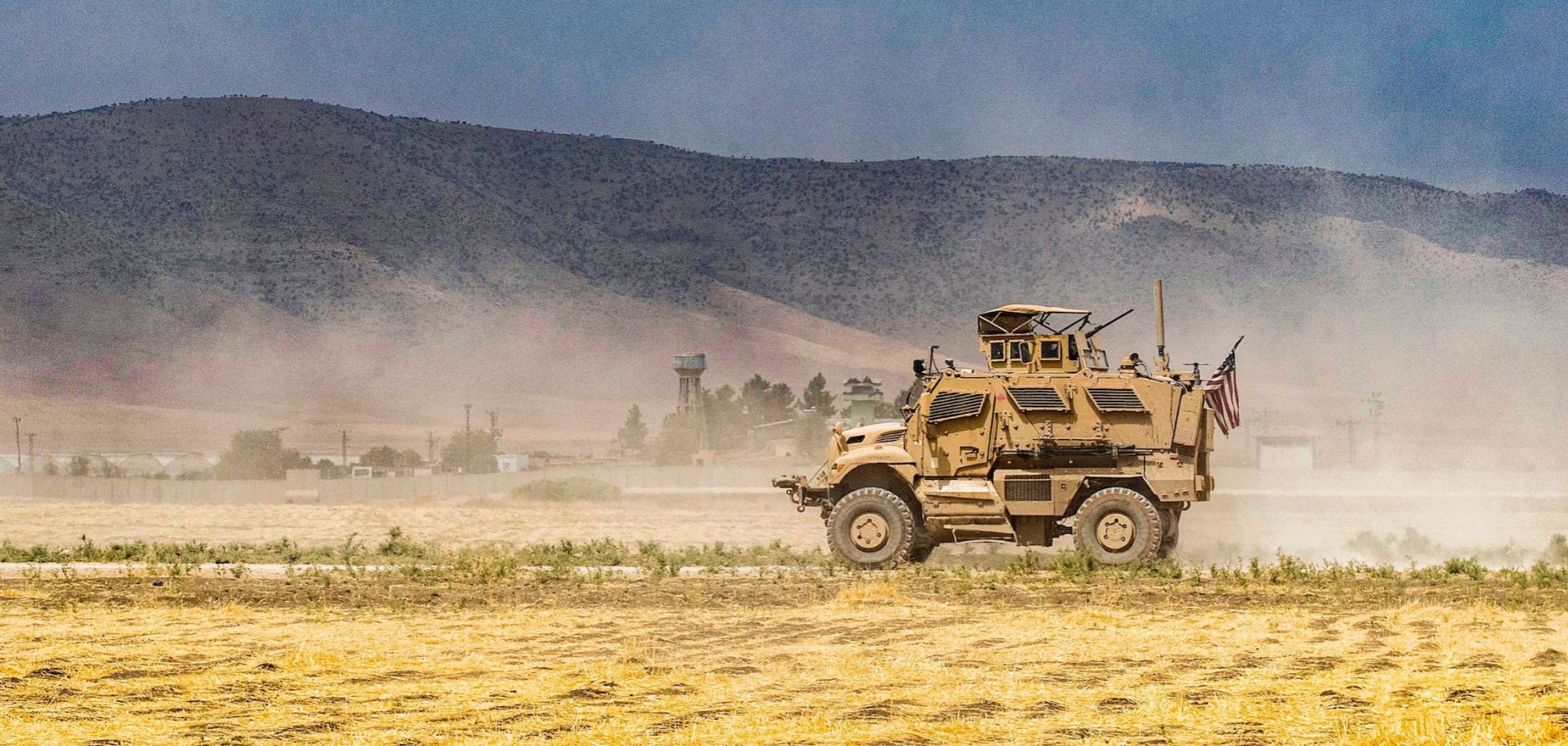
A U.S. Oshkosh M-ATV Mine Resistant Ambush Protected military vehicle patrols near the Syria-Turkey border in a village east of Qamishli in Syria's northeastern Hasakah province on Aug. 21. The village was subject to bombardment the previous week.
A recent round of Iran-U.S. skirmishes in Syria demonstrates that bilateral tensions will linger regardless of a potential nuclear deal, and more such conflicts could eventually threaten U.S. political support for troop deployment in Syria. Reported Iran-backed forces launched a drone on Aug. 15 at the U.S. military garrison in al-Tanf, Syria, and on the same day, a rocket attack took place against U.S. forces in the northeast of the country. In retaliation, the United States struck targets linked to Iran's Islamic Revolutionary Guard Corps on the Syria-Iraq border on Aug. 23. Iran continued the skirmishes, responding on Aug. 24 with more attacks on U.S. forces that wounded at least three troops, and the United States responded again with attack helicopters and artillery, reportedly killing several militants.
- Iran and the United States' conflicts of interest in Syria have led to several skirmishes, including those with drone attacks on the al-Tanf military base in 2020 and 2021, but typically the skirmishes end after a single round of attacks and retaliation.
- Iran's involvement in Syria is rooted in efforts to maintain its land bridge to allies in Lebanon and to restore Syrian President Bashar al Assad's full control over the country. U.S. troops are officially in Syria to conduct counterterrorism missions rather than focus on Iran.
Ongoing nuclear talks will not resolve Washington and Tehran's competing strategies in Syria, making future clashes likely and potentially even larger in scope and duration. Ongoing U.S.-Iran negotiations over the restoration of the 2015 Joint Comprehensive Plan of Action (JCPOA) nuclear deal do not cover other issues of geopolitical competition between them, like Iran's support for proxy militias, Iran's development and deployment of ballistic missiles, and the United States' deployment of forces throughout the region. So even if Iran and the United States strike a nuclear deal (which is uncertain), Iran will remain focused on trying to undermine Washington's position in Syria. Meanwhile, the United States does not currently plan to withdraw from Syria, in part because the Islamic State remains an underground movement in Iraq and Syria that could resurge if regional counterterrorism operations and/or U.S.-allied Kurdish militias weaken. Additionally, the recent round of sustained clashes between Iran and the United States in Syria suggests that both sides are willing to escalate conflicts within the confines of proxy theaters, as this will enable them to remain diplomatically functional on issues like Iran's nuclear program. Such escalated proxy conflicts will result in a heightened risk of larger clashes between the two sides in Syria and Iraq.
- Iran similarly has compartmentalized its competition with Turkey, as the two countries officially maintain economic and diplomatic ties even though they back opposing sides in Syria.
- In February, Islamic State militants attacked prisons around Hassakeh, Syria, and were suppressed with U.S. assistance.
Future clashes between the United States and Iran will threaten American political support for Washington's counterterrorism mission there, especially if there are U.S. casualties. Syria is low in the U.S. public mind at the moment due to preoccupations with bigger geopolitical challenges, like the Russian invasion of Ukraine and China's threats against Taiwan, but that could change in the face of persistent harassment by Iran and/or U.S. casualties. Additionally, many former officials who have worked in Syria over the years have become critical of the U.S. strategy in Syria, with former U.S. Ambassador to Syria Robert Ford describing it as similar to the United States' experience in Vietnam. With the Syrian civil war nowhere near resolution, the perception that the United States is stuck in a quagmire likely will grow, and greater public scrutiny of the war likely would result in demands to withdraw forces from Syria.
- U.S. military involvement in Syria has always had a light footprint because of the legacy of the Iraq and Afghan wars, which caused a deep and lasting public skepticism of wars in the Middle East. There are only around 800-900 U.S. troops left in Syria, down from a high of several thousand at the height of the war against the Islamic State.
