
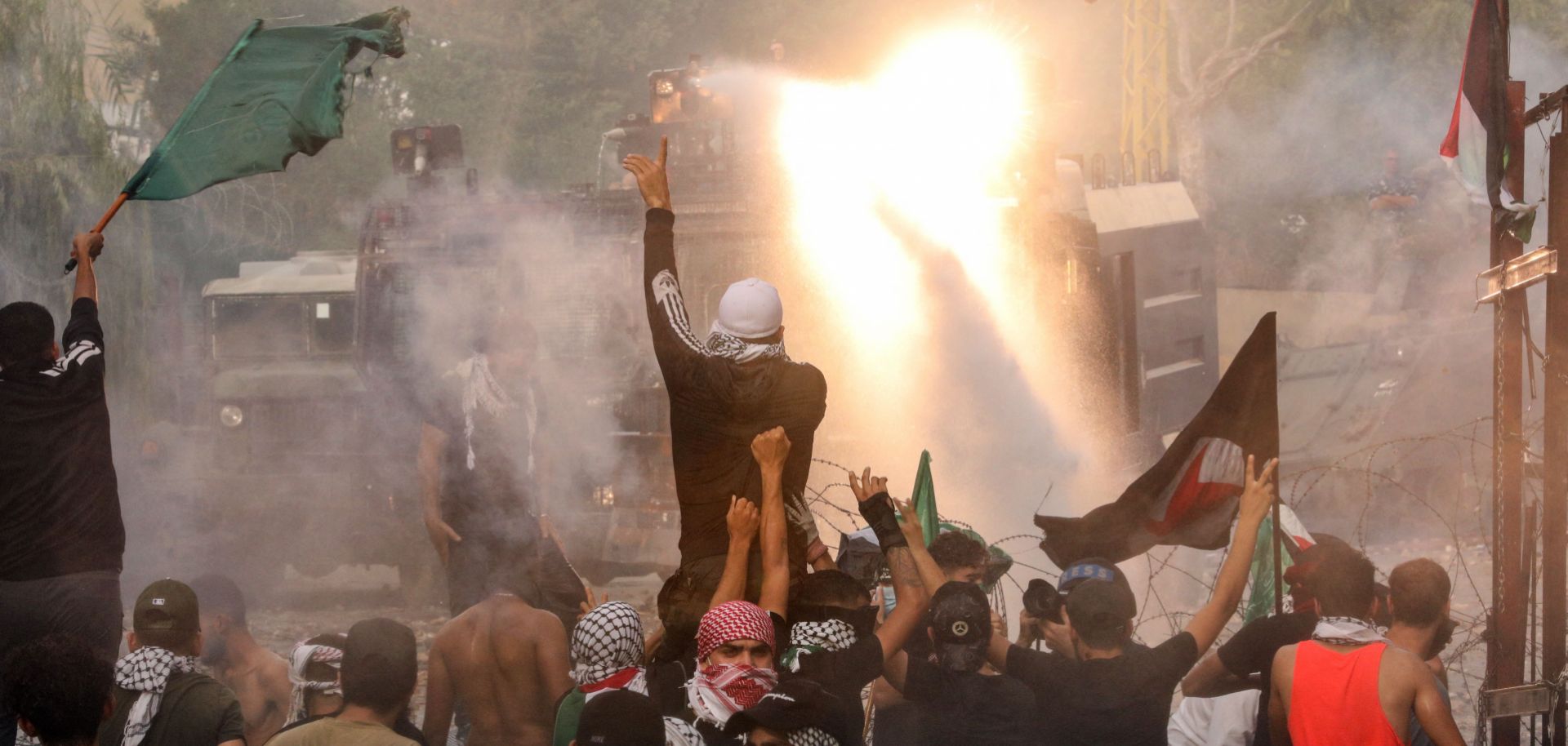
Regardless of who's to blame for the Gaza hospital blast, the United States will continue to back Israel's military campaign against Hamas, but this will weaken Washington's hand in preventing regional escalation and popular unrest that will also threaten to reinvigorate radical groups. On Oct. 17, international media reported a deadly blast at the Al-Ahli Baptist Hospital in Gaza City, with Gaza-based health officials claiming that hundreds had been killed in a potential Israeli airstrike on the hospital. Israel quickly denied it had struck the hospital, and the Israel Defence Forces (IDF) soon went public with information that suggested an errant rocket from Palestinian Islamic Jihad (PIJ) may have hit the building, an assessment reportedly backed by U.S. intelligence. Nevertheless, Hamas rapidly called for regional protests in response to the blast, while Iran, Turkey, Jordan, Egypt, Lebanon, Saudi Arabia and the United Arab Emirates blamed the tragedy on an Israeli strike. Anger over the Gaza hospital blast has since triggered protests in Cairo, Beirut, Casablanca and Tunis, as well as in Amman and Ankara, where security forces clashed with demonstrators attempting to storm the Israeli embassies in the Jordanian and Turkish capitals. Amid the unrest, Israel called for its citizens to evacuate from Turkey and Morocco on Oct. 17. The strike also derailed U.S. President Joe Biden's regional trip, as Jordan's King Abdullah II called off a summit that would have seen Biden meet with the king, Egyptian President Abdel Fattah el-Sissi and Palestinian Authority (PA) President Mahmoud Abbas — all three of whom blamed Israel for the blast.
- Initial images from the blast site suggest the explosion was smaller than the typical ordnance used by the Israeli air force, and that the resulting fire, rather than the explosion itself, may have caused most of the casualties.
- The affected hospital was a safe haven for civilians fleeing the latest violence between Hamas and Israel following the former's surprise Oct. 7 attacks on the latter. Although the IDF had ordered the hospital's evacuation, hospital officials demurred, claiming there weren't enough beds in southern Gaza's safe zone.
- Hosam Naoum, the Anglican archbishop in Jerusalem, declined to assign blame to the hospital blast on Oct. 18.
Both Israel and Hamas are using information warfare to shape international perceptions about the war, aiming to isolate one another from their key partners and create coalitions that will pressure one side to accept concessions. During the 2014 Gaza War, both the IDF and Hamas helped pioneer the strategic use of social media to create narratives for both domestic and international audiences designed to garner sympathy for their cause and create coalitions designed to pressure their adversary into concessions. During the current war, Israel has used Hamas' attacks on civilians and its hostage-taking as a means to buttress key partnerships — especially with the United States, Israel's key military ally and supplier. Hamas, meanwhile, has attempted to maximize the humanitarian impact of Israel's siege of the Gaza Strip and its airstrikes on the territory in a bid to both gain support from regional governments, as well as convince the West to pressure Israel into a more restrained military campaign that might leave Gaza under Hamas' control. In a notable and likely coordinated push as part of this strategy, pro-Hamas social media channels were quick to cast the recent hospital blast as proof of further IDF human rights violations. And the IDF's immediate denial of the allegation spoke to its imperative to prevent such a narrative from impacting U.S. views and policies toward Israel's military campaign against Hamas.
- As the Israel-Hamas war rages on, one of the United States' top priorities is averting a humanitarian catastrophe (or the perception of one) that could fuel radicalism in the region and bring Iran and its Lebanese proxy Hezbollah into the war. This is because such an outbreak of widespread violence and unrest in the oil-rich Middle East would rattle the global energy market and potentially warrant a U.S. military intervention — two scenarios Washington wants to prevent.
- Iran, Hezbollah and Hamas also have a strong imperative to emphasize allegations of Israeli human rights violations to distract from their own economic and governance records. Iran still faces a simmering anti-hijab protest movement, Hezbollah is blamed by many Lebanese for having a major role in the country's economic crisis, and Hamas faced economically motivated protests from Gazans this past summer.
Biden's political backing of the Israeli position ensures Israel will continue its current military strategy, though it may further delay or alter its planned invasion of the Gaza Strip in the wake of the hospital blast. The tragedy will also harm the White House's ability to coordinate friends and allies to prevent the conflict and unrest from spreading. Because of its prioritization of humanitarian conditions, the White House would have likely pressured Israel to alter its military campaign against Hamas had it backed the allegation that the IDF was responsible for the hospital blast. But with the United States at least publicly clearing the IDF of the allegation, the White House has signaled that the IDF's tactical decisions and overall military strategy remain acceptable. While some form of Israeli ground incursion into Gaza remains the most likely scenario, the hospital explosion may lead Israel to further delay an invasion or alter its plans to be more surgical and less of a full-scale assault. Regardless, U.S. support for Israeli military action in the wake of the Oct. 17 blast will make it more difficult for the White House to coordinate with its key allies and partners in the region amid the ongoing conflict. This includes the PA, Egypt, Jordan, Saudi Arabia and the United Arab Emirates, all of which have not yet accepted Washington or the IDF's explanation of the incident and are having to manage populations that largely believe that the blast was caused by an Israeli strike. With their populations convinced of a fresh Israeli human rights outrage, these states will be unable to enact policies that might appear to be enabling the Israeli military campaign, including taking steps to find a political solution for Gaza once the current war is over.
- Israel's current, broad military strategy is aimed at isolating Hamas and pressuring it into releasing hostages, as well as potentially removing the militant group from power by launching a major ground invasion in Gaza. An Israeli ground invasion, however, would involve high casualties and could spark a regional war with Hezbollah and Iran, developments that require sustained U.S. political and military support to ensure Israel would be able to handle all of these challenges.
- When the war is over, it is unclear what the plan will be for the Gaza Strip, though some have floated the prospect of returning the PA to power there, possibly with partial IDF control of the territory. In an Oct. 18 interview with Army Radio, Israeli Foreign Minister Eli Cohen said Hamas would ''no longer be in Gaza'' at the end of the war, and that ''the territory of Gaza [would] also decrease,'' in a sign that the IDF may intend to partially reoccupy the Gaza Strip.
As regional reactions escalate to both the hospital blast and possible future allegations of Israeli human rights violations, Iran and Hezbollah will be more incentivized to enter the war, while regional unrest could re-invigorate radical groups like al Qaeda and the Islamic State. Over the course of the war, Israel's military campaign will spur more allegations of human rights violations, some of which may be confirmed by the IDF or the United States. These allegations, especially if they include another mass casualty incident, will give Iran and Hezbollah triggers to escalate their current anti-Israel campaign, which has so far largely been symbolic, to include more substantial attacks against Israel, including on major cities. This would, in turn, raise the risk of a regional war, given that the United States has prepared war plans for a possible intervention against Hezbollah and Iran, and has also already deployed military assets to the region, including two aircraft carrier battlegroups. Finally, both in the near and long term, regional unrest caused by allegations of Israeli human rights abuses will reinvigorate radical narratives pushed by not only Hamas but also al Qaeda and Islamic State, all of which have an ideological goal to replace Israel with an Islamist, Arab state or caliphate. These groups maintain some territorial control in regional countries like Iraq, Syria, Yemen and certain North African states, all of which offer a potential springboard for attacks. But their global influence also means any calls for attacks could also provoke violence from lone actors and small groups in Western countries.
- Israel has always played a central role in radical Islamist ideologies, with former al Qaeda head Osama bin Laden justifying the September 11th attacks on the United States by citing the close U.S. relationship with Israel.
- Hezbollah called for a ''day of unprecedented anger'' after the Oct. 17 hospital blast, which sparked protests outside the U.S. embassy near the Lebanese capital of Beirut, and saw an uptick in Hezbollah attacks on IDF forces along the Lebanese-Israeli border.
- On Oct. 16, a Tunisian national killed two Swedish citizens in Brussels, posting on social media that he carried out the attack on behalf of the Islamic State. While the number of Islamic State-inspired attacks in the West has vastly decreased in recent years, officials from multiple Western security services — including, most recently, the chief of the United Kingdom's MI5 — have publicly raised concerns over the potential for the Israel-Gaza war to spark attacks in the West.
